
D175 Udang Merah (Red Prawn)
Overview
Among Malaysia's elite durian varieties, D175 Udang Merah occupies a singular position. Known in English as Red Prawn, this Penang-born cultivar is defined by a trait that no other premium durian can claim: salmon-pink flesh. While other top varieties compete on sweetness, bitterness, or creaminess, Red Prawn stands apart on color alone — and then surprises with a flavor profile that veteran tasters describe as reminiscent of rose wine, with effervescent, almost fizzy notes that make it unlike anything else in the durian world.
Registered as D175 in 1990, Red Prawn is one of the older entries in Malaysia's Department of Agriculture (DOA) registry. In Chinese, it is called 红虾 (Hong Xia, literally "Red Prawn"), while in Penang Hokkien — the dialect of its homeland — it goes by Ang Heh or Ang Hae. The name refers to two visual characteristics of the fruit: the reddish-orange hue of the flesh resembles the color of cooked prawns, and the curved shape of each fruitlet (aril) is said to look like a curled prawn body.
Red Prawn is a durian of extremes. Its flesh is among the softest and most watery of all premium varieties — melting on the tongue like ice cream. Its season is extremely short, sometimes just four to six weeks per year. Its yield per tree is low and the fruit is fragile, with virtually no shelf life once ripe. And its flavor and color are highly sensitive to terroir, changing significantly depending on where the tree is grown. These qualities make Red Prawn a fleeting, location-specific experience that cannot be easily industrialized or replicated — which is precisely what makes it so prized.
Origin & History
The story of D175 is inseparable from the life of one man: Lee Tek Hin. Born in 1945 in Pondok Upeh, a small village in the Balik Pulau area of Penang, Lee began working as a rubber tapper at the age of 13. By 16, he had taught himself the art of bud grafting — the technique of splicing a branch from one tree onto the rootstock of another to propagate a desired variety.
Around 1961 or 1962, while still a teenager, Lee encountered a durian at a fruit stand that stopped him in his tracks. The fruit, sold by a farmer named Mr. Loh from the same village of Pondok Upeh, had an unusual pale-pinkish flesh and a taste Lee would later describe as having a "fizzy, rose wine flavor." Recognizing something extraordinary, Lee convinced Mr. Loh to give him branches from the parent tree for bud grafting. From those branches, Lee began cultivating and refining the variety.
What followed was a patient, decades-long effort. Lee nurtured the Red Prawn variety for approximately 25 years, perfecting his trees and building a reputation among Penang's durian community. His vindication came in 1989, when he entered the Penang Durian and Fruit Festival — a prestigious competition that drew 83 contestants. Lee did not merely win. He swept first, second, and third place, a feat that made his name and the Red Prawn variety famous across the island.
On 4 June 1990, the variety was officially registered with Malaysia's Department of Agriculture under the code D175 and the Malay name Udang Merah. The registration was filed by Jabatan Pertanian (the Department of Agriculture itself), with the state of origin listed as Pulau Pinang.
Following the registration, Lee established a nursery that supplied Red Prawn trees to growers nationwide, spreading the variety far beyond its Penang origins. However, the family's nursery operations were disrupted by the 1997 Asian financial crisis, and the business was closed. In more recent years, Lee's son James Lee has restarted nursery operations from Bukit Genting in Penang, continuing his father's legacy.
Appearance
Red Prawn is a medium-sized durian, typically weighing between 1.5 and 3.0 kilograms according to the DOA registry, which records an average weight of 2.25 kilograms. However, quality-focused growers and sellers tend to favor specimens in the 1.0 to 2.0 kilogram range, where the flesh-to-shell ratio is often more favorable.
The shape is elongated elliptical — sometimes compared to a rugby ball — with a pointed tip at the bottom (the end opposite the stem). This tapering silhouette gives Red Prawn a somewhat elegant profile compared to the rounder or more squat shapes of other varieties.
The husk is one of Red Prawn's most distinctive external features. Unlike the vibrant green shells of many durian varieties, a genuine D175 has a dull grey-brown husk, often with a pearly dust-like coating on the surface. In some specimens, faint lavender tinges are visible. The thorns are notably short, thin, and widely spaced — so much so that from a distance, the fruit can appear almost smooth. This is a key visual identifier. Importantly, the thorns extend all the way down to the bottom of the fruit, with no bald spot — a detail that becomes critical when distinguishing D175 from its imposters.
The shell is very thick and hard, which provides structural protection but also means that the edible flesh makes up a smaller proportion of the total fruit weight than some other varieties.
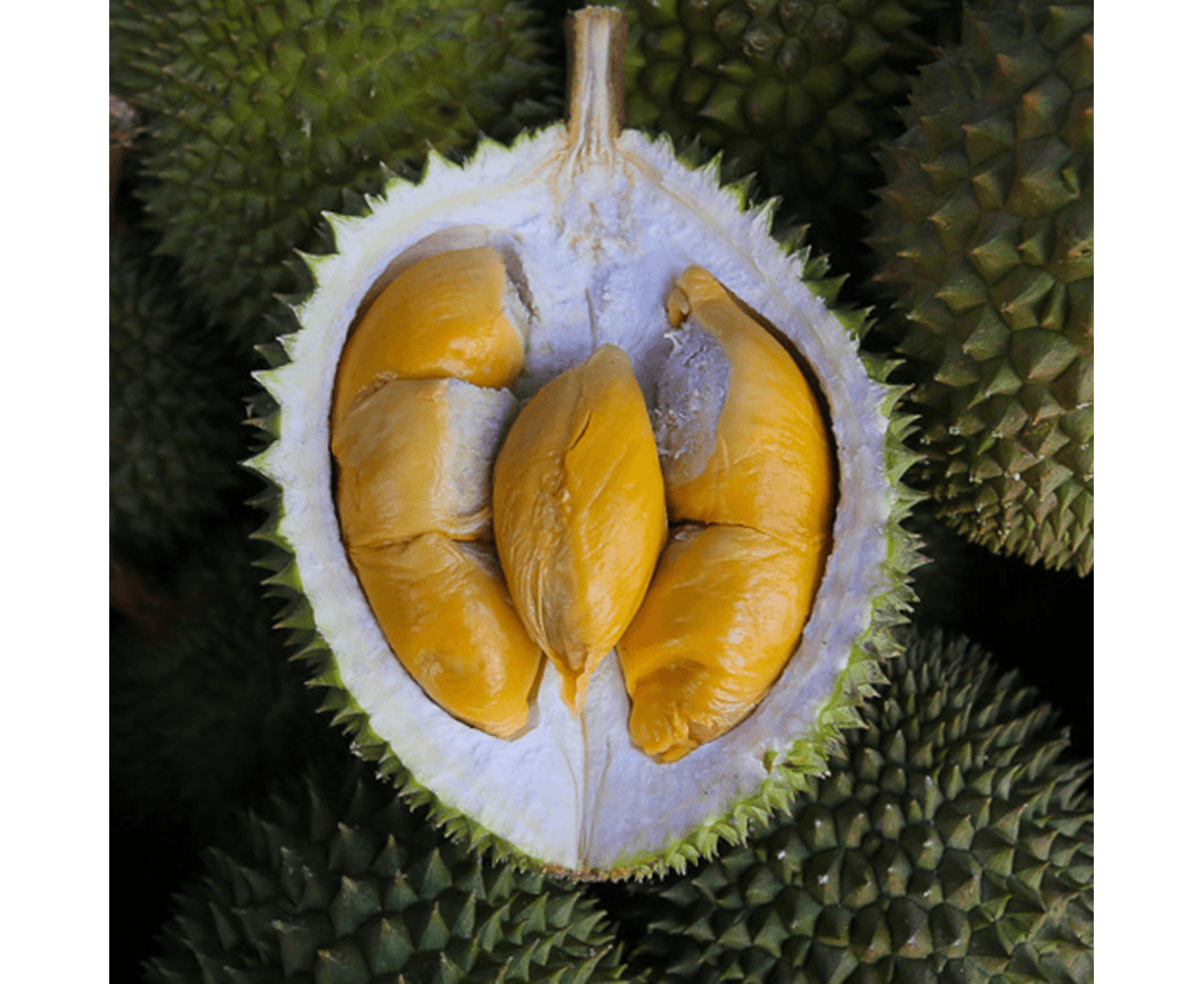
When opened, the flesh is immediately arresting. The color is best described as salmon-pink or reddish-orange — a warm, sunset-like hue that sits over a yellow base. This is the feature that gives the variety its name and its fame. The flesh is thick, largely fiber-free, and has a paste-like consistency that borders on liquid in fully ripe specimens.
Taste & Texture
The flavor of Red Prawn is where this variety truly distinguishes itself. The primary taste is sweet, but it is not the simple, one-dimensional sweetness of lesser varieties. There is a complexity to it — subtle-to-moderate bitter undertones that become more pronounced in hot weather, and an unusual effervescent quality that Lee Tek Hin himself described as a "fizzy, rose wine flavor." Tasters frequently note hints of alcohol or fermentation, comparing the experience to red wine or champagne. Berry-like and floral notes — particularly a rosy character — round out the profile.
The texture is arguably the most extreme of any premium durian. Red Prawn's flesh is ultra-soft and watery, melting in the mouth like ice cream. It is widely considered to have the most watery texture among all premium Malaysian durian varieties. The consistency is largely fiber-free and paste-like, almost approaching a puree in fully ripe fruit. For those who prize richness and body in their durian, this may be a departure; for those who value delicacy and a melt-on-the-tongue experience, Red Prawn is without equal.
The DOA registry describes the taste simply as "lemak manis" (fatty sweet) and the texture as "halus" (smooth/fine), which, while accurate in broad strokes, understates the nuance that makes Red Prawn a connoisseur's durian.
How to Identify
Identifying a genuine D175 Red Prawn is an essential skill for any serious durian buyer, and it is more important here than with most varieties. The reason is a well-known imposter problem: D13 is frequently sold as "Red Prawn," particularly in Singapore and parts of Johor. Knowing the differences can save you from paying a premium price for the wrong fruit.
Husk color. A genuine D175 has a dull grey-brown husk, often with a pearly or dusty coating and occasional lavender tinges. If the durian's shell is vibrant green, it is not D175. D13, the most common imposter, has a distinctly green husk.
Thorn shape and spacing. Red Prawn's thorns are short, thin, and widely spaced. The fruit looks relatively smooth from a short distance. D13, by contrast, has blocky, pyramidal thorns that are more prominent and densely packed.
Bottom of the fruit. Examine the base of the durian (the end opposite the stem). On a genuine D175, the thorns extend all the way to the bottom — there is no bald spot. D13 typically displays a brown, bald patch at the base where thorns are absent. This is one of the quickest and most reliable checks.
Flesh color. When opened, D175 flesh is salmon-pink or reddish-orange over a yellow base. D13 flesh is dark orange — a distinctly different tone. The salmon-pink hue of true Red Prawn has a warmth and subtlety that dark orange does not.
Texture. D175 flesh is ultra-soft, watery, and paste-like — it practically dissolves on the tongue. D13 flesh is noticeably firmer and denser.
Shape. D175 has an elongated elliptical (rugby ball) shape with a pointed bottom. D13 tends to be rounder and more compact.
The "Penang Red Prawn" vs. "Singapore Red Prawn" convention. Responsible vendors in markets where both varieties circulate have adopted an informal labeling convention: D175 is sold as "Penang Red Prawn" and D13 as "Singapore Red Prawn." While not an official standard, this naming convention is a useful signal of a vendor who is being transparent about what they are selling. If a seller simply labels a durian "Red Prawn" without further qualification, exercise caution — especially if the price seems too good to be true.
Availability & Pricing
Red Prawn is one of the most limited premium durians on the market in terms of availability. Its season is extremely short — typically just four to six weeks per year during the main durian season, which falls roughly between June and August. The variety is also known for low yields per tree compared to more commercially productive cultivars. Combined with its fragile nature — the ultra-soft flesh means the fruit has virtually no shelf life once it drops from the tree — supply of genuine D175 is always constrained.
Pricing for Red Prawn generally falls in the range of RM 20 to RM 35 per kilogram for whole fruit under normal market conditions. However, at peak season, Grade A specimens from Penang — the variety's heartland and the source of the most vivid flesh color — can command prices that compete with Musang King, reaching RM 40 to RM 60 or more per kilogram. The wide price range reflects the significant quality variation between sources: a Penang-grown Red Prawn with intense salmon-pink flesh and the characteristic wine-like flavor is a fundamentally different product from a Johor-grown specimen with paler, more brownish flesh and muted flavor.
The extremely short season, low yield, high fragility, and strong terroir sensitivity combine to make Red Prawn a variety that resists the kind of large-scale commercialization that Musang King has undergone. It remains, by nature, a seasonal specialty rather than a year-round commodity.
Growing Regions
Balik Pulau, Penang is the undisputed heartland of Red Prawn. The mother tree from which the entire variety descends stood in Pondok Upeh, within the Balik Pulau area. Penang's volcanic soil is credited with producing the most vivid and intense salmon-pink flesh color — the signature trait that gives the variety its name. For durian purists, a Penang-grown Red Prawn is the definitive expression of D175, and no other region is considered to produce quite the same result.
Johor has become a significant and growing source of Red Prawn, driven by the state's large durian planting acreage and its proximity to the Singapore market. However, there is a notable quality difference: Johor-grown Red Prawn tends to produce flesh that is more brownish or pale yellow in color, lacking the vivid salmon-pink that Penang specimens are known for. The flavor profile can also be more muted. This is not a criticism of Johor's growing conditions — it is a demonstration of how sensitive D175 is to terroir.
Pahang and Sabah also have some Red Prawn plantings, contributing to the national supply but in smaller volumes than Penang and Johor.
The terroir sensitivity of D175 is one of its most important characteristics. The same genetic variety, planted in different soils and climatic conditions, produces visibly and tastefully different fruit. This is analogous to how a single grape variety can produce dramatically different wines depending on the vineyard. For Red Prawn, the volcanic soil and microclimate of Penang's Balik Pulau remain unmatched for producing the variety at its fullest expression.
Fun Facts
- The name "Udang Merah" (Red Prawn) is a dual reference: the salmon-pink color of the flesh resembles cooked prawns, and the curved shape of each individual fruitlet is said to resemble a curled prawn body.
- Lee Tek Hin did not just win the 1989 Penang Durian and Fruit Festival — he swept first, second, and third place out of 83 contestants, a near-unbelievable dominance that launched the variety's fame.
- The DOA registry officially describes the flesh color as "kuning" (yellow), which has confused many readers given that Red Prawn is famous for its pink flesh. The explanation is that the base color is indeed yellow, with the salmon-pink overlay varying in intensity by growing conditions. The DOA likely used a conservative color category.
- Red Prawn is considered to have the most watery texture of any premium Malaysian durian — a characteristic that makes it impossible to eat slowly. Once a ripe fruit is opened, the clock is ticking.
- The flesh color of D175 functions as an informal quality indicator tied to geography. Vivid salmon-pink generally signals Penang origin and volcanic soil; brownish or pale yellow suggests cultivation elsewhere. Experienced buyers use flesh color as a proxy for provenance.
- Lee Tek Hin spent approximately 25 years nurturing the variety from a chance discovery at a village fruit stand to a registered DOA variety. Few durian cultivars have such a well-documented origin story tied to a single individual's lifelong dedication.
- The 1997 Asian financial crisis forced the Lee family to close their nursery, which had been supplying Red Prawn trees to growers across Malaysia. The recent reopening of nursery operations by James Lee from Bukit Genting, Penang represents a return to the family's original mission.
- Red Prawn's extremely short season of four to six weeks makes it one of the most time-limited premium durian experiences available. Missing the window means waiting an entire year for the next opportunity.