

D158 Kan Yau (Tangkai Panjang)
Overview
D158 Kan Yau is a durian with an identity crisis - or perhaps an identity surplus. It is a Thai variety that was registered three separate times under three different codes in Malaysia's Department of Agriculture (DOA) registry. It holds the Guinness World Record for the most expensive durian ever sold. It goes by at least half a dozen names across three languages. And its most distinctive physical feature - an absurdly long stem that can reach 17 centimeters - makes it one of the easiest durians to identify from across a market stall.
Known as Kanyao (also spelled Kan Yau or Kan Yao) in Thailand, Tangkai Panjang ("Long Stem") in Malay, Ganja in some Malaysian circles, and Cheong Peng or 干尧 (gan yao) in Chinese, this variety traces its roots not to any Malaysian orchard but to the ancient durian gardens of Nonthaburi, on the outskirts of Bangkok. Nonthaburi has over 400 years of durian cultivation history along the tidal Chao Phraya River, and Kanyao is one of its most celebrated cultivars, documented as far back as 1927.
In Malaysia, D158 occupies a curious niche: respected, well-liked, but never quite achieving the commercial fame of Musang King or the cult status of Black Thorn. It is a late-season variety with a punchy, sweet, floral flavor and a texture that durian writer Lindsay Gasik memorably likened to natural peanut butter. For those who find Musang King's bitterness too intense, Kan Yau offers something different - an ambrosial sweetness with crisp, melon-like clarity.
Origin & History
The story of Kan Yau begins not in Malaysia but in Thailand. The name itself is Thai: ก้านยาว (kan yao), meaning simply "long stem." This is one of the oldest documented durian cultivars in Thailand, originating from Nonthaburi district, a province on the western bank of the Chao Phraya River just north of Bangkok. Nonthaburi's durian heritage stretches back more than four centuries, and the province's tidal riverside orchards - where trees are irrigated by the natural ebb and flow of the river - have long been considered among the finest growing conditions for durian in all of Thailand.
Kanyao was already a named and recognized cultivar by 1927. In Nonthaburi, it is regarded with something approaching reverence. The combination of the ancient growing region, the distinctive fruit, and the limited supply has elevated Nonthaburi Kanyao to a luxury status that few durians anywhere in the world can match.
The variety made its way into Malaysia through what appears to have been multiple independent introductions, resulting in one of the most unusual stories in the DOA registry: the same cultivar was registered three separate times under three different codes.
The first registration came in 1970, when Encik Awang Haji Yaacob from Taiping, Perak, registered it as D105. In the Taiping area, the variety was locally known as "Ganja" or "Taiping 3." The name "Ganja" is almost certainly a phonetic corruption of "Ganyao" - the Thai name spoken quickly and adapted into local Malay pronunciation - rather than any reference to cannabis. That said, the name has stuck, and the folk explanation that the durian is "addictive like ganja" has become part of its lore.
The second registration occurred in 1973, when the DOA itself registered it as D130 (also designated T63) from Sik, Kedah.
The third registration, and the one this article focuses on, came in 1987, when Hj. Omar Hj. Bin from Kedah registered it as D158 under the name "Kan Yau" with the local name "Tangkai Panjang" - Malay for "Long Stem." The DOA description from that registration reads: "Buah berbentuk eliptik lebar; kulit berwarna perang dan tangkai sangat panjang 17 cm. Isi berwarna kuning jingga; ulas bersaiz besar dan rasa manis." (Fruit of wide elliptic shape; skin brownish in color with a very long stem of 17 cm. Flesh orange-yellow; large arils with sweet taste.)
That a single Thai variety could enter Malaysia's registry three times under three different codes speaks to the organic, decentralized way durian varieties historically spread across the region - carried by traders, planted by farmers, and known by different local names in different states, with no centralized system to catch the duplication.
In Chinese, the variety is known as 干尧 (gan yao), a phonetic transliteration of the Thai name, or less commonly as 长柄 (chang bing), a semantic translation meaning "long handle." It is also sometimes called Cheong Peng in Cantonese communities and Tiger Hill in certain Malaysian markets.
Appearance
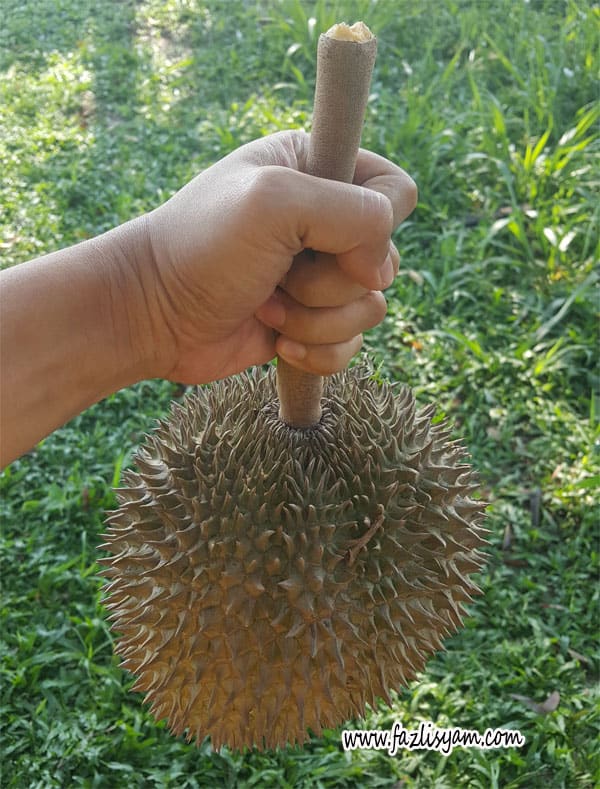
Kan Yau is a medium to large durian, with individual fruits ranging from 1.5 to 4.5 kilograms, though the average tends toward the lower end at around 1.6 kilograms. The shape is broad elliptic - rounder and wider than the elongated forms of many Malaysian varieties.
The husk is brownish (perang) at maturity, a color that distinguishes it from the green or yellowish-green husks of varieties like Musang King. The thorns are short, densely packed, and triangular, with a notable tendency to curve or bend inward - giving the surface a somewhat compressed appearance compared to varieties with tall, sharply projecting spikes.
But the feature that defines the variety's physical identity is the stem. The DOA registration records it at 17 centimeters, and while real-world measurements range from 10 to 17 centimeters, even at the lower end this is dramatically longer than any other commercial durian variety. It is the trait that gives the variety its Malay name (Tangkai Panjang), its Thai name (Kan Yao), and its Chinese semantic name (长柄). When you see a durian with a stem that sticks out like a handle, it is almost certainly a Kan Yau. No other variety comes close.
The skin is thin, measured at approximately 0.8 centimeters - thinner than most Malaysian varieties and contributing to a favorable flesh-to-fruit ratio of 32.9 percent.
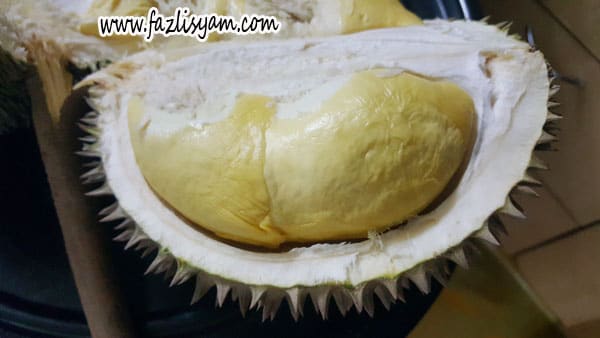
When opened, the flesh ranges from orange-yellow (as noted in the DOA registration) to a rich golden-yellow. The arils are large, and the overall presentation is generous and visually appealing.
Taste & Texture
Kan Yau's flavor profile occupies a distinctly different space from Malaysia's dominant premium varieties. Where Musang King leads with bitterness and Black Thorn with a caramel complexity, Kan Yau leads with sweetness - but it is a sweetness of considerable depth and character.
The taste is sweet and rich, with an ambrosial, almost floral quality that distinguishes it from one-dimensional sweet varieties. Tasters frequently describe a punchy floral note, followed by hints of fudge and, most distinctively, peanut butter. This peanut butter association is perhaps the single most commonly cited flavor descriptor for Kan Yau, and it is apt - there is a nutty, toasty richness that lingers beneath the sweetness. The overall impression is lighter and fresher than Musang King, with what some describe as a crisp, melon-like clarity.
The aroma is mild by durian standards - noticeably less pungent than most Malaysian varieties. This makes Kan Yau more approachable for those who find the smell of stronger varieties overwhelming.
The texture is where Kan Yau truly distinguishes itself. The flesh has a sublime sticky quality, often compared to natural peanut butter - a firm surface that yields to reveal a creamy, soft, sticky interior. This is not the wet, custard-like creaminess of Musang King. It is denser, more cohesive, with a satisfying resistance that gives way to smoothness. One of Kan Yau's distinctive traits is that it retains a somewhat firm consistency even when overripe, unlike many varieties that become watery or mushy past their prime.
There is, however, a notable difference between Thai-grown and Malaysian-grown Kan Yau. Thai specimens, particularly those from Nonthaburi, tend to be firmer, with what has been described as a "peanut butter pound cake" density. Malaysian-grown Kan Yau tends toward what durian enthusiasts call "ooey-gooey smooth" - softer, more yielding, and closer to the textural preferences of the Malaysian palate. This difference was vividly demonstrated by durian writer and researcher Lindsay Gasik, who once transported a $300 Nonthaburi Kanyao by train to Penang for a side-by-side tasting with the Malaysian-grown version. The experiment revealed a fundamental cultural divide: Thai consumers prize firmness in their durian, while many Malaysian consumers consider a firm durian "practically inedible."
How to Identify
Identifying Kan Yau is, frankly, one of the easier tasks in the durian world, thanks to that unmistakable stem.
The stem. This is the primary identifier. If the durian has a stem measuring 10 centimeters or longer - dramatically longer than the 4-6 centimeter stems typical of most varieties - it is very likely a Kan Yau. The stem often appears to stick straight out like a handle, giving the fruit a distinctive silhouette.
Husk color. The brownish husk at maturity is a useful secondary marker. Most popular Malaysian varieties have green to yellowish-green husks.
Thorn pattern. The short, densely packed, inward-curving triangular thorns are characteristic. The surface has a flatter, more compressed look than varieties with tall, aggressive spikes.
Shape. The broad elliptic (round-ish) shape, wider than it is long, helps distinguish it from elongated varieties.
Flesh color. Orange-yellow to golden-yellow flesh, consistent with the DOA description.
Taste confirmation. Sweet without the bitterness typical of varieties like Musang King. Peanut butter notes and a sticky, firm texture confirm the identification.
Availability & Pricing
Kan Yau is a late-season variety, typically among the last durians available each season. This late timing means it often arrives when the major varieties have already finished, giving it a natural window of reduced competition.
In Malaysia, Kan Yau is priced in the mid-range of the premium durian market, typically between RM 18 and RM 55 per kilogram depending on region, season timing, and quality. This places it below Musang King and Black Thorn but above most kampung varieties.
In Thailand, the pricing picture is dramatically different. Nonthaburi Kanyao operates in a different economic universe entirely. Regular Nonthaburi Kanyao starts at around 20,000 Thai baht (approximately RM 2,500) per fruit. Premium specimens regularly fetch 10,000 to 20,000 baht. And at the extreme end, on 7 June 2019, a single Kanyao sold for 1.5 million Thai baht - equivalent to $47,784 USD or approximately RM 199,000 - at "The King of Durian 2019" auction held in Nonthaburi. This set the Guinness World Record for the most expensive durian ever sold.
The staggering price differential between Malaysian and Thai Kanyao reflects not just quality differences but entirely different cultural frameworks for valuing durian. In Nonthaburi, Kanyao from century-old orchards along the Chao Phraya River is treated as a luxury agricultural product comparable to high-end wine or wagyu beef - with provenance, terroir, and cultivation methods commanding enormous premiums.
Kan Yau has received an interim recommendation from Malaysian agricultural authorities for commercial planting in Kuala Muda, Kedah, suggesting ongoing efforts to establish it as a more widely cultivated variety in Malaysia.
Growing Regions
Thailand: Nonthaburi is the ancestral and most prestigious growing region for Kanyao. The province's durian orchards along the tidal Chao Phraya River have been cultivated for over 400 years, and Nonthaburi Kanyao is considered the gold standard. The cultivation methods here are intensely artisanal: each tree retains only three to four fruits per season (the rest are pruned to concentrate the tree's energy), individual fruits are covered in plastic bags and wire mesh to protect against squirrels, mothballs are hung near the fruit as insect deterrents, trees are fed homemade organic fertilizer made from fish parts, molasses, and yeast, and painted umbrellas are placed over fruits to provide shade from direct sun. The result is an entirely organic product cultivated with obsessive care.
However, the 2011 flood that devastated Nonthaburi destroyed over 90 percent of the province's durian orchards. Out of 2,941 rai (approximately 470 hectares) of durian cultivation, only 43 rai (approximately 7 hectares) survived. This catastrophe dramatically increased the rarity - and therefore the price - of authentic Nonthaburi Kanyao.
Thailand: Rayong and other eastern provinces also grow Kanyao, though without the prestige premium of Nonthaburi.
Malaysia: Kedah is the primary growing state for Kan Yau in Malaysia, consistent with its D158 registration by Hj. Omar Hj. Bin from Kedah and the D130 registration from Sik, Kedah. Kuala Muda in Kedah has received an interim recommendation for commercial Kan Yau planting.
Malaysia: Penang, particularly the Balik Pulau area on the island's western side, grows Kan Yau and was the site of Lindsay Gasik's Thai-versus-Malaysian tasting experiment.
Malaysia: Perak has a historical connection to the variety through the D105 registration from Taiping in 1970.
Malaysia: Selangor also has Kan Yau cultivation, though it is not a primary growing region.
Fun Facts
- Kan Yau holds the Guinness World Record for the most expensive durian ever sold. A single fruit fetched 1.5 million Thai baht ($47,784 USD) at the 2019 "King of Durian" auction in Nonthaburi. The buyer was reportedly a Thai businessman purchasing it as a gift.
- The same variety was registered three times in Malaysia's DOA registry: as D105 in 1970 (Perak), D130 in 1973 (Kedah), and D158 in 1987 (Kedah). All three are the same Thai cultivar, Kanyao, entered by different people in different states who apparently did not realize it was already registered.
- The nickname "Ganja" used in the Taiping area is almost certainly a phonetic corruption of "Ganyao" (the Thai name spoken quickly) rather than a reference to cannabis. However, the coincidence has proven irresistible to durian marketing - the folk claim that this variety is "addictive like ganja" has become part of its identity.
- In Nonthaburi, each Kanyao tree retains only three to four fruits per season. Individual fruits are shaded with painted umbrellas, protected from squirrels with wire mesh, and defended from insects with mothballs. The trees are fed homemade organic fertilizer brewed from fish parts, molasses, and yeast. The entire process is organic.
- The 2011 Chao Phraya River flood destroyed over 90 percent of Nonthaburi's durian orchards, reducing cultivation from 2,941 rai to just 43 rai. This disaster is a key reason Nonthaburi Kanyao commands such extreme prices today.
- Lindsay Gasik once spent $300 on a single Nonthaburi Kanyao and carried it by train to Penang for a side-by-side tasting with a Malaysian-grown specimen. The verdict: Thai consumers prize firmness, while Malaysians prefer their durian soft and creamy.
- The 17-centimeter stem recorded in the DOA registration is the longest of any registered Malaysian durian variety. Even at the lower end of the range (10 cm), it is roughly twice a typical durian stem.
- In Nonthaburi, Kan Yau is sold by the individual fruit, not by weight. Prices start at around 20,000 baht (approximately RM 2,500) per durian - before you even get to the auction-grade specimens.