
D159 Mon Thong (Bantal Mas)
Overview
If you have eaten durian anywhere outside of Malaysia - in a Chinese supermarket, a Bangkok street stall, a London Chinatown shop, a Hong Kong dessert parlor - there is an overwhelming probability that the durian you ate was a Mon Thong. This single variety accounts for over half of Thailand's total durian production and dominates global durian exports to a degree that no other cultivar from any country comes close to matching. When the world thinks of durian, whether they know it or not, they are usually thinking of Mon Thong.
In Thailand, Mon Thong (หมอนทอง) means "Golden Pillow" - a name that refers to the thick, generous lobes of yellow flesh that cradle the seed like a plump cushion. In Malaysia, where it was registered as D159 by the Department of Agriculture (DOA) in 1987, it is known as Bantal Mas, the direct Malay translation of the same name. In Chinese, it is called 金枕头 (jin zhen tou), again meaning "golden pillow."
Mon Thong occupies a paradoxical position in the durian world. It is simultaneously the most commercially successful durian variety on the planet and something of a second-class citizen in the eyes of Malaysian durian connoisseurs. Where Malaysian premium varieties like Musang King and Black Thorn command devoted followings for their complex, bitter-sweet flavor profiles, Mon Thong is often characterized - sometimes dismissively - as the "beginner's durian." Its flavor is sweet and mild. Its aroma is gentle by durian standards. Its flesh is firm rather than custardy. For many Malaysian enthusiasts, these are precisely the qualities that make it uninteresting.
But that characterization misses the larger picture.
Mon Thong's mild sweetness and approachable aroma are exactly what have made it the gateway durian for hundreds of millions of people across East Asia, and its firm flesh and remarkable shelf life of up to 20 days are what make it viable for the long-distance export trade that Malaysian varieties, with their preference for drop-harvesting at full ripeness, simply cannot match at scale.
Origin & History
Mon Thong is a Thai variety through and through. While the exact origins of the cultivar are not documented with precision, it emerged from the intensive durian breeding and selection programs that developed in Thailand from the late 19th century onward. As Chinese immigrants settled in eastern Thailand during that period, they brought commercial agricultural practices to durian cultivation, and the provinces of Chanthaburi, Rayong, and Chumphon became centers of durian production. By the mid-20th century, Mon Thong had established itself as the dominant commercial cultivar - a position it has never relinquished.
In Malaysia, Mon Thong was registered as D159 in 1987 by Hj. Ahmad Yaakob from Kedah, classified as an individual (INDIVIDU) reporter. The DOA description from that registration reads: "Buah bersaiz sangat besar; purata berat 5 kg (julat 4-6 kg); berbentuk eliptik panjang; kedalaman alur kuat dan hujung buah menajam. Isi berwarna kuning, ulas bersaiz besar dan rasa manis." (Fruit very large in size; average weight 5 kg, range 4-6 kg; elongated elliptic shape; deep suture grooves with a sharply pointed tip. Yellow flesh, large arils, sweet taste.)
D159 received an interim recommendation for commercial planting in the Kuala Muda District of Kedah, placing it in Class II - suitable for commercial cultivation in specific agroclimatic zones. Notably, it shares this Kedah connection with D123 Chanee, another Thai variety (known as ชะนี in Thai, meaning "gibbon") that was registered in the Malaysian DOA system. Chanee is considered one of the first commercial durians in Thailand, with records dating to 1687, and like Mon Thong it found its way into Malaysia's northern states. The presence of both major Thai cultivars in the Kedah registry reflects the natural cross-border flow of durian germplasm between southern Thailand and northern Malaysia - regions separated by a political border but united by similar tropical growing conditions.
Appearance
Mon Thong is a conspicuously large durian. The DOA registration describes it as "very large" (sangat besar), with an average weight of 5 kilograms and a range of 4 to 6 kilograms. In practice, specimens can be even larger, with some reportedly exceeding 7 kilograms. By comparison, Musang King typically weighs 1.5 to 3 kilograms, and even the large D24 rarely reaches 4 kilograms. When you see a truly massive durian at a market, Mon Thong should be your first guess.
The shape is elongated elliptic - longer than it is wide, with a distinctly tapered profile that narrows to a sharply pointed tip (hujung menajam). This pointed tip is one of the variety's most recognizable features and helps distinguish it from the rounder forms of many Malaysian varieties. The suture lines (alur) - the grooves that run along the fruit's surface marking the internal chambers - are deep and pronounced.
The husk is covered in pointed, densely packed triangular spines that range in color from pale green to golden-brown at maturity. The spine pattern has been described as featuring large central spikes surrounded by smaller satellite spikes, sometimes called "snake fangs" (เขี้ยวงู) in Thai. The overall impression is of a formidable, heavily armored fruit.
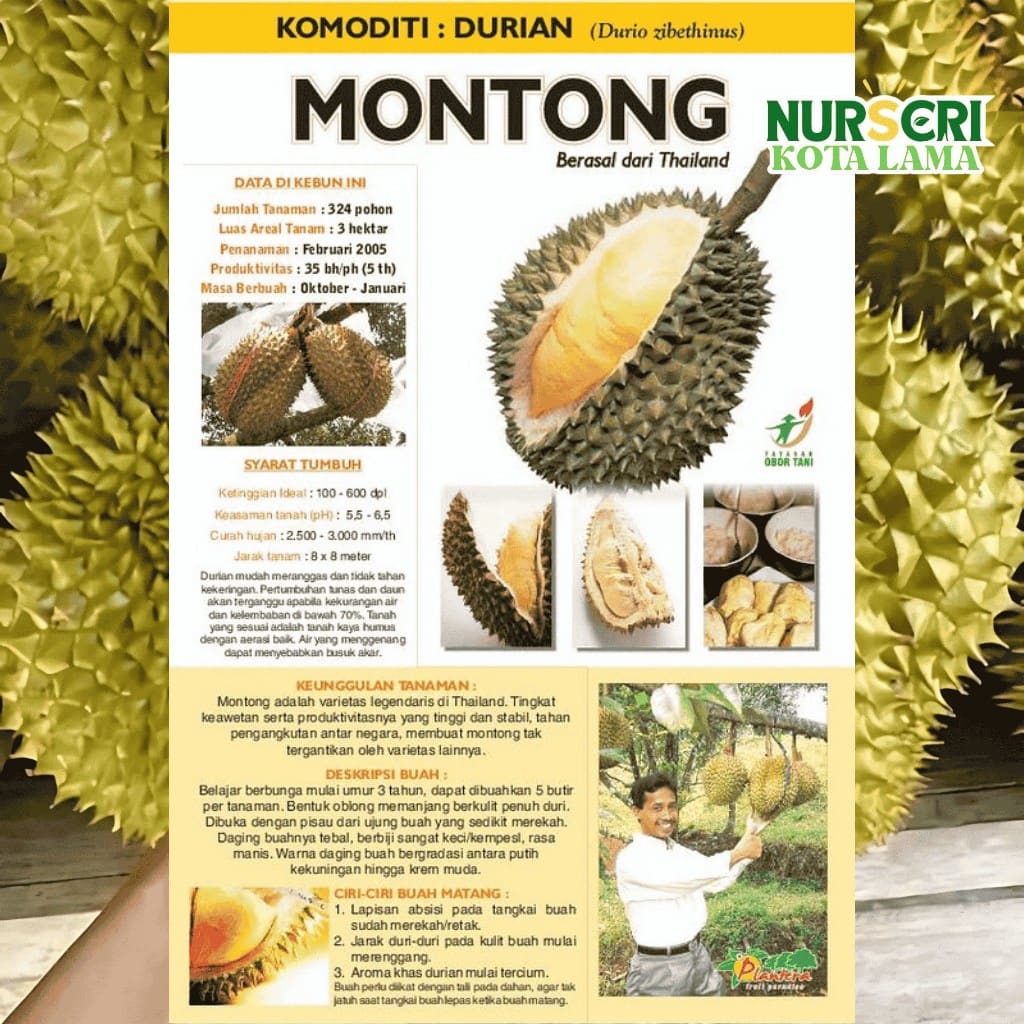
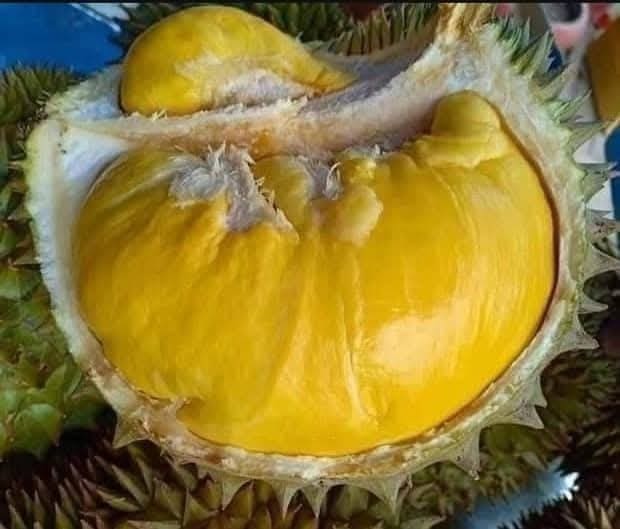
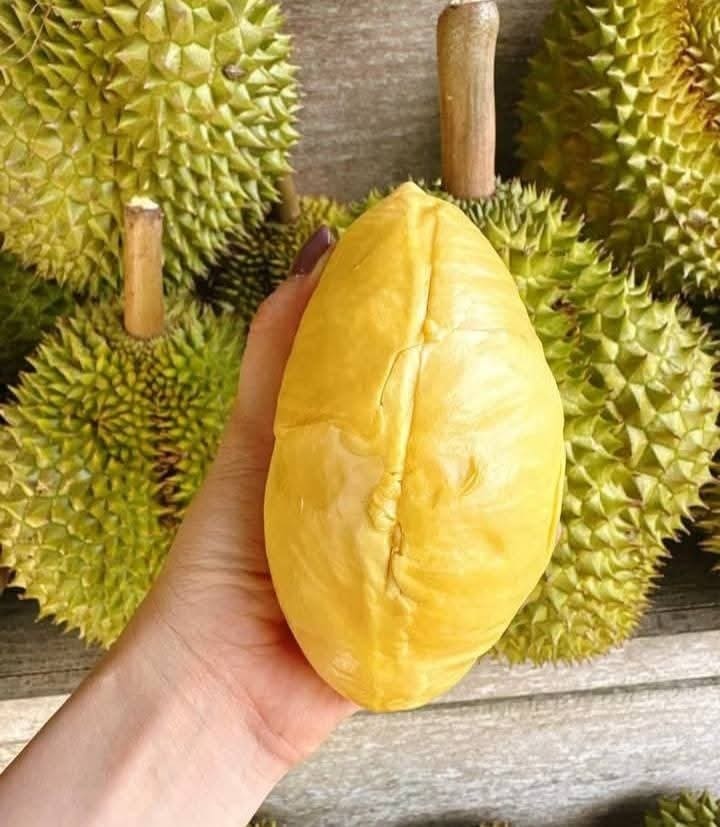
When opened, the interior reveals a white, spongy pith surrounding multiple chambers of flesh. The flesh is yellow - not the deep orange-gold of Musang King or Red Prawn, but a clean, bright yellow. The arils (individual flesh lobes) are notably large, each encasing a small, hard seed. The flesh-to-seed ratio is favorable; Mon Thong is known for having relatively small seeds compared to its generous flesh volume, and some commercially processed Mon Thong is even marketed as "seedless" - though in truth the seeds are simply small or shrunken rather than truly absent.
Taste & Texture
Mon Thong's flavor profile can be summarized in two words: sweet and mild. This is the defining characteristic that distinguishes it from the complex, bitter-sweet Malaysian premium varieties and simultaneously explains both its global commercial success and its lukewarm reception among Malaysian connoisseurs.
The sweetness is rich and warm, with tasting notes commonly described as blending vanilla, caramel, and a subtle sulfurous undertone that is characteristic of all durian but far less pronounced in Mon Thong than in varieties like Musang King or Black Thorn. The Brix level - the standard measure of sugar content in fruit - typically registers between 26 and 28 for Mon Thong, compared to 39 to 44 for Musang King. This is still quite sweet in absolute terms, but it is a gentler, more approachable sweetness that does not hit the palate with the same intensity.
Crucially, there is very little bitterness in Mon Thong. For Malaysian durian aficionados who prize the sweet-bitter interplay of varieties like Musang King, this absence can make Mon Thong taste one-dimensional. But for the vast majority of global consumers encountering durian for the first time, the lack of bitterness is precisely what makes Mon Thong palatable. It is, without question, the most beginner-friendly durian variety commercially available.
The aroma is noticeably milder than most Malaysian varieties. Mon Thong's scent, while still unmistakably durian, is subdued and moderate - it will not clear a room the way a ripe Musang King or D24 can. This moderate aroma is another factor in Mon Thong's global marketability; it is less likely to trigger the visceral negative reactions that stronger-smelling varieties provoke in the uninitiated.
The texture is where a fundamental cultural divide reveals itself. Mon Thong flesh is firm, with a semi-firm surface that yields to a thick, creamy, buttery interior. Thai consumers - and Mon Thong is, above all, a Thai durian - prefer their durian with a noticeable firmness, even a slight crunch. This is because Mon Thong is typically harvested before it is fully ripe, cut directly from the tree rather than allowed to fall naturally.
This contrasts sharply with Malaysian durian culture, where the standard practice is to wait for durians to drop from the tree at full maturity, producing fruit that is soft, wet, creamy, and intensely flavored. Many Malaysian consumers consider a firm durian to be underripe and therefore inferior. Many Thai consumers consider a soft, strongly aromatic durian to be overripe and unpleasant. The same fruit, at different stages of ripeness, satisfies completely different cultural palates - and Mon Thong sits squarely at the center of this divide.
How to Identify
Size. This is your strongest clue. If the durian weighs 4 kilograms or more, Mon Thong should be high on your list. Few Malaysian varieties approach this weight range.
Shape. The elongated elliptic profile with a sharply pointed tip is characteristic. Mon Thong is noticeably longer than it is wide, distinguishing it from rounder varieties like D24 or Kan Yau.
Deep suture grooves. The lines running along the fruit's surface are deep and well-defined, more pronounced than on many other varieties.
Spine pattern. Large, pointed spines surrounded by smaller satellite spikes, densely packed and triangular.
Flesh. Clean yellow, firm and thick - not the orange-gold of Musang King, and not soft or custardy. If the flesh holds its shape with a semi-dry surface, this is consistent with Mon Thong.
Aroma and taste. Mild aroma by durian standards. Sweet with essentially no bitterness. If there is a complex bitter-sweet interplay, it is not Mon Thong.
Availability & Pricing
Mon Thong is among the most widely available and affordable durians in the region, which is another key differentiator from premium Malaysian varieties.
In Thailand, Mon Thong is available during the main durian season from approximately May through August, with the primary harvest in eastern provinces like Chanthaburi beginning around late May. Mon Thong takes 140 to 150 days to mature from flowering to harvest. Wholesale prices in Thailand typically range from 120 to 185 Thai baht per kilogram (approximately RM 15 to RM 23), though prices fluctuate with seasonal supply and export demand, particularly from China.
In Malaysia, Mon Thong is significantly cheaper than premium local varieties. While specific prices vary by season and location, Thai-imported Mon Thong generally sells for a fraction of what Musang King commands. For context, Musang King was recently priced at RM 15 to RM 35 per kilogram during a period of relatively low prices, while premium season prices can exceed RM 50 per kilogram. Mon Thong, whether locally grown or imported from Thailand, typically occupies the lower end of the market - often comparable to or below D24 pricing.
The price differential reflects several factors: Mon Thong's milder flavor profile, its enormous production volume (simple supply and demand), and the perception among Malaysian consumers that Thai durian is a fundamentally different - and lower-tier - product compared to Malaysian drop-harvested durian.
Mon Thong is also available year-round in frozen and processed forms, particularly as vacuum-packed frozen flesh exported from Thailand to markets across East Asia, Europe, and North America. This processed form is how many global consumers first encounter durian.
Growing Regions
Thailand is overwhelmingly the primary growing region for Mon Thong. The variety accounts for more than half of Thailand's total durian production, and Thailand itself is the world's largest durian exporter. The key provinces are:
- Chanthaburi, in southeastern Thailand, is the single most important durian-producing province in the country and a major center for Mon Thong cultivation. The annual Chanthaburi Fruit Festival celebrates the region's durian harvest.
- Rayong, also in the east, is another significant production area.
- Chumphon, in southern Thailand, contributes substantially to total production.
The Thai durian season runs from approximately March through June in the eastern provinces and extends into later months in the south.
Malaysia: Kedah is the primary region associated with Mon Thong cultivation in Malaysia, consistent with the D159 registration by Hj. Ahmad Yaakob from Kedah and the interim recommendation for commercial planting in Kuala Muda District. The eastern Kedah districts of Padang Terap, Sik, and Baling have established durian cultivation, with the local season typically running from May through August.
However, Mon Thong's commercial footprint in Malaysia is modest compared to its dominance in Thailand. Malaysia's durian industry is built around its own premium varieties - Musang King, Black Thorn, D24, Red Prawn - and the cultural preference for drop-harvested, fully ripe fruit means that Mon Thong, even when grown on Malaysian soil, does not command the same market position it enjoys in Thailand.
Other countries also cultivate Mon Thong, including Vietnam (which has rapidly expanded durian production in recent years), Cambodia, and parts of Indonesia. Vietnam's growing production has made it Thailand's primary competitor in the Chinese import market.
Fun Facts
- Mon Thong accounts for over half of all durian produced in Thailand, and Thailand in turn exported approximately 928,000 tonnes of durian to China in a recent year - the vast majority of which was Mon Thong. This makes it, by volume, the most consumed durian variety in the world by a substantial margin.
- The name "Golden Pillow" refers to the thick, cushion-like lobes of flesh that surround the seed. The image is of a plump golden pillow - and given the size of Mon Thong arils, it is an apt metaphor.
- Thailand's "Khao Banthat Mon Thong Durian" achieved Geographical Indication (GI) status and became the country's highest-earning GI product, generating over 11 billion baht (approximately RM 1.4 billion) in revenue in the first nine months of 2025 alone.
- Mon Thong's shelf life of approximately 20 days is exceptional for a durian and is one of the key reasons it dominates international trade. Malaysian varieties, harvested at full ripeness, typically last only 2 to 5 days - making long-distance shipping far more challenging and expensive.
- The cultural divide over ripeness is real and measurable. In southern Thailand, people prefer durian that is relatively young, with a crisp texture and mild flavor. In Malaysia and Singapore, most consumers prefer durian as ripe and pungent as possible, sometimes even allowing it to continue ripening after the husk has cracked. The same Mon Thong fruit, eaten at different stages, produces genuinely different eating experiences.
- China imports approximately 95 percent of all globally traded durian, and Mon Thong has historically been the dominant variety in the Chinese market. At the Huayin Fruit Wholesale Market in Jinan, Shandong Province, Thai Mon Thong reportedly accounts for 90 percent of durian sales.
- Mon Thong shares the Malaysian DOA registry with one other major Thai variety: D123 Chanee (ชะนี, meaning "gibbon"). Chanee is one of the oldest documented commercial durians in Thailand, with records dating to 1687, and was registered in Malaysia in 1971. Together, D123 and D159 represent the two pillars of Thai durian culture given formal recognition in Malaysia's system.
- Despite its commercial dominance, Mon Thong is rarely featured in Malaysian durian rankings or "best durian" lists, which are invariably dominated by Musang King, Black Thorn, and other local varieties. This reflects a fundamental difference: Thailand optimizes for volume, consistency, and shelf life; Malaysia optimizes for flavor complexity, ripeness, and terroir.