

D160 Buluh Bawah (Tekka / Musang Queen)
Overview
D160 Buluh Bawah is a durian variety with an unusually rich identity. Registered with Malaysia's Department of Agriculture (DOA) in 1987, it carries three names across three languages: Buluh Bawah in Malay, Tekka in Hokkien, and Musang Queen in English-language marketing. All three names trace back to the same tree - a wild seedling discovered among bamboo in the coastal lowlands of Selangor.
The variety produces large fruit, typically around 3 kilograms, with thick, smooth-textured flesh in a warm orange-yellow color. The DOA describes the taste as "lemak manis" - creamy sweet - and that remains the dominant note, though enthusiasts also detect a bittersweet complexity, floral undertones, and a lingering finish that can overpower lighter varieties eaten afterward.
In Chinese-speaking markets, D160 is known as 竹脚 (Zhu Jiao, literally "Bamboo Leg") - a direct translation of its Hokkien name Tekka. More recently, it has also been marketed as 猫山王后 (Mao Shan Wang Hou, "Musang Queen"), positioning it as a companion to the dominant D197 Musang King. Among durian enthusiasts who have followed the variety for decades, "Tekka" remains the preferred name.
Origin & History
The story of D160 begins in the 1980s in Banting, a town in the Kuala Langat district of coastal Selangor, near the fishing village of Tanjung Sepat. A farmer named Lim Hai Chua discovered a wild durian seedling growing among a cluster of bamboo plants. The seedling was small - reportedly no taller than four feet - and had sprouted on its own, unbidden and uncultivated. Lim, who grew wild seedlings as a hobby, recognized something promising in the tree and nurtured it.
The fruit it produced was distinctive: large, creamy-sweet, and thick-fleshed. Lim registered the variety with the DOA on June 30, 1987, under the name Buluh Bawah - literally "bamboo below" or "under the bamboo" in Malay, describing precisely where the seedling was found. The variety was assigned the code D160.
The alternate name "Tekka" comes from the Hokkien dialect spoken by many Chinese-Malaysian communities in Selangor. In Hokkien, "tek" means bamboo and "ka" means leg or foot. Tekka - bamboo leg - is thus a parallel description of the same origin story, told in a different language.
The original mother tree no longer exists. The oldest surviving Tekka specimens are estimated to be approximately fifty years old, but the variety lives on through grafted clones cultivated across multiple Malaysian states.
The most significant chapter in D160's recent history is its rebranding as "Musang Queen." On December 5, 2015, at a celebration marking the 50th anniversary of the Federal Agricultural Marketing Authority (FAMA), former Prime Minister Najib Razak reportedly tasted a Tekka durian and made a favorable remark about it. Marketers seized the moment and began promoting D160 as Musang Queen - a regal counterpart to D197 Musang King. The name stuck in certain commercial circles, though it remains more of a marketing label than an organically established moniker. Many seasoned durian enthusiasts continue to use "Tekka" in everyday conversation.
Appearance
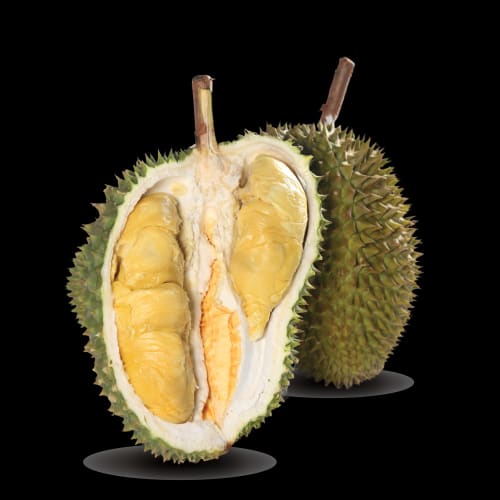
D160 is a large durian, with an average weight around 3 kilograms and particularly hefty specimens reportedly reaching up to 5 kilograms. The shape is elongated elliptic - oblong and somewhat oval, wider at the top and tapering toward the base. Some descriptions liken it to a heart or kidney bean shape, with a protruding pointed navel at the bottom and indentations near the base.
The husk is green, sometimes with a dull brownish mesh pattern on the surface. The thorns are coarse and short - the DOA registration describes them as "duri kasar, pendek" - and they are densely packed, with a concave profile that some observers compare to inverted ice cream cones. The spines curve inward near the stem.
The DOA notes that D160 is "senang dibuka" - easy to open - though some more recent accounts from durian sellers describe it as one of the trickier varieties to dehusk, with difficult-to-find seams and spikes that can break when prying. This discrepancy may reflect variation between individual fruits or between naturally fallen versus hand-harvested specimens.
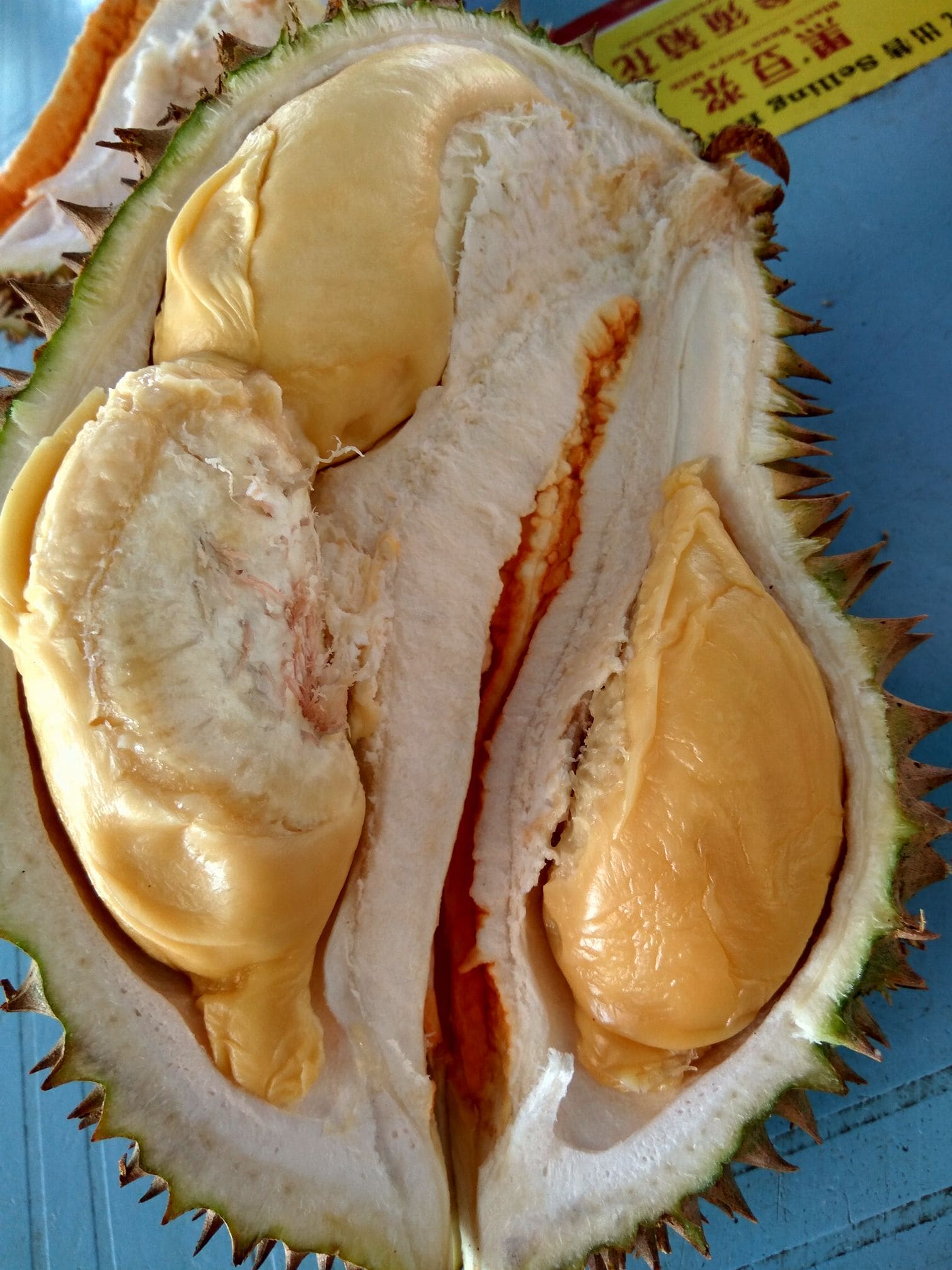
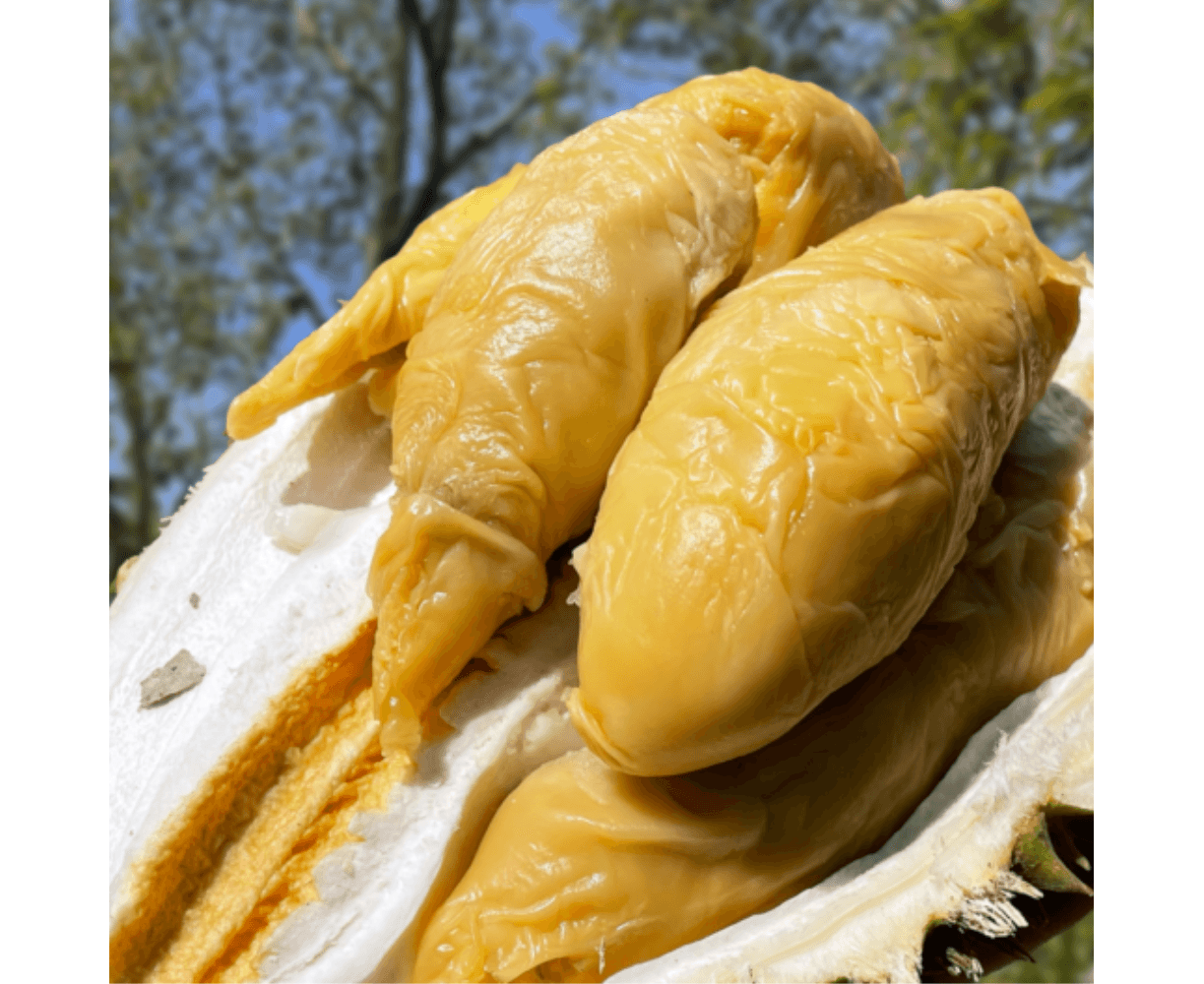
When opened, the flesh is immediately appealing. The arils are large and thick, with a smooth, fine texture. The color ranges from pale golden yellow to orange-yellow, sometimes with slightly darker patches. Seeds are present but tend to be smaller relative to the generous amount of flesh, yielding a favorable flesh-to-seed ratio.
Taste & Texture
The DOA's official description of D160's flavor is concise: "lemak manis" - creamy sweet. This captures the primary impression: a rich, fat sweetness that coats the palate. The texture is thick, smooth, and extra creamy, with a slightly sticky mouthfeel that distinguishes it from drier or more fibrous varieties.
Enthusiasts, however, describe a more complex profile than the DOA's two-word summary suggests. The sweetness is the foundation, but it is accompanied by a detectable bittersweet undercurrent - not as pronounced as in Musang King, but present enough to add depth and prevent the flavor from becoming one-dimensional. Some tasters report floral notes, while others detect nutty or savory undertones that contribute an umami-like quality.
The aroma is strong and pungent. It is not overwhelming in the way that some varieties assault the senses, but it is assertive enough to appeal to experienced durian eaters rather than newcomers. The smell has been described as characteristically "gassy," with a soda-like effervescence that hints at the fruit's ripeness.
One notable characteristic of D160 is its persistent aftertaste. The flavor lingers on the palate well after eating, and some durian enthusiasts warn that eating Tekka early in a tasting session can overpower the flavors of milder varieties consumed afterward. This lingering quality is considered a virtue by those who appreciate intensity and a drawback by those who prefer to sample many varieties in one sitting.
Each 100-gram serving of D160 flesh contains approximately 153 kilocalories, consistent with its rich, high-fat profile.
How to Identify
Identifying D160 in a pile of durians requires attention to several distinguishing features:
Size. D160 is a large durian, typically 2.5 to 3.5 kilograms. Its weight alone sets it apart from medium-sized varieties like Musang King, which usually tops out around 2.5 kilograms.
Shape. The elongated elliptic profile - wider at the top, tapering and narrowing toward the base - is distinctive. Look for the protruding pointed navel at the bottom and the kidney-bean-like curvature.
Husk and thorns. The green husk has coarse, short, densely packed thorns. Compared to Musang King's more widely spaced pyramidal spines, D160's thorns are stubbier and packed more closely together. They are not as compact as D24's spines but are noticeably denser than those of Musang King.
Flesh color. Orange-yellow to golden-yellow. The color is warm and distinctly orange-toned, differentiating it from the deeper turmeric yellow of Musang King or the pale cream of some other varieties.
Flesh texture. Smooth, thick, and creamy with minimal fibrousness. The flesh should feel dense and slightly sticky.
Taste confirmation. Creamy sweet with a hint of bittersweet complexity. If the durian is purely sweet with no depth, or intensely bitter, it is likely a different variety.
Availability & Pricing
D160 is available during Malaysia's durian seasons, with peak supply typically occurring in August and early harvests beginning in late July. The variety follows the standard Peninsular Malaysia durian calendar, with the major season running from June to August and a minor season from November to February, though timing varies by region.
Supply of D160 is modest compared to market-dominant varieties like Musang King or D24, but more abundant than rare cultivars like Black Thorn. Many plantation owners retain legacy Tekka trees alongside newer plantings, though relatively few growers are actively expanding D160 acreage. This is partly because D160 trees require approximately twelve years to achieve consistent fruit production and partly because the variety can be finicky about ripeness, with moisture and fermentation issues complicating harvest timing.
Pricing for D160 sits in the mid-to-upper range of the Malaysian durian market. Grade A specimens typically command RM 30 to RM 40 per kilogram - below Musang King's premium pricing but above entry-level varieties. In Singapore, where Malaysian durians command higher prices, D160 flesh packages retail for approximately SGD 63 for 750 grams. Export-grade frozen whole fruit is available from specialty retailers in Australia and other markets, typically at a premium.
As with all durian varieties, prices are volatile and fluctuate significantly based on seasonal supply, weather conditions, and market demand. It is always advisable to confirm current pricing before purchasing.
Growing Regions
D160 originated in Selangor, specifically in the Banting area of the Kuala Langat district. This coastal lowland region provided the conditions under which the original wild seedling grew among bamboo. Selangor remains an important source, though it is no longer the sole growing area.
Pahang has become a significant growing region for D160, with orchards contributing to commercial supply. The interior highlands of Pahang offer elevation and soil conditions that are favorable for many durian varieties.
Johor, in the south of Peninsular Malaysia, is another producing state. D160 seedlings are sold by nurseries in areas like Muar, indicating active cultivation and new plantings in the state.
Negeri Sembilan and Penang also have D160 trees, though production volumes in these states are smaller. The variety has demonstrated adaptability across different growing conditions in Peninsular Malaysia.
Overall, D160 is not concentrated in a single dominant production zone the way Musang King is tied to Raub. Its distribution is more dispersed, reflecting its origins as a variety that spread organically through hobbyist growers and small-scale nurseries rather than through a coordinated commercial planting campaign.
Fun Facts
- The three names of D160 - Buluh Bawah (Malay), Tekka (Hokkien), and Musang Queen (English marketing) - all reference the same origin story but from different linguistic angles. "Buluh bawah" means "under the bamboo," "tekka" means "bamboo leg," and "Musang Queen" is purely a commercial invention.
- The original wild seedling that became D160 was reportedly only four feet tall when Lim Hai Chua discovered it growing among bamboo. He cultivated it as a hobby, unaware that it would eventually be registered as a national durian variety and rebranded with a royal title.
- The "Musang Queen" name is a deliberate marketing play on D197 Musang King, positioning D160 as its feminine counterpart. The designation reportedly gained traction after former Prime Minister Najib Razak made a favorable remark about the fruit at a FAMA anniversary event in 2015.
- Despite the DOA's description of D160 as "senang dibuka" (easy to open), some durian sellers report that Tekka can be one of the trickier varieties to dehusk, with elusive seams and fragile spikes. The contradiction may reflect the difference between naturally fallen, fully ripe fruit and those harvested earlier.
- D160 is sometimes listed among Malaysia's top ten durian varieties, though it operates in a quieter register than headline-grabbing cultivars like Musang King or Black Thorn. Its loyal following appreciates it as a variety that rewards patient, experienced palates.
- The largest documented D160 specimen reportedly weighed approximately 5 kilograms - well above the average and making it one of the heftier individual durian fruits on record for any variety.
- In Selangor, D160 (Buluh Bawah) is traditionally planted alongside other local favorites such as D162 (Tawa) and Penu (MDUR 505), reflecting the state's historically diverse durian cultivation practices.