

D123 Chanee
Overview
Before Mon Thong conquered the world's durian markets, there was Chanee. This variety - whose Thai name, ชะนี, means "gibbon" - is one of the oldest documented commercial durians in Thailand, with cultivation records stretching back to 1687. For much of the 20th century, Chanee was the dominant commercial durian in Thailand, the variety that Thai farmers planted and Thai consumers ate. It was only in the late 1980s and 1990s that Mon Thong gradually displaced Chanee from the top position, reshaping Thailand's durian industry in the process.
Today, Chanee and Mon Thong together form the two pillars of Thai commercial durian production. Mon Thong accounts for approximately 41 percent of Thailand's cultivated durian area, and Chanee holds approximately 33 percent - together comprising nearly three-quarters of the entire Thai durian industry. But the two varieties occupy fundamentally different roles. Where Mon Thong is the mild, sweet, firm-fleshed variety that dominates exports and appeals to first-time eaters, Chanee is the bolder, more pungent counterpart - softer, butterier, more intensely flavored, with a strong aroma that announces itself without subtlety. If Mon Thong is the diplomat of Thai durian, Chanee is the one who says exactly what it means.
In Malaysia, Chanee was registered as D123 by the Department of Agriculture (DOA) in 1971, reported by Pertab Singh from Selangor. In the northern states of Penang and Kedah, it is also widely known as D15 - a separate designation that reflects the variety's independent introduction to those regions. In Chinese, it is called 青尼 (qing ni), a phonetic adaptation of the Thai name.
Origin & History
The historical roots of Chanee run deeper than almost any other commercially cultivated durian. The variety is native to Thonburi, the region along the western bank of the Chao Phraya River near modern-day Bangkok. In 1687, the French diplomat Simon de la Loubere documented that most of the Thai government's revenues came from taxing fruit gardens, with durian trees attracting a higher tax rate than other fruit trees. This tells us that durian was already a major commercial crop in the Thonburi-Bangkok region by the late 17th century, and Chanee is believed to have been among the varieties cultivated during that era.
In Thailand's classification system, Chanee belongs to the Luang group - one of five families used to categorize the country's 234 registered durian varieties into groups with similar characteristics. The Luang group contains approximately ten varieties, and Chanee is its most commercially prominent member.
The transition from Chanee's dominance to Mon Thong's supremacy is not precisely documented. Studies from the 1980s list Chanee as the main commercial durian, and the earliest English-language reference to Mon Thong dates to 1987. By the 1990s, Mon Thong had overtaken Chanee in planted area and production volume. The reasons are commercial: Mon Thong's firmer flesh gives it a shelf life of approximately 20 days versus Chanee's much shorter window; its milder aroma suits export markets better; and its larger fruit size yields more flesh per unit. For the export-driven industry Thailand was building - particularly the trade to China - Mon Thong was a better logistical fit.
But Chanee never disappeared. It retained a loyal domestic following and remains the second most planted variety. One critical advantage keeps it indispensable: it matures significantly faster. Chanee takes approximately 100 to 120 days from flowering to harvest, compared to 140 to 150 days for Mon Thong. This makes Chanee the early-season variety - the first major commercial durian to hit Thai markets each year, typically in late April to early May. For farmers, this early harvest means income arrives weeks before the Mon Thong crop is ready.
In Malaysia, D123 was registered on 24 July 1971 by Pertab Singh from Sungai Buloh, Selangor. The registration of a Thai durian variety by an individual in Selangor - far south of the northern states where Thai durian influence is strongest - speaks to the organic, cross-border movement of durian germplasm that has characterized the region for centuries. The DOA description from that registration reads: "Buah bersaiz besar; eliptik; kulit berwarna hijau perang; berduri kasar dan mempunyai warna perang di hujung; bertangkai pendek dan besar. Isi berwarna kuning; rasa isi lemak manis dan beraroma kuat." (Fruit large in size; elliptic; greenish-brown husk; coarse thorns with brown tips; short thick stem. Yellow flesh; creamy sweet taste with strong aroma.)
The variety also appears in northern Malaysia as D15, particularly in Penang and Kedah, where it goes by local names including "Penang 15" and "Juara 90." Malaysian-grown D15 differs somewhat from Thai Chanee, tending to develop a brownish husk rather than the greener coloring typical of Thai specimens.
Appearance
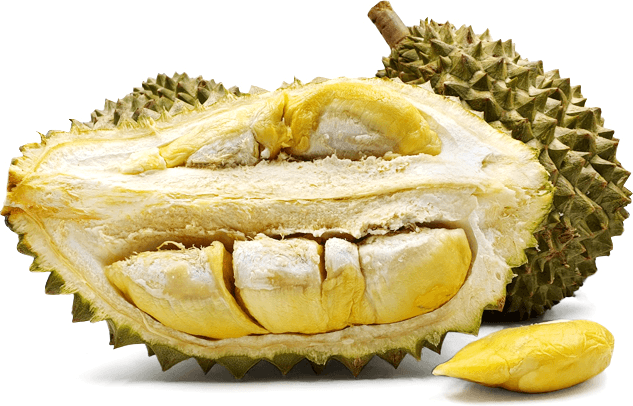
Chanee is a large durian, though not as massive as Mon Thong. Fruits typically weigh between 2.5 and 4.0 kilograms, with some specimens reaching over 4 kilograms. The shape is elliptic - an oval profile that is broader through the middle and tapers at both ends.
The husk ranges from green to greenish-brown, with the DOA registration specifically noting the "hijau perang" (greenish-brown) coloring. At maturity, the color may shift further toward yellowish-brown or grey-brown. The thorns are coarse and widely spaced - large, blocky pyramids that give the surface a rugged, imposing texture quite different from the more densely packed spines of many Malaysian varieties. The brown coloring at the tips of the thorns, as noted in the DOA description, is a distinctive visual marker. The stem is short and thick (pendek dan besar), contrasting sharply with the dramatically long stem of D158 Kan Yau.
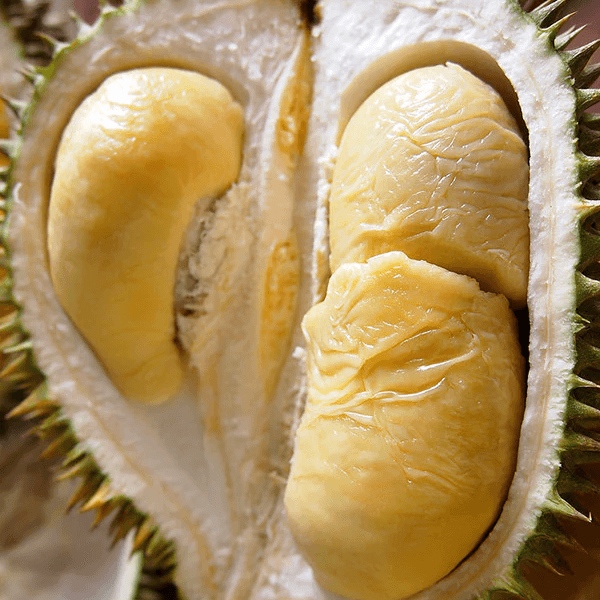
When opened, the interior reveals three to four lobes per chamber, with the white, spongy pith typical of all durian separating the flesh compartments. The flesh is bright yellow - a vivid, saturated yellow that sometimes carries golden or even faintly orange undertones. The flesh is notably thick and voluminous; Chanee is recognized as having some of the thickest flesh among durian varieties, with generous fruitlets that can make the seeds difficult to see. The seeds themselves are relatively large, though they are well-concealed within the abundant pulp.
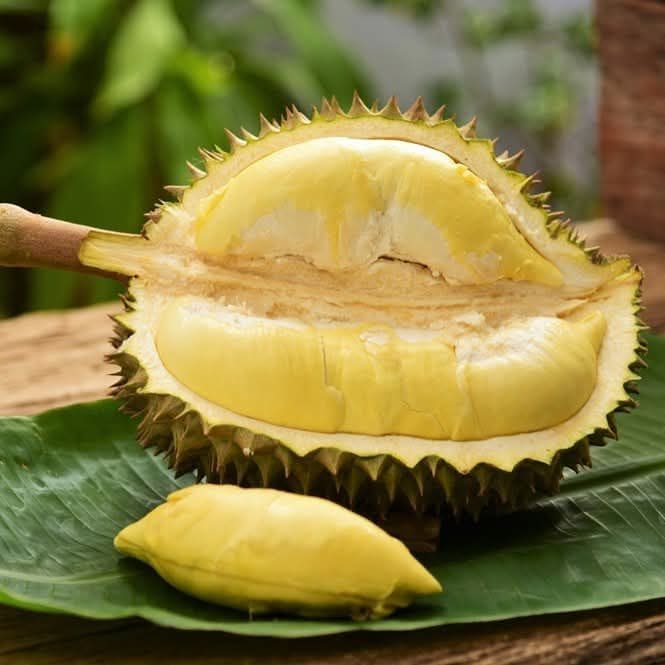
The overall visual impression of a Chanee durian is one of robust solidity - a large, coarsely thorned fruit with brown-tipped spikes, a short sturdy stem, and an interior packed with thick yellow flesh.
Taste & Texture
The DOA registration describes Chanee's flavor as "lemak manis" - creamy sweet - "dan beraroma kuat" - with strong aroma. This is an accurate and telling summary. Chanee is a durian that leads with intensity.
The sweetness is rich and deep, with a complexity that goes beyond simple sugar. There are savory undertones, occasional hints of bitterness like dark honey, and in some specimens a faint alcoholic or fermented note. The flavor has been described as a balance of sweet and bitter, with the sweetness always dominant but the supporting notes preventing monotony. Some tasters detect a metallic tang at the finish. This is markedly different from Mon Thong's clean, gentle sweetness - Chanee demands more from the palate and rewards those who appreciate bold durian.
The aroma is where Chanee truly diverges from its more famous companion. Where Mon Thong is mild and restrained, Chanee is unapologetically pungent. The scent carries notes of garlic, sulfur, and onion - the full spectrum of volatile sulfur compounds that give durian its polarizing reputation. For enthusiasts who appreciate a strongly aromatic fruit, Chanee's fragrance is a feature, not a flaw. For the export market and uninitiated consumers, however, this intense aroma has limited Chanee's international reach compared to Mon Thong.
The texture is smooth, buttery, and creamy - softer and more yielding than Mon Thong's characteristically firm flesh. The pulp is thick and fine-textured, with a custard-like consistency when perfectly ripe. One of Chanee's distinctive qualities is that it is softer, butterier, and more pungent in nearly every dimension than Mon Thong. If Mon Thong represents the firm, mild end of the Thai durian spectrum, Chanee occupies the soft, intense end.
There is a critical caveat about timing. Chanee connoisseurs in Thailand speak of a narrow "golden period" - a window of perfect ripeness that may last only a single day. Before this window, the fruit tastes lean and underdeveloped; after it, the flesh becomes mushy and overly fermented. This sensitivity to ripeness is one reason Chanee has proven more difficult to commercialize at scale than the forgiving Mon Thong.
How to Identify
Size and shape. A large, elliptic durian weighing 2.5 to 4.0 kilograms. The oval profile, broader in the middle and tapering at the ends, is characteristic. Chanee is big, but not as enormous as Mon Thong.
Husk color. Greenish-brown, shifting toward grey-brown or yellowish-brown at full maturity. The DOA notes the "hijau perang" coloring. In Malaysian-grown specimens (D15), the husk may appear more brown than green.
Thorns. Coarse, large, and widely spaced - triangular pyramids with distinctly brown tips. This is a key visual marker from the DOA registration. The spacing and coarseness of the thorns give Chanee a rougher, more rugged appearance than varieties with densely packed, finer spines.
Stem. Short and thick. If the stem is long, you are likely looking at a different variety (possibly D158 Kan Yau, which is also Thai).
Flesh. Bright yellow, thick, and voluminous. The flesh should be notably generous - Chanee is known for having some of the thickest pulp among durian varieties. If you see deep yellow flesh that nearly buries the seeds, Chanee is a strong candidate.
Aroma and taste. Strong, pungent aroma with sulfurous, garlicky notes. Creamy sweet flavor with savory complexity and occasional bitter or alcoholic undertones. If the durian is boldly aromatic and richly flavored, rather than mild and gently sweet, this is more consistent with Chanee than Mon Thong.
Availability & Pricing
Chanee's defining commercial advantage is its early-season timing. In Thailand's eastern provinces - the heartland of durian production centered on Chanthaburi - Chanee harvest typically begins in late April to early May, several weeks ahead of the Mon Thong crop. The Thai Department of Agriculture sets official harvest start dates each year to prevent farmers from selling immature fruit; for Chanee, these dates usually fall in late April or early May in the eastern region.
This early timing means Chanee captures the first wave of seasonal demand, when supply is limited and consumers are willing to pay early-season premiums. As the season progresses and Mon Thong enters the market in volume, Chanee prices typically decline.
In Thailand, Chanee is generally priced lower than Mon Thong. Recent wholesale prices have hovered around 70 to 120 Thai baht per kilogram, though early-season farm-gate prices may approach 200 baht per kilogram before supply increases.
In Malaysia, D123/D15 is positioned in the mid-range. Prices typically fall between RM 25 and RM 45 per kilogram, varying by region and quality. In Penang, where D15 is well-known, it is available at local stalls particularly during the July to August period. Some vendors price it around RM 14 per kilogram at certain points in the season, offering good value for consumers seeking quality without premium pricing.
Chanee is also available in processed forms. In Thailand, unsold fresh Chanee durians are traditionally made into durian guan - a thick, sticky, sweet paste-like candy that is considered a delicacy in many Thai villages.
Growing Regions
Thailand is the primary and historically dominant growing region for Chanee. The variety originated in the Thonburi area near Bangkok and is now cultivated across Thailand's major durian-producing provinces.
- Chanthaburi, in southeastern Thailand, is the country's most important durian production hub, accounting for approximately 44 percent of national output. Both Chanee and Mon Thong are extensively grown here, with Chanee typically harvested earlier in the season.
- Rayong, adjacent to Chanthaburi in eastern Thailand, is another significant production area.
- Chumphon, in southern Thailand, contributes to production with a later harvest season.
Chanee accounts for approximately 33 percent of Thailand's total cultivated durian area, making it the second most planted variety after Mon Thong's 41 percent. Together, these two varieties occupy roughly three-quarters of all Thai durian farmland.
Malaysia: Selangor is the state of origin for the D123 registration, through Pertab Singh's 1971 filing from Sungai Buloh. However, Chanee's commercial presence in Malaysia is most strongly felt in the northern states.
Malaysia: Penang is arguably the most important Malaysian market for Chanee, where it is known as D15. The Balik Pulau area on Penang Island's western side and the Teluk Bahang area are key growing and selling locations. The local season runs from approximately May through August, peaking in July.
Malaysia: Kedah, particularly the eastern districts of Padang Terap, Sik, and Baling, has established Chanee cultivation alongside other Thai-origin varieties like Mon Thong and Kan Yau.
Chanee has also been noted for its use as a rootstock in Thai cultivation. Its resistance to Phytophthora palmivora - the devastating root rot fungus that is among the most serious threats to durian trees - makes it a practical choice for grafting programs, even in orchards primarily producing other varieties.
Fun Facts
- Chanee's name, ชะนี (cha-nee), translates to "gibbon" in Thai. One folk explanation suggests the name arose because someone thought the fruit's appearance resembled a gibbon's head, though the true origin of the name is not definitively recorded.
- With cultivation records dating to 1687 - the same year French diplomat Simon de la Loubere documented the Thai government's taxation of durian orchards - Chanee's documented history spans approximately 340 years, making it one of the oldest traceable commercial fruit varieties in Southeast Asia.
- The registrant of D123 in Malaysia, Pertab Singh, was an individual from Sungai Buloh, Selangor. The registration of a Thai variety by a Sikh individual in Selangor - far from the northern border regions where Thai agricultural influence is strongest - illustrates the remarkably diverse and decentralized way durian varieties have historically moved across Southeast Asia.
- Thai durian connoisseurs speak of Chanee's "golden period" - an exceptionally narrow window of perfect ripeness, sometimes lasting only a single day. If you have tasted Chanee at its golden moment, the saying goes, you will never forget it.
- Chanee is recognized as the most resistant among major Thai commercial cultivars to Phytophthora palmivora, the root rot fungus that is one of the most devastating diseases in durian cultivation. This makes Chanee doubly valuable - as a fruit in its own right and as rootstock material for grafting more susceptible varieties.
- D123 Chanee and D159 Mon Thong together represent Thailand's two pillars of commercial durian, both registered in Malaysia's DOA system. Mon Thong was registered in 1987 from Kedah, sixteen years after Chanee's 1971 registration from Selangor. Two varieties from different Thai traditions, registered by different individuals, in different states, decades apart, yet inextricably linked.
- Unsold Chanee durians in Thailand are traditionally processed into durian guan, a thick sweet paste-like confection considered a village delicacy. The tradition reflects both the variety's abundance and its shorter shelf life compared to Mon Thong - the fruit that cannot wait must be transformed.