
Overview
D101 is arguably the most misidentified durian in Malaysia. The code officially belongs to a variety called Bangkok Tree 16, a Thai-origin seedling registered in 1970 from the Department of Agriculture's germplasm collection in Serdang, Selangor. It is a relatively obscure cultivar that most Malaysians have never tasted.
Yet the name "D101" is well known throughout the country. Walk into any durian stall in Johor and ask for D101, and the seller will hand you a large, golden-fleshed fruit with a sweet, creamy, vanilla-like flavor. That durian is not D101 at all. It is D168, officially registered as Mas Johor, a completely different variety from a completely different state, registered nearly two decades later.
How one of Malaysia's most popular durians ended up permanently carrying the wrong code is one of the most fascinating stories in the country's durian culture. Understanding this confusion is essential for anyone who wants to navigate the Malaysian durian landscape with genuine knowledge rather than inherited misinformation.
Origin & History
The real D101 - Bangkok Tree 16 - originates from the Department of Agriculture's research station in Serdang, Selangor. It was registered in 1970 by the Jabatan Pertanian (Department of Agriculture) as part of a systematic effort to catalog and preserve durian germplasm from various sources, including seedlings of Thai origin.
The name "Bangkok Tree 16" indicates that this was the sixteenth seedling in a collection of durian trees grown from Bangkok-sourced material at the Serdang station. This collection was part of a broader DOA program to evaluate and document durian genetic diversity. Several other varieties in the national registry share this Bangkok-series lineage, including D88 (Bangkok 8, registered 1950), D92 (Bangkok A, registered 1955), D102 (Bangkok 17, registered 1970), and D103 (Bangkok 28, registered 1970). Together, these entries represent a chapter of Malaysia's agricultural history when the Department was actively studying Thai durian genetics alongside local cultivars.
As a germplasm collection specimen rather than a commercially promoted variety, the real D101 was never widely propagated or planted in commercial orchards. It has remained somewhat rare and harder to track down - a footnote in the registry rather than a household name.
According to the official DOA description, the real D101 produces large, elliptic fruit. The flesh is thick, sweet, and dry in texture, with a yellow color and few seeds. These characteristics are consistent with many Thai-origin durians, which tend toward sweetness and drier flesh compared to the often creamier, more complex profiles of Peninsular Malaysian cultivars.
The Great Identity Confusion
This is where the D101 story becomes genuinely remarkable, and where this profile diverges from a standard variety write-up. The durian that most Malaysians know as "D101" is not D101 at all. It is D168, a variety officially registered as Mas Johor.
D168 was registered in 1989 by the Malaysian Agricultural Research and Development Institute (MARDI). Its mother tree was originally grown by Hajah Hasmah in a home garden in Muar, Johor. MARDI recognized the quality of this seedling and formally documented it, giving it the registry code D168 and the name Mas Johor - literally "Johor Gold."
The confusion began in the early days of durian stall culture in Johor. When sellers at IOI Mall in Kulai, Johor, started selling this variety, they wrote "DIOI" on their signage - shorthand for "Durian IOI," referencing the mall where it was being sold. Customers misread "DIOI" as "D101." The number 101 looked close enough to the letters IOI, and the misreading spread. Sellers who bought from Kulai carried the "D101" label to other stalls. Customers repeated it. Within a relatively short period, the entire market in Johor and beyond had adopted "D101" as the name for this durian.
By the time anyone might have corrected the record, it was too late. The name had become self-reinforcing. New stall operators learned from existing ones. Consumers who had always known the fruit as D101 had no reason to question the label. The actual D101 - Bangkok Tree 16 - was obscure enough that there was no commercial pressure to resolve the mismatch.
Today, the confusion is essentially permanent. In practical terms, if you order "D101" at a durian stall anywhere in Malaysia, you will receive D168 (Mas Johor). The market has spoken, and no amount of registry correction can undo decades of established usage. This profile covers the actual registered D101, but readers looking for information about the popular durian sold under that name should refer to the D168 (Mas Johor) profile, which covers the variety in full detail.
Appearance
The real D101 (Bangkok Tree 16), based on its DOA registry description, produces large fruit with an elliptic shape. The overall appearance is consistent with other Bangkok-series durians in the DOA collection, which tend to be substantial, well-formed fruit.
The details recorded for D101 note thick flesh, yellow coloring, and few seeds. These are desirable commercial traits, though the variety was never commercially exploited at scale.
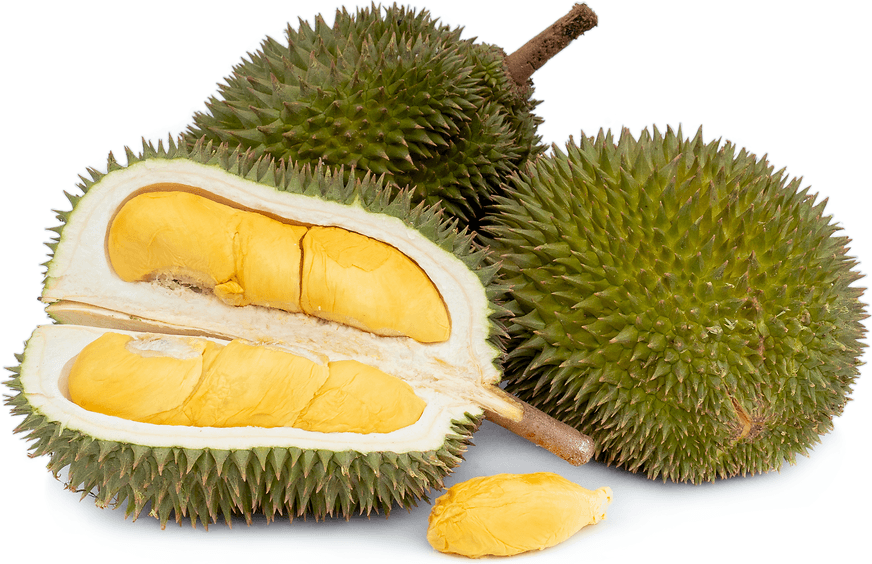
For comparison, the durian most people call "D101" - which is actually D168 - has its own distinct appearance: large fruit weighing 2 to 3 kilograms with an oval or elliptic shape, dark green husk with brown tips on the thorns, long sharp conical thorns that spread in all directions, and a distinctive fold on the husk that durian enthusiasts sometimes describe as a "buttock" crease. Inside, D168 has brilliant golden yellow to orange-gold flesh. These visual details, however, belong to the D168 profile and are mentioned here only to help readers understand which fruit they are actually looking at when they see "D101" at a stall.
Taste & Texture
The DOA description of the real D101 records the flesh as sweet, dry, and yellow. The "dry" texture designation places it in a category that is characteristic of many Thai-origin durians - the flesh is firm and does not have the wet, custard-like consistency that defines popular Malaysian varieties like Musang King or D24. Sweet and dry durians tend to appeal to those who prefer a cleaner, less rich eating experience, with the sweetness carrying the flavor rather than the interplay of bitterness and creaminess.
Since the real D101 was never widely commercialized, detailed tasting notes from the broader durian community are sparse. Its flavor profile is best understood in the context of its Bangkok-series siblings, which generally share a sweet, straightforward character without the complex bittersweet layers found in premium Malaysian cultivars.
Again, for clarity: the durian that the market calls "D101" - actually D168 (Mas Johor) - has a markedly different flavor profile. That variety is known for its sweet taste with low bitterness, vanilla-like notes, honeyed sweetness, hints of caramel and almond, and a smooth creamy custard texture with a milder aroma than Musang King. It is often described as a humble but delicious alternative to Musang King. All of these tasting notes, however, describe D168, not the registered D101. Readers interested in that flavor experience should refer to the D168 profile.
How to Identify
Identifying the real D101 (Bangkok Tree 16) in the market is, frankly, nearly impossible for the average consumer. The variety was never widely planted, has no established commercial presence, and lacks the kind of widespread visual familiarity that allows experienced buyers to spot varieties like D24 or Musang King on sight.
The DOA registry provides the basic physical markers: large size, elliptic shape, thick yellow flesh, dry texture, and few seeds. But these descriptors overlap with numerous other varieties, and without access to a verified source tree or DOA collection material, positive identification would require expert knowledge or genetic testing.
As a practical matter, what most consumers need to know is how to distinguish the durian sold as "D101" - which is actually D168 - from other varieties, particularly Musang King. This distinction matters because D168 is one of the top five durians commonly sold as fake Musang King due to the visual similarity of their golden flesh. Key differences include D168's longer and more sharply conical thorns (compared to Musang King's more pyramidal spines), D168's generally darker green husk, and D168's milder, sweeter flavor without Musang King's signature bitterness. D168 is also sometimes marketed under the name "Wang Zhong Wang" (King of Kings) as a Musang King substitute, which is another label to be aware of.
Availability & Pricing
The real D101 (Bangkok Tree 16) is effectively unavailable in the commercial market. It exists primarily as a germplasm accession in the DOA system and possibly in small numbers at research stations or specialist collectors' orchards. For all practical purposes, a consumer cannot walk into a durian stall and buy the genuine registered D101.
The durian sold under the name "D101" - D168 (Mas Johor) - is a different story entirely. It is widely available throughout Peninsular Malaysia, particularly during the main durian season from June to August. In Johor, where it originated, it is one of the most commonly found varieties at roadside stalls and durian markets. Its availability extends to Melaka, Pahang, Penang, and Perak.
In terms of pricing, D168 (sold as "D101") occupies one of the most attractive positions in the durian market. It typically sells for RM 10 to RM 18 per kilogram - approximately one-third the price of Musang King. This makes it arguably the best value proposition among premium-quality durians. For consumers who enjoy a sweet, creamy durian with golden flesh and are not wedded to the Musang King name, the durian sold as "D101" delivers remarkable quality for the price.
Growing Regions
The real D101 (Bangkok Tree 16) was catalogued from the DOA station in Serdang, Selangor. Its growing distribution, to the extent it exists outside germplasm collections, is unknown and likely negligible.
The durian sold as "D101" - D168 (Mas Johor) - has well-established growing regions. Its primary home is Johor, particularly the districts of Muar (where the original mother tree stood in Hajah Hasmah's garden), Segamat, and Batu Pahat. These southern Peninsular Malaysia growing areas provide the bulk of the "D101" supply that reaches markets throughout the country.
Beyond Johor, D168 is also cultivated in:
- Melaka - Neighboring Johor, with growing conditions that suit the variety well.
- Pahang - One of Malaysia's major durian-producing states, where D168 is grown alongside Musang King and other premium varieties.
- Penang - In the northern states, D168 is sometimes known by an entirely different name: "Buaya Emas," meaning Golden Crocodile. This regional naming adds yet another layer to the already complex identity of this variety.
- Perak - Another significant growing region where the variety has been adopted by commercial orchards.
The geographic spread of D168 across multiple states reflects its commercial viability and consumer demand. Its relatively lower price point compared to Musang King, combined with its visually appealing golden flesh and crowd-pleasing sweet flavor, has made it a practical choice for orchard operators looking for a reliable variety with strong market demand.
Fun Facts
The name that stuck. The "D101" misnomer is one of the most enduring cases of accidental rebranding in Malaysian food culture. A handwritten sign at a Johor shopping mall, misread by customers, created a name that has now outlasted two decades of durian seasons. The actual D101 never had a chance to claim its own code in the public consciousness.
Part of a Bangkok family. The real D101 belongs to a collection of Thai-origin seedlings catalogued by the DOA in Serdang. Its siblings include D88 (Bangkok 8), D92 (Bangkok A), D102 (Bangkok 17), and D103 (Bangkok 28). These varieties represent a period in Malaysian agricultural history when researchers were actively studying Thai durian genetics to understand and expand the country's cultivar diversity.
A durian by any other name. The variety most people call "D101" goes by at least three different names depending on where you are: "D101" or "IOI" across most of Malaysia, "Mas Johor" in official records, and "Buaya Emas" (Golden Crocodile) in the northern states. Its official code, D168, is ironically the least used of all its identifiers.
The fake Musang King connection. D168 - the durian sold as "D101" - is one of the varieties most commonly passed off as Musang King at unscrupulous stalls. The visual similarity of their golden flesh and large fruit size makes the substitution plausible to untrained eyes, but the price difference is enormous. Being aware of this practice is valuable consumer knowledge during durian season.
A home garden origin. While many registered durian varieties come from government research stations or established orchards, the original D168 tree grew in the home garden of Hajah Hasmah in Muar, Johor. It was a chance seedling that happened to produce exceptional fruit, noticed and formally documented by MARDI researchers. This origin story is a reminder that remarkable durian trees can appear anywhere - even in someone's backyard.
The one-third price secret. At RM 10 to RM 18 per kilogram, the durian sold as "D101" costs roughly a third of what Musang King commands. For many durian lovers, this makes it the best-kept value secret in the market: a premium-quality fruit with golden flesh, sweet creamy flavor, and a price tag that allows generous consumption without financial regret.
Two varieties, one code, zero corrections. Despite the confusion being well-documented among durian researchers and enthusiasts, no practical effort has been made to correct the mislabeling in the market. The commercial reality is that "D101" as a brand name for D168 is simply too entrenched. This is a case where market usage has permanently overridden official registry records - a uniquely Malaysian outcome in a uniquely Malaysian fruit culture.