

Overview
D88 Bangkok 8 is a durian with a quiet but significant place in Malaysian agricultural history. Registered on 30 August 1950 by the Jabatan Pertanian (Department of Agriculture) from its research station in Serdang, Selangor, D88 is the earliest recorded variety in the Bangkok series -- a collection of Thai-origin seedlings that were cultivated, studied, and catalogued at the DOA's Serdang facility over several decades. Its siblings in this series include D92 (Bangkok A, registered 1955), D101 (Bangkok Tree 16, registered 1970), D102 (Bangkok 17, registered 1970), and D103 (Bangkok 28, registered 1970).
The name "Bangkok 8" indicates that this was the eighth seedling in a collection of durian trees grown from Bangkok-sourced material. The number tells us that there were at least eight trees in the earliest phase of this collection, and possibly more that were never formally registered. D88 was the one that made it into the national registry, marking it as the first of the Bangkok-series durians to receive an official D-code.
In the Chinese-speaking durian community, D88 is known by the affectionate nickname Xiao Tian Tian (small sweet sweet), a term of endearment that reflects the variety's straightforwardly sweet character. In Penang, it goes by a different alias entirely -- Lan Jiao Yuan (field of bad bananas) -- a colorful local name said to originate from a story about a farmer whose failed banana plantation produced a durian tree instead.
D88 is not one of Malaysia's headline durian varieties. It does not command the prices or the fame of Musang King, Black Thorn, or even D24. But it occupies a historically interesting position: registered just sixteen years after the DOA began its durian cataloguing program in 1934, D88 represents an early chapter in Malaysia's engagement with Thai durian genetics. It is a bridge between the pioneering first wave of registrations (D2 through the 1930s and 1940s) and the more systematic collections that followed in the 1950s, 1960s, and 1970s.
Origin & History
To appreciate D88's place in history, it helps to understand what the DOA was doing in Serdang in the mid-twentieth century. The Department of Agriculture had begun formally registering durian cultivars in 1934, when D1 and D2 (Data Nina) became the first entries in what would grow into a registry of more than 200 varieties. The early registrations -- from D2 through to approximately D88 -- span the period from 1934 to 1950, covering the late colonial era, the Japanese occupation, and the early years of post-war Malaya.
During this period, the DOA was not only documenting local Malay durian cultivars but also collecting and evaluating germplasm from other Southeast Asian sources, notably Thailand. Thai durians had been traded across the Malay Peninsula for generations, and the DOA recognized the value of studying these varieties systematically. The research station at Serdang became the hub for this work.
The Bangkok-series seedlings represent exactly this effort. Seeds or seedlings from Bangkok-origin durian stock were planted at the Serdang station, where they were grown, observed, and eventually evaluated for their fruit characteristics. D88, as "Bangkok 8," was the eighth such seedling to be planted and assessed. Its registration in 1950 means it was likely planted years earlier -- durian trees take at least five to seven years to bear fruit from seed, and often longer. The original planting may well date to the early or mid-1940s, a period when Malaya was under Japanese occupation and agricultural research was disrupted. This makes the survival and eventual registration of these Bangkok seedlings all the more noteworthy.
The Bangkok-series collection continued to yield registrations over the following two decades. D92 (Bangkok A) was registered in 1955, and then in 1970, three more Bangkok varieties were added to the registry in a single batch: D101 (Bangkok Tree 16), D102 (Bangkok 17), and D103 (Bangkok 28). The numbering of these varieties -- 8, A, 16, 17, 28 -- suggests a larger collection of numbered seedling trees from which only certain individuals were selected for formal registration based on their fruit quality or other notable characteristics.
Together, the Bangkok-series entries tell a story about Malaysia's agricultural research infrastructure during a formative period. This was an era when the DOA was systematically building a genetic library of durian diversity, drawing from both domestic and regional sources. D88, as the earliest Bangkok-series entry, marks the beginning of that particular chapter.
Appearance
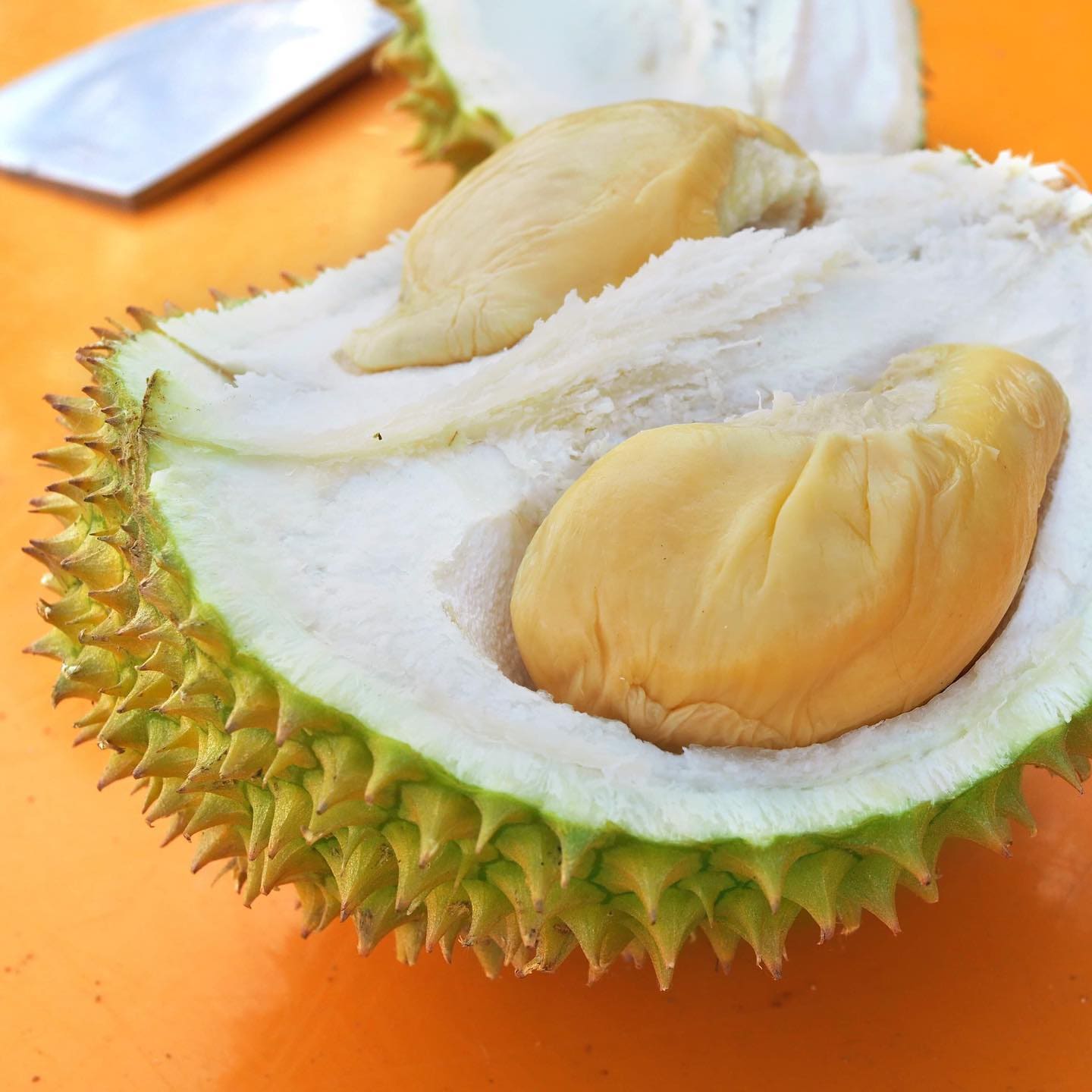
The official DOA description of D88 records it as a very large durian (sangat besar) with an elliptic shape. This places it among the bigger varieties in the national registry -- a substantial fruit that stands out at a stall simply by its size. Weights in the range of 3 to 5 kilograms are consistent with the "very large" designation, though individual fruit size varies with growing conditions and tree age.
The most distinctive visual feature is D88's bulging oval shape. The fruit has a rounded, convex profile with visible pod segments that give it a swollen appearance. This has led to a widely repeated observation that D88 resembles a pregnant belly -- a comparison that has become one of the variety's most persistent associations in popular durian culture.
The husk is light brownish-green, with orderly, uniform thorns that are convex rather than sharply pointed. The thorn pattern is relatively even across the fruit, giving it a tidy, well-structured appearance.
Inside, the flesh is yellow and recorded by the DOA as very thick (sangat tebal). The fruitlets are large and fleshy, filling the pod compartments generously. D88 is known for its high flesh-to-seed ratio, which means that despite having medium-sized seeds, each fruit yields a satisfying amount of edible flesh.
One notable characteristic recorded in the DOA description is uneven ripening (masak tidak sekata). Within a single fruit, some flesh segments may be fully ripe while others remain firmer or less developed. This trait is not uncommon in very large durian varieties -- the greater volume of flesh means that different parts of the fruit can reach maturity at different rates.
Taste & Texture
The DOA's official description records D88's taste simply as "manis" -- sweet. This aligns with the variety's Chinese nickname, Xiao Tian Tian, which essentially means "little sweetie." Sweetness is the dominant flavor note, and D88 is generally characterized as a durian with a mild, approachable flavor profile.
Multiple sources describe D88 as an excellent entry-level durian -- a variety whose gentle sweetness and relatively mild aroma make it suitable for those who are new to the fruit or who prefer not to confront the more aggressive bitterness or pungency of varieties like Musang King. The flavor is clean and straightforward, without the complex bittersweet layering that defines many premium Malaysian cultivars.
That said, some tasters report additional flavor dimensions beyond simple sweetness. Notes of mild bitterness have been mentioned, particularly in fruit from older trees. A slight alcoholic or fermented note has also been reported in very ripe specimens. D88 is known to become watery relatively quickly after harvest, which means the window for optimal eating is somewhat narrow.
The texture is smooth and creamy, with a satisfying density. Some sources note a slightly fibrous quality on the exterior of the fruitlets that gives way to a creamier interior. The aroma is mild by durian standards -- D88 does not fill a room the way Musang King or Black Thorn does, which many consumers consider an advantage.
In the context of the broader Bangkok series, D88's sweet, mild character is consistent with the general tendency of Thai-origin durians registered in Malaysia. The DOA descriptions of D101 (sweet, dry) and the other Bangkok-series varieties tend toward sweetness without the complex bitter-sweet interplay that characterizes the most celebrated Peninsular Malaysian cultivars. This is not a shortcoming -- it is a different tradition of durian flavor, one that prizes accessibility and clean sweetness.
How to Identify
Identifying D88 at a durian stall requires attention to a few distinctive features, though the variety is uncommon enough that finding it is often the harder challenge.
Size. D88 is classified as very large. If you are looking at a fruit that weighs well over 2 kilograms and approaches 3 to 5 kilograms, it is at least in the right size category. Small or medium durians are unlikely to be D88.
Shape. The elliptic, bulging oval shape is the most recognizable visual cue. Look for a fruit with a rounded, swollen profile where the pod segments are visible beneath the husk, creating a convex, almost inflated appearance. The "pregnant belly" comparison, while informal, is genuinely helpful as a visual reference.
Husk. Light brownish-green coloring with orderly, uniform thorns. The thorns are convex and relatively even in size, without the sharp, aggressive points of varieties like D168 or the pyramidal spines of Musang King.
Flesh. Very thick, yellow, and generously filling the pod compartments. The fruitlets are large and fleshy. If you open a very large durian and find massive, thick yellow segments, D88 is a possibility.
Uneven ripening. If some segments within the same fruit are noticeably riper or softer than others, this is consistent with D88's documented characteristic of uneven ripening.
Confusion with D178. In Penang specifically, be aware that D178 is a separate registered variety officially named "Penang 88." The shared "88" in the names can cause confusion, which is one reason D88 goes by the alias Lan Jiao Yuan in the Penang market -- to avoid being mixed up with D178.
Availability & Pricing
D88 is commercially available but not widely cultivated. It occupies a position in the market that is best described as a value durian -- a variety that delivers generous flesh at an accessible price point, without the premium branding of Musang King, Black Thorn, or even D24.
Pricing for D88 has been reported in the range of RM 15 to RM 25 per kilogram in Malaysia, placing it firmly in the affordable tier. In Singapore, where Malaysian durians are exported and sold at higher markups, D88 has been offered at SGD 59 per 750-gram package of dehusked flesh from specialty retailers. The variety is sometimes positioned by sellers as a good alternative when customers find premium cultivars too expensive -- a "value for money" durian that still delivers a satisfying eating experience.
D88 is not mass-cultivated. Most durian farmers have focused on high-value varieties like Musang King, Black Thorn, and D24. D88 tends to come from older trees on mixed-variety orchards or kampung (village) plantings rather than dedicated commercial cultivation, which means supply is irregular and season-dependent.
The variety is most likely to appear at stalls during the main durian season (June to August in Peninsular Malaysia), with occasional availability during the smaller off-season fruiting around December. Outside peak season, D88 is difficult to find. Some Singapore-based retailers stock frozen D88 flesh year-round.
Growing Regions
D88 was registered from the DOA research station in Serdang, Selangor, but its current growing distribution is primarily associated with other states.
Johor is the state most commonly cited as a D88 growing region. The southern Peninsular Malaysia districts of Batu Pahat, Segamat, Tangkak, and Pontian are mentioned in connection with D88 availability. These are established durian-producing areas where mixed-variety orchards still maintain older cultivars alongside the dominant commercial varieties.
Penang is the other key region for D88, particularly in the Balik Pulau durian-growing area. The existence of a distinct Penang alias (Lan Jiao Yuan) and the need to differentiate D88 from the separate D178 (Penang 88) both indicate that the variety has an established, if modest, presence in the Penang market.
Selangor remains the registered origin state, and specimens may survive near the original DOA Serdang station, though this has not been confirmed.
Beyond these areas, D88's distribution is sparse. It is not a variety that has been planted in the newer durian frontiers of Pahang's highlands or the expanding orchards of Kelantan and Terengganu. Its survival in the market depends largely on old trees and the continued interest of small-scale growers.
Fun Facts
The first of the Bangkok family. D88 is the earliest registered member of the Bangkok series in Malaysia's national durian registry. Registered in 1950, it predates its siblings D92 (1955), D101, D102, and D103 (all 1970) by years or decades. When the D101 article describes the Bangkok-series collection at the DOA Serdang station, D88 is the variety that started that collection's presence in the official registry.
A durian that survived the war. D88's 1950 registration date means the Bangkok seedlings at Serdang were likely planted during or shortly after the Japanese occupation of Malaya (1942-1945). Durian trees take years to bear fruit from seed, so the tree that produced D88's evaluated fruit may have been growing through one of the most disruptive periods in Malaysian history. That it survived to be formally catalogued is a small but noteworthy agricultural footnote.
The pregnancy durian. D88's bulging, swollen appearance has earned it a persistent association with pregnancy in popular durian culture. The rounded pod segments visible through the husk, combined with the fruit's very large size, create a visual resemblance that durian enthusiasts have commented on repeatedly. This has nothing to do with the fruit's taste or nutritional properties -- it is purely a visual observation that has become part of D88's identity.
Two names in Penang. D88 goes by "Lan Jiao Yuan" in Penang, a Hokkien name meaning "field of bad bananas." The story goes that a farmer tried and failed to grow bananas on his land, only for a durian tree to spring up and produce excellent fruit instead. Whether the story is true or apocryphal, the name stuck. The alternate naming also serves a practical purpose: it prevents confusion with D178, a completely different variety officially registered as "Penang 88."
Xiao Tian Tian. The Chinese nickname Xiao Tian Tian literally translates to "little sweetie" or "little sweet sweet" -- an affectionate term typically used for someone cute and endearing. It is an unusually sentimental name for a durian variety, reflecting the fruit's gentle, sweet nature rather than any fierce or complex flavor profile. Most durian nicknames tend toward the dramatic (Black Thorn, Red Prawn, Golden Phoenix); Xiao Tian Tian is more of a term of endearment.
Closing the first chapter. D88 is positioned near the end of the DOA's first wave of durian registrations. The registry's first collection period ran from D2 (registered 1934) through to approximately D88 (registered 1950). After D88, the next phase of registrations -- D90 through D96 -- covers the 1950s and 1960s. D88 thus marks a transition point in Malaysia's durian cataloguing history: the closing entry of the pioneering era and the doorstep of the next.
The beginner's durian. D88's mild flavor and gentle aroma have led multiple commentators to recommend it as a starting point for durian newcomers. In a fruit culture that celebrates intensity -- the more bitter, the more pungent, the better -- D88 offers an alternative entry point. Its sweetness is uncomplicated, its smell restrained, and its generous flesh provides a forgiving introduction to the king of fruits.