

Overview
D24 is one of the most significant durian varieties in Malaysian history. Registered in 1937, it is among the oldest officially documented cultivars in the country's durian registry. The "D" in its code stands for "Daftar," the Malay word for "register," reflecting its place in the national system maintained by the Department of Agriculture.
For decades before Musang King (D197) rose to fame in the 2000s, D24 was the undisputed premium durian of Malaysia and Singapore. It earned the nickname "Sultan" for its association with prestige and quality, and it shaped what an entire generation of Malaysians understood a top-tier durian to taste like. Today, D24 remains the most widely planted named variety in the country and continues to be the backbone of the durian trade, prized for its balanced bittersweet flavor and accessible price point.
Unlike many registered varieties, D24 has no official name in the Department of Agriculture registry -- the entry simply reads "Tiada" (none). It is known universally by its registry code, a testament to how deeply embedded the numbering system is in Malaysian durian culture.
Origin & History
D24 originates from Bukit Merah in the state of Perak, located in the northern part of Peninsular Malaysia. It was registered in 1937 by the Jabatan Pertanian (Department of Agriculture), making it one of the earliest varieties to enter the national durian registry. At the time, the Department was systematically cataloguing durian clones across the country, and D24 stood out for its exceptional flesh quality and flavor balance.
Over the following decades, D24 became the commercial standard for premium durian. It was the variety that transformed durian from a seasonal wild fruit into a serious agricultural commodity. Orchards across Perak, Pahang, Johor, and Penang planted D24 extensively, and it became the primary variety exported to Singapore, where demand for quality durian was consistently high.
D24's dominance lasted well into the late 1990s and early 2000s. It was only with the aggressive marketing and distinct flavor profile of Musang King that D24 was gradually displaced from the top of the premium market. Even so, D24 never truly fell from grace -- it simply shifted from being the most expensive option to being the most popular "affordable premium" durian, a position it holds to this day.
The variety has also played an important role in durian breeding science. The Malaysian Agricultural Research and Development Institute (MARDI) has used D24 as a parent in several hybrid breeding programs, producing notable crosses including D144 (a hybrid of D24 and D7), D188, D189, and D190. This legacy in both commerce and research underscores D24's foundational importance to the Malaysian durian industry.
Appearance
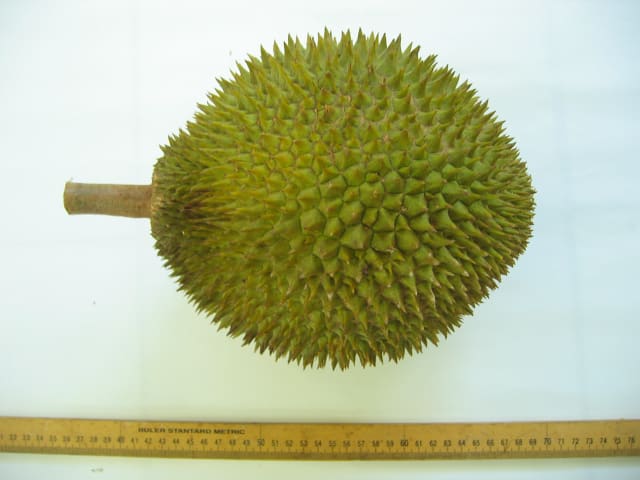
D24 is a medium-large durian, typically weighing between 1.5 and 3.0 kilograms. Its shape is distinctly elliptic -- more elongated than round, which helps distinguish it from rounder varieties at a glance.
The husk is light green in color and covered with fine, sharp thorns. The thorns are relatively uniform in size and distribution around the fruit, giving D24 a consistent, well-groomed appearance compared to varieties with more irregular spines.
One of D24's most notable physical characteristics is its thin shell. While this might seem like a minor detail, the thin husk is both a distinguishing feature and a practical consideration. It means D24 contains a higher flesh-to-shell ratio, but paradoxically, the thin shell actually makes the fruit harder to open cleanly. Experienced durian sellers know to handle D24 with care when splitting it, as the shell can crack unpredictably rather than separating along neat seams. By comparison, Musang King has a noticeably thicker shell that splits more predictably.
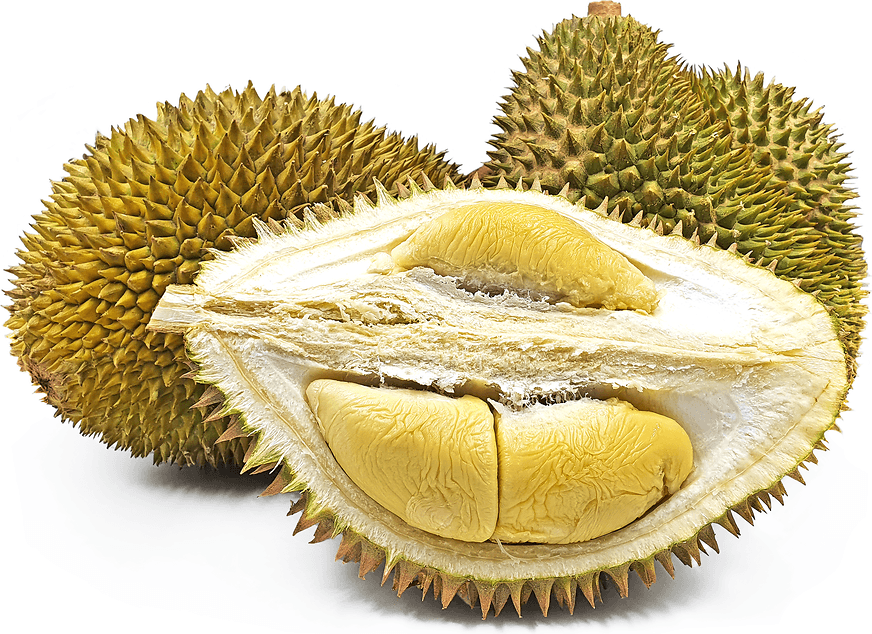
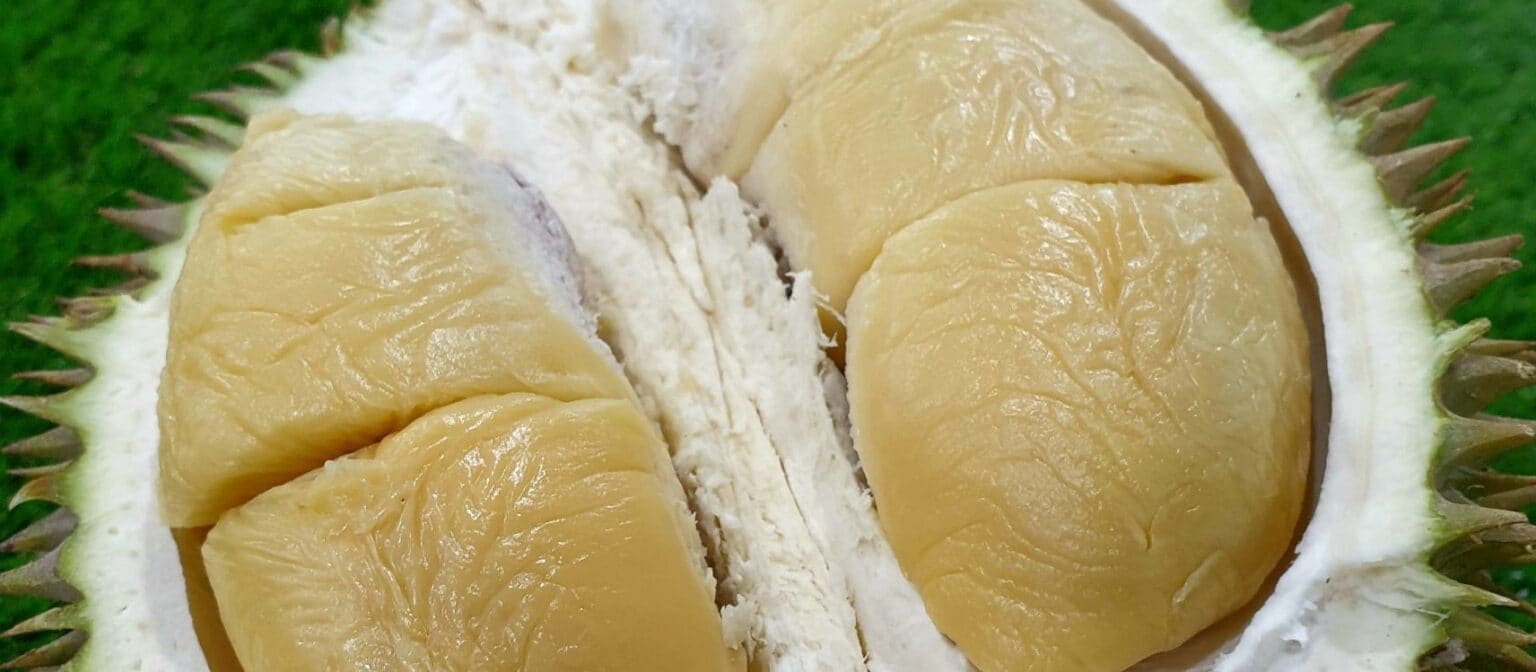
Inside, the flesh is thick and golden yellow, arranged in generous lobes around medium-sized seeds. The vibrant color of the flesh is one of the first things that catches the eye when a D24 is opened, and it remains one of the visual hallmarks of this variety.
Taste & Texture
D24's flavor profile is often described as the perfect balance of durian characteristics. The flesh delivers a harmonious combination of sweetness and moderate bitterness, tied together by a rich, fatty quality that Malaysians call "lemak." This creamy richness is central to D24's appeal and gives the flesh a satisfying, almost buttery depth.
Compared to Musang King, D24 is less intensely bitter. Where Musang King tends toward a sharp, assertive bitterness that polarizes opinions, D24 offers a gentler interplay between its sweet and bitter notes. This makes D24 more approachable for those who are newer to durian or who prefer a less confrontational flavor experience, while still providing enough complexity to satisfy dedicated durian enthusiasts.
The texture is creamy and smooth, with a consistency that is often compared to custard. The flesh holds together well but yields easily on the palate, without the fibrous or watery qualities found in lesser varieties. This smoothness, combined with the thick flesh and relatively small seed size, means each lobe delivers a generous and satisfying mouthful.
The aroma of D24 is strong and unmistakably durian, but it is not as pungent or overpowering as Musang King. For many people, D24 hits a sweet spot where the scent is inviting and rich without being overwhelming -- an important consideration in contexts like hotel rooms and shared spaces where durian's famously powerful smell can become an issue.
Over the decades of clonal propagation, several sub-varieties of D24 have emerged in the market, each with its own flavor emphasis:
- Sultan King (D24 Sultan) -- A premium-grade selection known for particularly refined flavor and texture.
- D24 XO -- Fruits that are left on the tree longer before harvest, developing a stronger, more fermented flavor with deeper complexity.
- Tan Sri XO -- Another premium sub-variant with enhanced flavor characteristics.
It is worth noting that these sub-varieties are not officially registered with the Department of Agriculture. They are market and orchard names used to describe D24 grown under different conditions or from different clonal lines, rather than genetically distinct varieties.
How to Identify
Identifying D24 among the many durian varieties available at a stall or orchard requires attention to several key features:
Shape: Look for an elliptic, slightly elongated form. D24 is not as round as some varieties and has a distinctive oval silhouette.
Husk color: The skin is light green, sometimes with a slightly yellowish tinge when very ripe. It does not have the brownish-green tones seen in some other varieties.
Thorns: D24's thorns are fine and sharp, with a relatively uniform distribution around the entire fruit. The consistency of the thorn pattern is a distinguishing trait -- varieties with irregular or coarse thorns are likely something else.
Shell thickness: If you can examine a cut fruit, note the thin shell. This is one of D24's most reliable identifying features. The husk wall is noticeably thinner than that of Musang King or other thick-shelled varieties.
Flesh color: Inside, the flesh should be a clear golden yellow -- not pale, not orange, but a warm, rich yellow. The lobes are thick and generously sized.
Size and weight: D24 typically falls in the medium-large range of 1.5 to 3.0 kilograms. Extremely large or very small fruits are less likely to be D24.
In practice, buying from a reputable seller remains the most reliable way to ensure you are getting genuine D24, especially since visual identification alone cannot account for every possible variety or mislabeling.
Availability & Pricing
D24 is one of the most readily available named durian varieties in Malaysia. Because it is the most widely planted named cultivar, it can be found at durian stalls, roadside sellers, and markets throughout the country during durian season. Its widespread availability is one of its greatest advantages as a variety -- while rarer cultivars may be difficult to source or require advance booking, D24 is almost always in stock when durians are in season.
In terms of pricing, D24 occupies a strategic position in the market. It typically sells for RM 20 to RM 45 per kilogram, depending on the region, the time of season, and the specific grade or sub-variety. This is significantly more affordable than Musang King, which commonly ranges from RM 45 to RM 65 per kilogram or higher. This price difference has made D24 the go-to choice for consumers who want a premium durian experience without the premium price tag.
D24's affordability and consistent quality have also made it the preferred variety for commercial durian products. It has been featured in a wide range of food and beverage applications, including one of the most notable: the McDonald's D24 McFlurry in Malaysia, which became one of the most successful limited-time durian products in the country's fast-food history. Beyond that, D24 is extensively used in pastries, ice cream, cakes, puffs, and other confections, where its balanced flavor and creamy texture translate well into processed formats.
For export, D24 was historically the primary variety shipped to Singapore and remains an important part of that trade. Its relatively lower cost compared to Musang King makes it attractive for bulk and commercial use in export markets.
Growing Regions
D24 is the most widely distributed named durian variety in Malaysia. While it originates from Bukit Merah in Perak, it has been propagated so extensively over the past nine decades that it can now be found in virtually every durian-growing state in Peninsular Malaysia.
The heaviest concentrations of D24 plantations are in:
- Perak -- The home state of D24, where it remains a dominant variety. The region around Bukit Merah and the broader Kinta Valley have long been centers of D24 production.
- Pahang -- One of Malaysia's largest durian-producing states, with significant D24 acreage alongside Musang King and other varieties. The Raub and Bentong districts are particularly well-known for quality durian cultivation.
- Johor -- The southernmost state of Peninsular Malaysia, where D24 benefits from proximity to the Singapore market, a major destination for the variety.
- Penang -- The northern island and mainland state where D24 has been cultivated for decades, particularly in the Balik Pulau area on the island's western side.
Beyond these primary regions, D24 can be found in Kedah, Kelantan, Terengganu, Negeri Sembilan, Selangor, and Melaka. Its adaptability to different growing conditions across the peninsula is one reason for its widespread adoption. D24 trees are generally considered reliable producers, which has encouraged planting across a range of elevations and soil types.
Fun Facts
The original premium durian. For Malaysians over the age of 40, D24 was likely their introduction to the concept of a "premium" durian. Before the Musang King era, ordering D24 at a durian stall was the mark of a discerning eater. It defined the gold standard of durian quality for an entire generation.
The nickname "Sultan." D24 earned the title "Sultan" due to its former status as the most prestigious durian variety available, with associations to Malay royalty and high-end consumption. While the nickname is well-known, it is distinct from the sub-variety "Sultan King" (D24 Sultan), which refers to a specific premium grade of D24.
A parent of future varieties. D24's genetic legacy extends beyond its own fruit. Through MARDI's breeding programs, D24 has contributed its DNA to several hybrid varieties, including D144 (a cross between D24 and D7), D188, D189, and D190. This makes D24 not just a commercial powerhouse but a foundational building block for the future of durian cultivation.
The thin shell paradox. D24's thin shell gives it a better flesh-to-husk ratio than many varieties, meaning you get more edible fruit per kilogram of weight. However, that same thin shell makes it one of the trickier durians to open neatly -- a test of skill for any durian seller.
One of the oldest registered varieties. With its 1937 registration, D24 is among the very first durians to be formally documented in Malaysia's national registry. It has been continuously cultivated for nearly nine decades, an extraordinary track record for any fruit variety.
No official name. Despite being one of the most famous durians in the world, D24 has no registered name. The Department of Agriculture registry simply lists it as "Tiada" (none). It is known everywhere simply by its code number -- proof that in the world of Malaysian durians, a number can be more famous than any name.
The McFlurry connection. When McDonald's Malaysia launched a D24 McFlurry as a limited-time offering, it became one of the chain's most talked-about seasonal products. The choice of D24 over Musang King or other varieties was a testament to D24's balanced flavor, which translates well into blended and frozen formats, and its commercial viability at scale.
A durian purist's choice. To this day, some experienced durian eaters actively prefer D24 over Musang King. Their reasoning is straightforward: D24 offers a more balanced, harmonious flavor without the aggressive bitterness that defines Musang King. For these purists, D24 represents what durian is supposed to taste like -- rich, complex, and perfectly composed.