

D2 Data Nina
Overview
D2 Data Nina holds a distinction that no amount of modern breeding can replicate: it is the second durian variety ever registered in Malaysia. Catalogued in 1934 alongside D1, it belongs to the very first cohort of durians to receive formal documentation under the Jabatan Pertanian (Department of Agriculture) registry system that continues to this day. More than 200 varieties have been registered since then. Data Nina was there at the beginning.
The variety originates from Ayer Molek in Melaka, and its registration marks a moment when colonial-era agricultural administrators began the methodical work of identifying, naming, and documenting the durian cultivars that Malay farmers had been growing for generations. Data Nina is not a modern creation engineered for yield or market appeal. It is a snapshot of what durian cultivation looked like in early twentieth-century Malaya -- a heritage variety that has survived nine decades while the industry around it transformed beyond recognition.
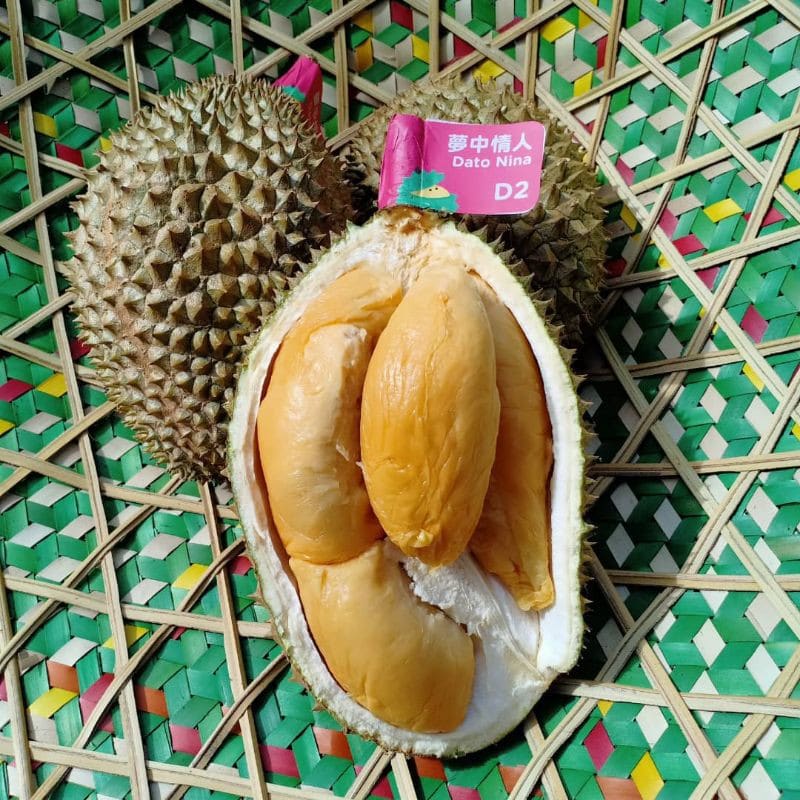
In the Chinese-speaking durian community, D2 carries an evocative nickname: meng zhong qing ren, which translates to "Dream Lover." The origin of this romantic name is unclear, but it has stuck, and sellers in Melaka, Penang, and Singapore use it readily. The fruit itself is known for a bittersweet flavor profile, orange-yellow flesh, and a notoriously difficult-to-open husk that frustrates even experienced durian sellers. It ripens earlier than most popular varieties, typically appearing in late June to July, and its supply is extremely limited. Data Nina is a durian you find by luck or by knowing the right people -- not by browsing the stalls at peak season.
Origin & History
To understand D2 Data Nina, you have to understand what was happening in Malaya in 1934. The country was not yet Malaysia. It was a patchwork of British colonial territories: the Federated Malay States, the Unfederated Malay States, and the Straits Settlements. The global economy was still recovering from the Great Depression, and Malaya's rubber industry -- the backbone of the colonial economy -- was operating under the International Rubber Regulation Agreement, which had been introduced that same year to prop up export prices.
Agriculture in colonial Malaya was overwhelmingly oriented toward export commodities: rubber, tin, and to a lesser extent palm oil. The colonial administration viewed local food crops -- rice, fruit, vegetables -- primarily as sustenance for the labor force that worked the rubber estates and tin mines. The Jabatan Pertanian existed within this framework, and its work on fruit crops, including durian, was a relatively minor part of its mandate compared to the attention lavished on rubber research.
Yet someone in the department had the foresight to begin cataloguing durian varieties. In 1934, the Jabatan Pertanian registered two durians: D1, from Hulu Langat in Selangor, and D2, from Melaka. These two entries represent the beginning of what would become the world's most comprehensive durian registry. The D-numbering system established that year -- a simple sequential code assigned to each registered cultivar -- remains in use today, now stretching past D200.
D2 was registered from Melaka, with its mother tree reportedly located in the Ayer Molek area. The registration was submitted by the Jabatan Pertanian itself, classified under the "Jabatan/Agensi" reporter type, meaning it was an institutional submission rather than a private individual's. This suggests that department officers identified the tree during fieldwork or surveys, rather than a farmer bringing a specimen forward for recognition.
The name "Data Nina" (sometimes written as "Dato Nina" or "Dato' Nina") is itself a small historical mystery. "Dato" or "Datuk" is a Malay honorific title, roughly equivalent to a knighthood, conferred for service or status. "Nina" is not a traditional Malay name, which has led to considerable speculation about the person behind the durian.
One account, discussed in Malaysian forums and attributed to the Sejarah Tun Sri Lanang (the Malay Annals), suggests that Data Nina was a princess during the reign of Sultan Mansur Shah of Melaka who had an interest in agriculture and horticulture. According to this version, she refused an arranged marriage, was stripped of her royal title, but was granted the honorific "Dato" in recognition of her contributions to local cultivation. The durian variety was then named after her. However, this account is unverified and has been met with skepticism by historians who note that "Nina" does not appear in the naming conventions of that period. The truth is that the identity of the original Data Nina has been lost to time. The name endures; the person behind it does not.
What we can say with certainty is that D2 represents an era when durian cultivation in Melaka was already well-established enough to produce distinctive, recognizable varieties. The fact that the Jabatan Pertanian saw fit to register it suggests that Data Nina was already locally notable -- a tree known in its community for producing fruit of particular quality or character.
Appearance
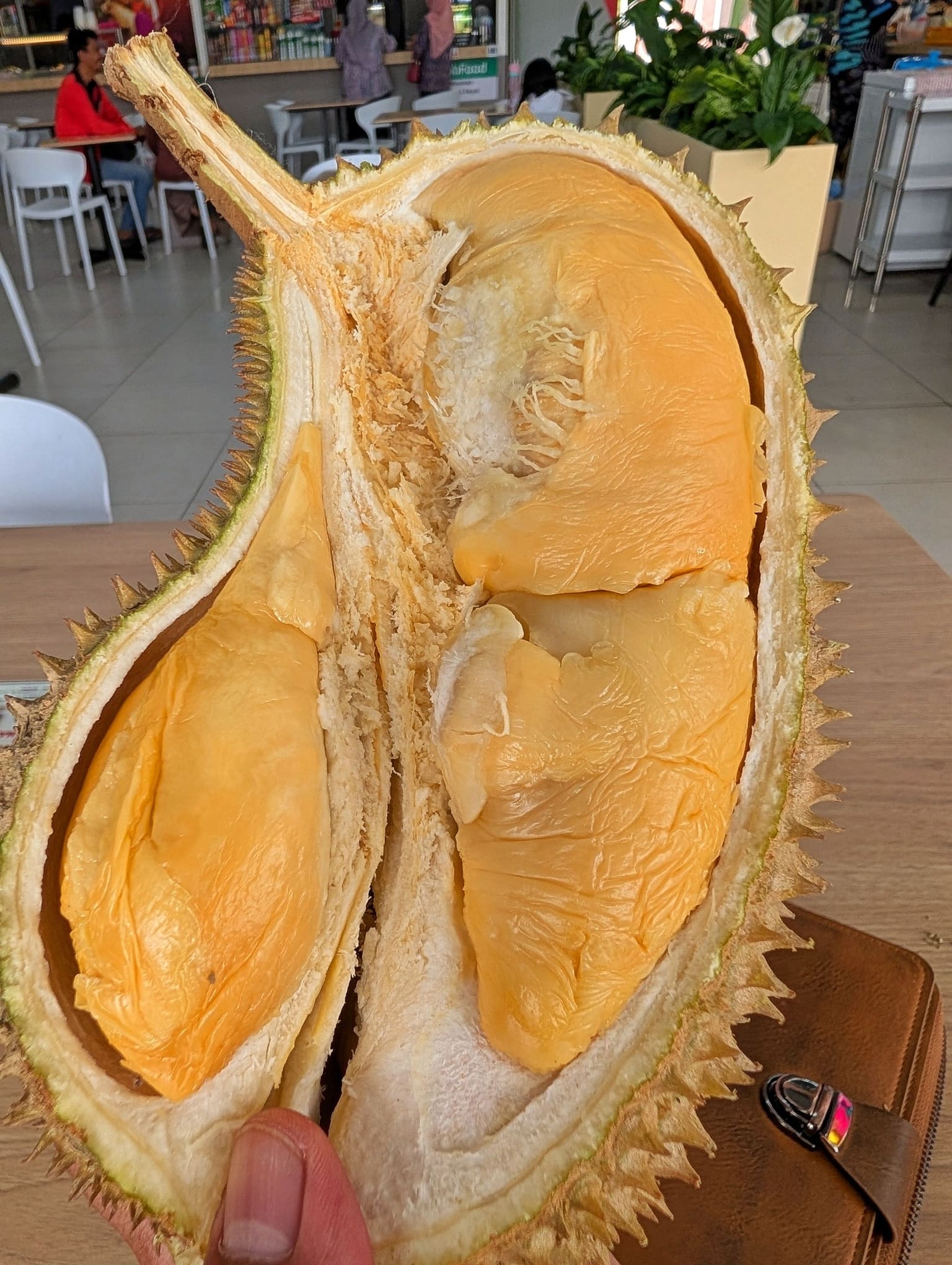
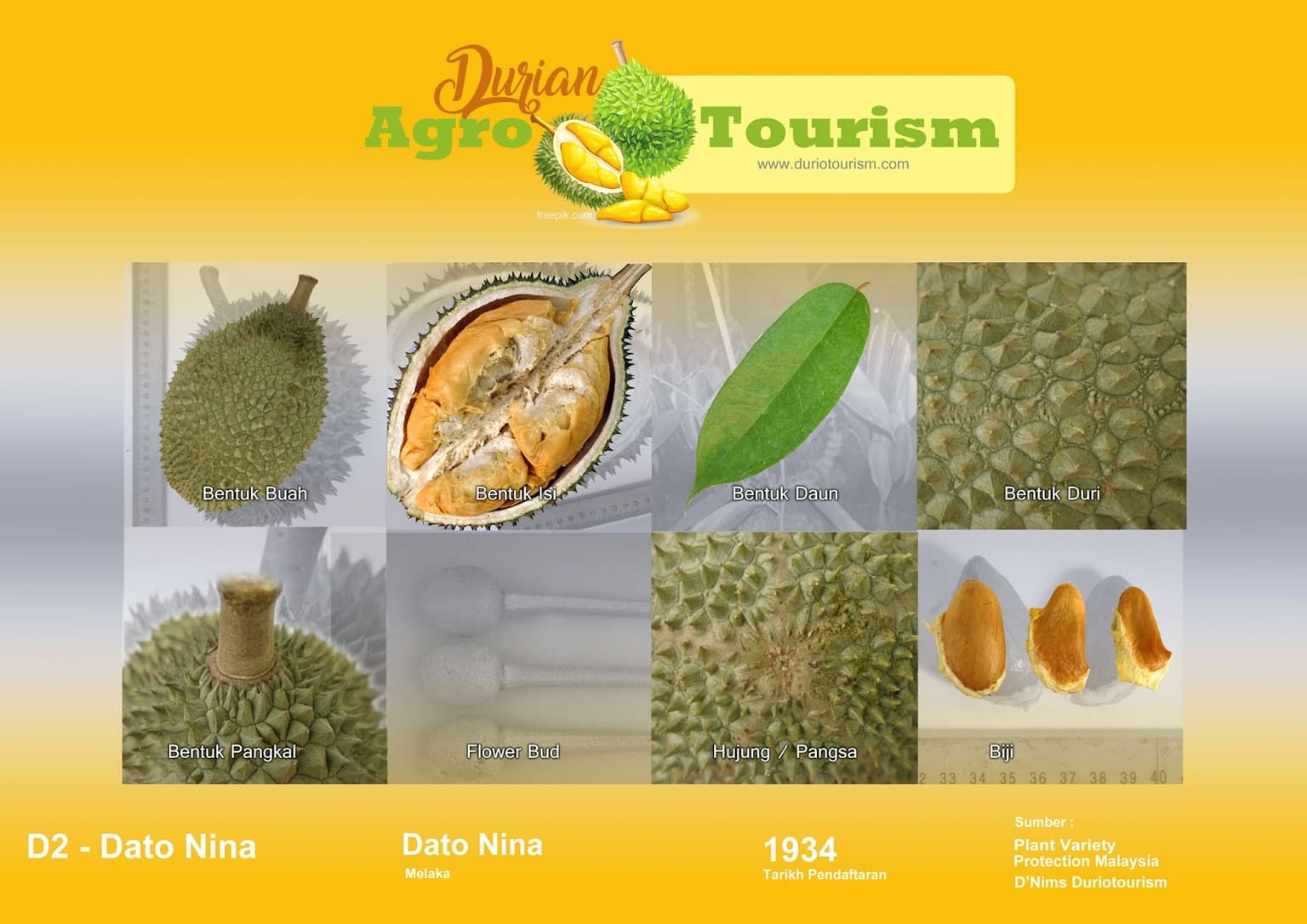
Data Nina is a medium-large durian, with individual fruit typically weighing between 1.5 and 2.5 kilograms. The DOA description records it as greenish-brown in color (hijau keperangan), with short thorns (duri pendek), a short thick stem (tangkai pendek dan saiz tangkai besar), and thin shell (kulit nipis).
The shape is where Data Nina becomes distinctive. Trees grown from grafted stock -- clones of the original mother tree -- produce fruit that is notably kidney-shaped or pear-shaped, with the top narrower than the broader base. This lopsided, asymmetric form is one of the variety's most recognizable visual signatures. Seedling-grown trees, by contrast, produce rounder fruit, but these are not considered true to the original cultivar. Among enthusiasts, the kidney-shaped grafted specimens are the ones worth seeking out, as they represent the genuine clone.
The thorns are short, concave, and slightly hooked, with a notably uniform size from top to bottom -- a pattern that has been compared to the thorn arrangement on D175 (Red Prawn). The husk color is a muted green that can take on brownish tones, and from a distance, some have noted a passing resemblance to Musang King's color profile, though the shape is entirely different.
Despite having thin shell walls, Data Nina is notoriously difficult to open. The DOA description explicitly rates the difficulty of opening the shell as "sukar" (difficult). The core of the fruit is held together extremely tightly, and even experienced durian sellers who crack dozens of fruits a day report struggling with D2. This is one of the paradoxes of the variety: the shell is thin, but the structural integrity of the husk is formidable.
Taste & Texture
The DOA's official description records Data Nina's flavor as "lemak manis" -- creamy sweet. This is accurate as far as it goes, but it does not capture the full complexity of the variety's taste profile as described by those who have eaten it.
The defining characteristic of Data Nina's flavor is a balance of sweetness and bitterness. Multiple sources describe the taste as bittersweet, with the two elements present in nearly equal measure. This is not the aggressive bitterness of Musang King, nor is it the pure sweetness of varieties like D88 or D24. It occupies a middle ground -- a refined, measured interplay between sweet and bitter that has been described as "cultured" and even "elegant." One reviewer compared the experience to eating a premium cut of steak: nothing about it is loud or showy, but every element is in its proper place.
The flesh is orange-yellow in color, consistent with the DOA description of "jingga kekuningan." The pulp has a wrinkled surface with thin skin around each segment, and the fruitlets tend to stick to the pod walls, which can make for a messy presentation. This is a durian where the eating experience matters more than the visual one.
Texture is smooth and creamy, with a slight fibrous quality that is unusual among modern premium varieties. The fibers give the flesh a bit of resistance when you bite into it, requiring you to chew rather than simply letting it dissolve on the tongue. Some tasters find that this fibrousness actually enhances the experience by prolonging the release of flavor with each mouthful.
Each side of the husk typically contains only two elongated pulp segments, which means the flesh-to-seed ratio is modest compared to modern commercial varieties bred for maximum flesh. Data Nina is not a meaty durian -- you eat it for the taste, not the volume. The seeds are medium-sized, with some sources reporting a high proportion of empty seeds (kesep), which works in the eater's favor.
The aroma is moderate by durian standards -- present but not overpowering. This gentler scent profile, combined with the bittersweet flavor, gives Data Nina a character that is sometimes described as being closer to traditional kampung (village) durian than to the intensely aromatic modern cultivars.
How to Identify
Identifying Data Nina in the market requires attention to a few key features, though the variety is rare enough that encountering it at all is the main challenge.
Shape. The kidney or pear shape is the primary visual marker for grafted specimens. Look for an asymmetric fruit where the top is noticeably narrower than the base. Rounded specimens are likely from seedling trees and may not represent the true cultivar.
Thorns. Short, concave, slightly hooked thorns of uniform size across the entire fruit. The thorn pattern is distinctively even, without the variation in size that many other varieties display.
Husk color. Greenish-brown, sometimes described as a muted green that shades toward bronze. Not a vivid green.
Stem. Short and thick -- the opposite of varieties like Kan Yau (D158) with their elongated stems. The stem on Data Nina is stubby and robust.
Size. Medium-large, generally 1.5 to 2.5 kilograms. Not the largest durian at the stall, but not small either.
Difficulty opening. If a seller is visibly struggling to crack the fruit despite it having a thin shell, that is consistent with Data Nina's reputation as one of the hardest durians to open.
Flesh color. Orange-yellow, not the pale yellow of D24 or the deep golden tone of Musang King. A warm, slightly dull orange with a yellow undertone.
Availability & Pricing
Data Nina is a rare durian in the current market. It has been largely displaced by modern commercial varieties, and the number of trees in active production is small. This is not a variety you will find stacked in piles at roadside stalls during peak season.
The fruit ripens earlier than most popular clones, typically appearing in late June to July. This early-season window means that Data Nina arrives before the main durian rush, when stalls are still getting set up for the season. Supplies are extremely limited and tend to sell out quickly. Enthusiasts who know the variety often pre-order from specific sellers or orchards to secure their allocation.
When available, D2 is relatively affordable by premium durian standards. Prices historically range from RM 10 to RM 25 per kilogram, which places it well below Musang King and Black Thorn territory. In Singapore, where the variety occasionally appears, prices have been noted at SGD 6 to 12 per kilogram. The low price reflects the reality that Data Nina lacks the brand recognition and market demand of newer premium varieties, not that the fruit is inferior in quality.
Commercially, Data Nina is considered unattractive by orchard operators. The trees flower prolifically but set limited fruit, resulting in low yields. Combined with the lack of consumer demand driven by brand awareness, this means few farmers have incentive to plant new D2 trees. The economic logic that drives Malaysian durian agriculture -- high yield, strong brand, premium price -- works against heritage varieties like Data Nina. Saplings are still available through nurseries (including online platforms like Lazada), suggesting that some hobbyist and small-scale planting continues.
Growing Regions
Melaka is the home state of Data Nina, with the original mother tree reportedly in the Ayer Molek area. Melaka remains the region most associated with the variety, and this is where buyers have the best chance of finding D2 during the early season.
Penang has sporadic availability of Data Nina, particularly in areas with older orchards that still maintain heritage varieties.
Perak is another state where D2 has been reported, again linked to older plantings rather than new commercial cultivation.
Beyond these three states, Data Nina's distribution is negligible. It is not widely grown in the major durian-producing states of Pahang or Johor, where modern commercial varieties dominate. The variety's survival is essentially tied to old trees and small-scale growers who maintain it out of personal preference or tradition rather than commercial calculation.
Fun Facts
Second in a dynasty of two hundred. D2 Data Nina and D1 (from Selangor) were registered in the same year, 1934, making them the founding entries in what is now a registry of more than 200 durian cultivars. Every D-numbered durian that followed -- from D24 to D197 Musang King to D200 Black Thorn -- belongs to a system that began with these two.
A colonial-era time capsule. The registration of D2 in 1934 places it squarely in the colonial period, when the Jabatan Pertanian operated under British administrative structures. The same year saw the introduction of the International Rubber Regulation Agreement, reflecting how rubber -- not fruit -- dominated the agricultural agenda. That durian was being catalogued at all shows a quiet commitment to documenting local food heritage even during an era focused on export commodities.
The Dream Lover. In Chinese-speaking durian circles, D2 goes by the poetic name meng zhong qing ren, meaning "Dream Lover." The origin of this nickname is unknown, and no one has been able to trace exactly when or why it was first applied. Sellers sometimes describe D2 with the phrase "tian zhong dai ku" -- bitterness in the midst of sweetness -- which could be read as both a literal tasting note and a poetic reflection worthy of the name.
The mystery of the name. Who was Data Nina? One popular account links the name to a princess of the Melaka Sultanate during the reign of Sultan Mansur Shah, who supposedly defied an arranged marriage and was granted the honorific "Dato" for her contributions to agriculture. This story, while colorful, is unverified and debated. What is not debated is that the name has endured for nine decades while the person behind it has been completely forgotten.
Grafted versus seedling. Data Nina produces visibly different fruit depending on how the tree was propagated. Grafted trees -- clones of the original -- yield the distinctive kidney-shaped or pear-shaped fruit that enthusiasts prize. Seedling-grown trees produce rounder fruit that is generally considered less desirable. If you see a lopsided D2, that is actually a good sign: it means you are eating a true clone.
Notoriously stubborn. Despite having thin shell walls, Data Nina is considered one of the hardest durians to crack open. The core is held together so tightly that even professional durian sellers, who open hundreds of fruit per season, report difficulty with this variety. The combination of thin shell and extreme structural resistance is unusual and somewhat paradoxical.
An early riser. Data Nina typically ripens in late June to July, arriving before many popular varieties hit their peak. This early-season timing gives it a brief window of availability before the market fills with Musang King, D24, and other mainstream varieties. For those who know to look for it, this is the brief annual moment when the Dream Lover appears.