

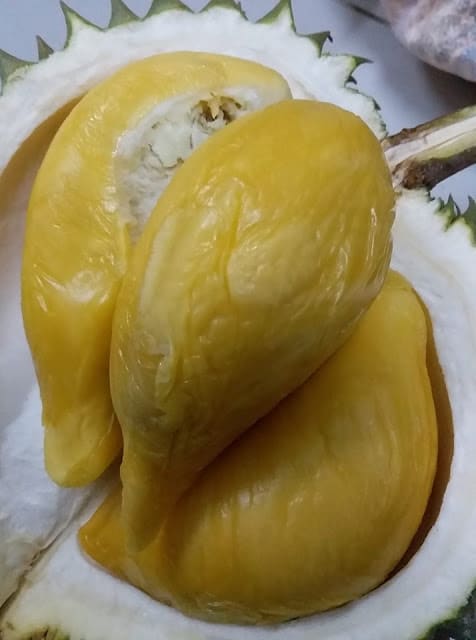
D145 Tuan Mek Hijau (Beserah)
Overview
D145 Tuan Mek Hijau is a heritage durian variety from Beserah, a fishing village on the coast of Kuantan, Pahang. Registered in 1981, it is one of the earlier varieties to enter the Department of Agriculture's official registry, predating household names like Musang King (D197, registered 1993) and Black Thorn (D200, registered 2008) by over a decade.
Known locally as Durian Beserah, Durian Hijau, or Durian Tuan Mek, the variety is distinguished by its green husk that remains green even at full ripeness, its large round fruit, and its creamy sweet flesh. Among Chinese-speaking communities, it is sometimes referred to by the descriptive name Cheh Poay or Cheh Kak (Hokkien for "green skin" or "green shell"), though this name can cause confusion with D165 Green Skin 15, a separate variety.
D145 occupies an unusual position in the Malaysian durian landscape. It is highly regarded by those who have tasted it - some enthusiasts and even the New Straits Times have described it as comparable to Musang King - yet it remains almost unknown outside Pahang. Its story is one of local pride, royal patronage, and quiet decline in the shadow of more commercially dominant varieties.
Origin & History
The story of D145 is rooted in Beserah, a small coastal town located approximately 10 kilometers north of Kuantan, the capital of Pahang. Beserah is primarily known as a fishing village - its economy revolves around the sea, with dried fish, anchovies, belacan (shrimp paste), and keropok lekor (fish crackers) as its signature products. But the people living on the landward side of the village have long depended on rubber and durian cultivation.
It was from this community that D145 emerged. On 30 October 1981, an individual named Khidzir Engku Ali registered the variety with Malaysia's Department of Agriculture (DOA). Not much is publicly known about Khidzir Engku Ali, though he has been described as a former village chief (ketua kampung) of Beserah. The "Engku" in his name is a Malay title associated with minor nobility, common in Pahang's east coast communities.
The registered name, Tuan Mek Hijau, is a compound of Malay words: "Tuan" is an honorific meaning "Sir" or "Mr.," "Mek" is a personal name or familiar form of address common in east coast Malay communities (particularly Kelantan and Pahang, where "Mek" can serve as a nickname or short form), and "Hijau" means "green," referring to the fruit's persistently green husk. The full name thus translates roughly to "Sir Mek the Green" or "Mr. Mek Green." It likely refers either to the original tree's owner or to a local figure associated with the mother tree, though the precise identity of "Tuan Mek" is not well documented. Like many heritage durian names in Malaysia, the story behind the name exists in local oral tradition rather than written record.
The variety became famous in the 1970s, before its formal registration. Legend has it that D145 was so prized at its peak that the Sultan of Pahang himself requested that all harvests from the original trees be sent to the palace. Whether fully accurate or embellished over time, this story reflects the esteem in which Beserah's durian was held - a village fruit elevated to royal status.
D145's origins on the Pahang coast are notable because Pahang's durian reputation today is dominated by the inland highland town of Raub, the heartland of Musang King production. Beserah, by contrast, is a low-lying coastal settlement, representing a very different growing environment. D145 is a product of that coastal Pahang terroir - the soil, humidity, and conditions of the Kuantan district - rather than the cooler, hillier terrain that produces Pahang's most famous export.
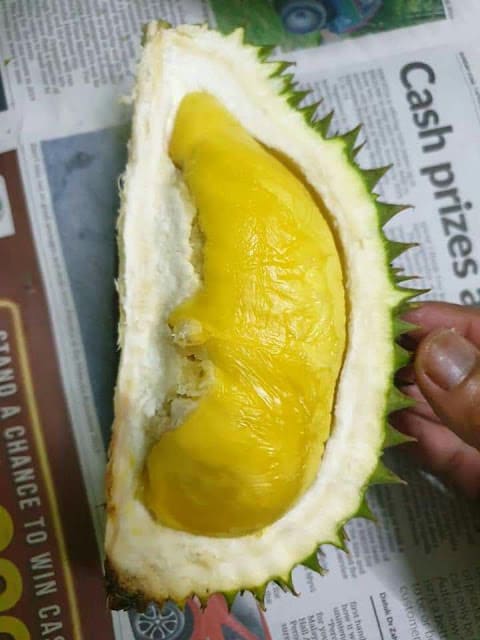
Appearance
D145 is a large durian. The DOA registry describes the fruit as "bersaiz besar" (large-sized), and individual fruits typically weigh between 1.5 and 3 kilograms, with some specimens reportedly reaching higher. It has a rounded shape (bulat), sometimes slightly lopsided or kidney-shaped, with a relatively compact, squat profile.
The most immediately recognizable feature is the husk color. D145 ripens green - a fresh, homogeneous green that persists even at full maturity. This is the trait that gives the variety its "Hijau" (green) descriptor and its various "green skin" nicknames. The thorns are coarse and somewhat bent inward, with brown-tipped ends, and they tend to be thick and lengthy compared to some other varieties.
The shell is of medium thickness, measured at approximately 0.85 centimeters according to documented evaluations. The fruit typically measures 15 to 19 centimeters in both length and diameter, with a flat shoulder and a relatively flat base.
When opened, the flesh is yellow - the DOA describes it as "berwarna kuning" - and it is medium-thick (sederhana tebal). Some sources describe the flesh color as ranging from bright yellow to golden-yellow, occasionally with slight reddish tones. The fruitlets have been described as "puffy" and oversized in appearance, filling the compartments generously.
The seeds are medium-large with full seed presence. According to detailed evaluations, approximately 78.9% of seeds are fully developed, 15.8% are partially full, and only 5.3% are empty. Each segment typically contains around 4 lobes. This high rate of full seeds means less occurrence of the vestigial seeds (biji kesep) that some consumers prefer, but it also means the fruit's compartments are well-structured and consistently filled.
Taste & Texture
The DOA registry describes D145's flavor as "lemak manis" - literally "fatty sweet" or more naturally translated as "creamy sweet" - with a smooth texture (bertekstur halus). This official description captures the variety's fundamental character, but enthusiast accounts add considerably more detail.
The primary impression is sweetness. D145 is a predominantly sweet durian, which makes it more approachable than varieties like Musang King that feature prominent bitterness. However, the sweetness is not one-dimensional. Multiple sources note a hint of bitterness that emerges beneath the sweetness, along with subtle alcoholic and floral notes. One detailed review described it as having "a cultured taste" - a phrase that captures the layered quality without overstating the complexity.
The texture is where D145 particularly excels. The flesh is fine-grained and smooth, with a tenderness and slight stickiness that enthusiasts find compelling. It has been described as creamy and soft, with a quality that draws the taster back for another piece almost by instinct. Unlike some varieties that are pasty or dry, D145 offers a moist, yielding consistency.
The aroma is notably mild compared to many durian varieties. This lower intensity of smell makes D145 more approachable for those who find the pungent aroma of varieties like Musang King overwhelming. The DOA registry notes a "medium" aroma, and practical accounts confirm that D145 does not fill a room the way some stronger-scented varieties do.
Some durian enthusiasts have compared D145 favorably to Mas Selangor in its approachable sweetness, while noting that it appeals particularly to those who prefer a less pungent, more gently flavored durian experience. For those seeking intensity and bitterness, D145 may lack the dramatic impact of Musang King. But for those who appreciate subtlety, creaminess, and clean sweetness, it delivers a refined eating experience.
How to Identify
Identifying D145 among other durian varieties relies on several distinctive markers:
Green husk at ripeness. This is the most reliable external identifier. While many durians have greenish husks when unripe, D145 maintains a fresh, vivid green color even when the fruit is fully ripe and ready to eat. If a large, round durian retains its bright green husk at maturity, D145 should be a strong candidate.
Round shape. D145 has a distinctly round (bulat) profile, sometimes slightly lopsided. It lacks the elongated or obovate shape of varieties like Musang King. The overall impression is compact and spherical.
Large size. The fruit is large, typically 1.5 to 3 kilograms. Combined with its round shape, it has a substantial, heavy feel in the hand.
Coarse, inward-bent thorns. The thorns are thick and somewhat bent inward, with brownish tips. They are not as sharply pyramidal or widely spaced as Musang King's thorns.
Yellow flesh. When opened, the flesh should be yellow - not pale white, not deep orange. The tone is a clear, honest yellow, occasionally tending toward golden.
Smooth, creamy texture. The flesh should feel fine-grained, smooth, and slightly sticky rather than fibrous, watery, or dry.
Sweet flavor with mild aroma. The taste should be predominantly creamy sweet, with a moderate rather than overpowering smell. If the durian has a strong bitter punch or an intense aroma, it is likely a different variety.
Availability & Pricing
D145 is a rare durian in the contemporary Malaysian market. It seldom makes its way out of Pahang, and even within the state, it can be difficult to procure outside of the Kuantan and Beserah area during season.
The harvest season for D145 typically falls in the middle of Malaysia's main durian season, with July being the peak month. This mid-season timing means it overlaps with more prominent varieties, which further limits its market visibility.
Pricing for D145 has been reported in the range of RM 30 to RM 60 per kilogram, depending on the source and the year. A 2021 report cited RM 30 to RM 35 per kilogram, while a 2023 New Straits Times article indicated prices of RM 40 to RM 60 per kilogram for particularly sought-after specimens. This is lower than peak Musang King pricing but represents a significant premium over common varieties, reflecting D145's scarcity and the esteem in which it is held locally.
The variety is not widely available in durian stalls outside Pahang. It is not a standard offering in the way that Musang King, D24, or D101 are at urban durian sellers in Kuala Lumpur or Penang. Occasionally, it appears in Penang's durian scene, where one platform has rated it 4.2 out of 5 based on over 150 ratings, but these are the exceptions. In Beserah itself, demand is strong enough that wealthy patrons - including, by local account, royalty and politicians - make advance reservations for the harvest.
Saplings of D145 are available through online nurseries, marketed as a rare heritage variety, indicating that there is interest in expanding its cultivation. However, commercial scaling remains limited.
Growing Regions
D145 is primarily associated with the Kuantan district of Pahang, specifically the Beserah area. The DOA registry notes that D145 (Beserah) is "suitable for planting in the District of Kuantan, Pahang," and this remains its core growing region.
The Beserah area is low-lying and coastal, quite different from the hilly inland terrain of Raub where Musang King thrives. The orchards around Beserah sit on land adjacent to the fishing village, where the soil and climatic conditions of the east coast - warmer temperatures, higher humidity, proximity to the sea - produce a distinct growing environment. This coastal terroir is part of what gives D145 its particular character.
However, the orchards in and around Beserah have faced serious threats. The 2015-2016 bauxite mining disaster in Kuantan had devastating effects on the area's agricultural land. Roads leading to durian orchards were badly damaged, rivers were polluted, and the soil of local orchards was tainted by mining runoff. Durian yields dropped sharply - where a single tree could previously produce 200 to 300 fruits per season, yields fell to approximately 100 fruits. Farmers like Ahmad Rizal Jaafar and Wan Udani Wan Ahmad, quoted in Malay Mail reporting, expressed concern that the unique Beserah durian variety could face extinction.
Adding to the pressure, newer generation farmers in the region have tended to prefer planting Musang King and Black Thorn - the varieties that command the highest market prices - over maintaining heritage D145 trees. This economic logic is understandable but means the pool of D145 trees is not being replenished.
A small but significant detail: Beserah's D145 trees are mostly non-cloned specimens, meaning individual trees may carry their own distinct sub-characteristics. This genetic diversity is a form of agricultural heritage, but it also makes the variety more vulnerable - once these old trees are gone, their specific qualities cannot be replicated.
Fun Facts
- The Sultan of Pahang's reported preference for D145 during the 1970s is one of the variety's most frequently told stories. While the details are difficult to verify independently, the tale of royal patronage has become part of Beserah's local identity and reflects the genuine esteem in which D145 was once held.
- Beserah is one of the few places in Malaysia where a fishing village is also known for a premium durian variety. The dual identity - fisherfolk by the sea, durian growers on the land - gives D145 an unusual cultural context that most durian varieties lack.
- D145 was registered in 1981, making it one of the older entries in the DOA registry. For comparison, many of today's most popular varieties were registered in the 1990s or later. D145 has been officially documented for over four decades.
- The "Engku" title in the reporter's name (Khidzir Engku Ali) is a hereditary title common among families with connections to Malay royalty in Pahang and other east coast states. This adds an interesting social dimension to the variety's registration - it was brought to the DOA by someone with roots in the local nobility.
- The bauxite mining crisis of 2015-2016 in Kuantan is one of the most serious environmental disasters to affect Malaysian agriculture in recent decades. Its impact on D145 orchards is a concrete example of how industrial activity can threaten heritage crop varieties that exist in limited geographic areas.
- Despite its scarcity, D145 continues to generate interest. Saplings are sold through online platforms like Shopee, often marketed as "super rare" or "heritage" durian, suggesting that a new generation of growers sees value in preserving and propagating the variety.
- D145's mild aroma makes it one of the more "approachable" durian varieties - a potential advantage in markets where the strong smell of durian is a barrier to broader acceptance.
- The New Straits Times ran articles in 2023 describing Durian Beserah as "comparable to Musang King" and "knocking on the doors of other elite varieties in Malaysia," signaling renewed media interest in this long-overlooked variety.