

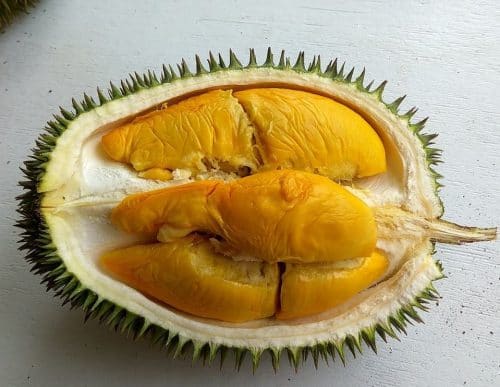
Overview
D168 is one of Malaysia's most widely consumed premium durians - and also one of its most misunderstood. Officially registered as Durian Mas Hjh. Hasmah, this Johor-born variety is the fruit that most Malaysians know as "D101" or "IOI." It delivers golden-orange flesh with a sweet, creamy, vanilla-inflected flavor at a fraction of the price of Musang King, making it arguably the best value proposition in the entire Malaysian durian market.
The variety carries a remarkable number of names. Depending on where you are and who you are talking to, it may be called IOI, Mas Muar, Mas Johor, Hajah Hasmah, Buaya Emas (Golden Crocodile, in the northern states), or Wang Zhong Wang (King of Kings, in Chinese-speaking markets). Its official DOA code, D168, is ironically the least commonly used identifier of all. And the name most Malaysians use for it - "D101" - actually belongs to a completely different variety. That confusion has its own fascinating backstory, which is covered in detail in the D101 (Bangkok Tree 16) profile.
What matters here is the durian itself. Behind the naming chaos is a genuinely excellent fruit with a compelling origin story, consistent quality, broad availability, and a price point that makes it accessible to nearly everyone.
Origin & History
The story of D168 begins in a home garden in Muar, Johor. Hajah Hasmah Haji Hashim grew a durian tree in her yard that produced fruit of exceptional quality - sweet, creamy, with a distinctive golden-orange flesh that stood out from the common seedling durians of the area.
According to local accounts, Hajah Hasmah faced a persistent problem with squirrels raiding her durian tree during fruiting season, destroying much of the harvest. She enlisted a neighbor to help deal with the squirrel problem, and in exchange, she offered him seeds and cuttings from her prized tree. The neighbor successfully propagated the variety, and the resulting trees produced fruit with the same outstanding characteristics as the original. Word spread among local growers, and by 1987, Hajah Hasmah had begun selling fruit and planting material from her tree.
The quality of the fruit caught the attention of agricultural authorities. On 24 May 1989, the variety was officially registered with the Department of Agriculture under the code D168 and the name Durian Mas Hjh. Hasmah. The DOA description records it as a medium-large fruit, round in shape, greenish-brown in color, with a short small stem averaging 4 cm in length, an average weight of 1.5 kg per fruit, and easy to open. The flesh is described as firm, orange-yellow in color, medium-thick, with medium-large segments, and a taste that is lemak manis (rich-sweet) with slight bitterness.
Of the twelve durian varieties registered from Johor, D168 is widely considered the most prestigious. It has earned its place through consistent quality and broad commercial appeal rather than through marketing hype or astronomical pricing.
The name "IOI" came later, when the variety became popular at stalls around IOI Mall in Kulai, Johor. Sellers wrote "DIOI" (Durian IOI) on their signage, which customers misread as "D101." That misreading became entrenched in the market and has persisted for decades. For the full account of how this confusion unfolded and why it has proven impossible to correct, see the D101 profile. Here, it is enough to note that D168 is the true identity of the durian that most of the market calls "D101."
Appearance
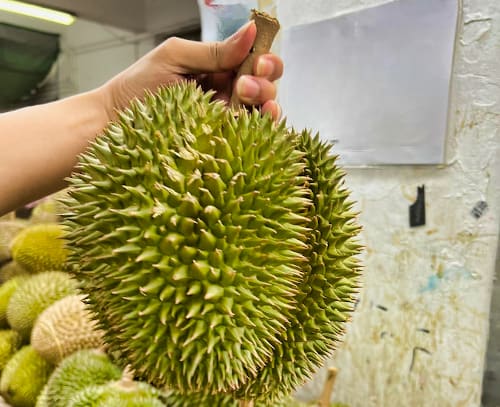
D168 is a medium-sized durian, typically weighing between 1.3 and 2.5 kilograms, with most fruit falling in the 1.5 to 2.0 kg range. The shape is round to slightly oval - the DOA description uses "bulat" (round), which distinguishes it from the more elongated forms of varieties like Musang King or D24.
The husk is greenish-brown at maturity, covered in dense, sharp thorns that are notably inconsistent in size and direction. D168 is one of the spikiest durians around - the thorns are extremely sharp and closely packed, giving the fruit a somewhat fuzzy, aggressive appearance. The stem is short and stocky, averaging about 4 cm in length, with a roughly consistent diameter throughout. This stocky stem is one of the more reliable identification features.
The base of the fruit typically shows a bald, indented star-shaped pattern where the lobes converge.
One practical advantage: D168 is easy to open. The DOA notes "senang dikopek" (easy to pry open), and this is confirmed by sellers and consumers. The shell separates cleanly along the suture lines without requiring excessive force.
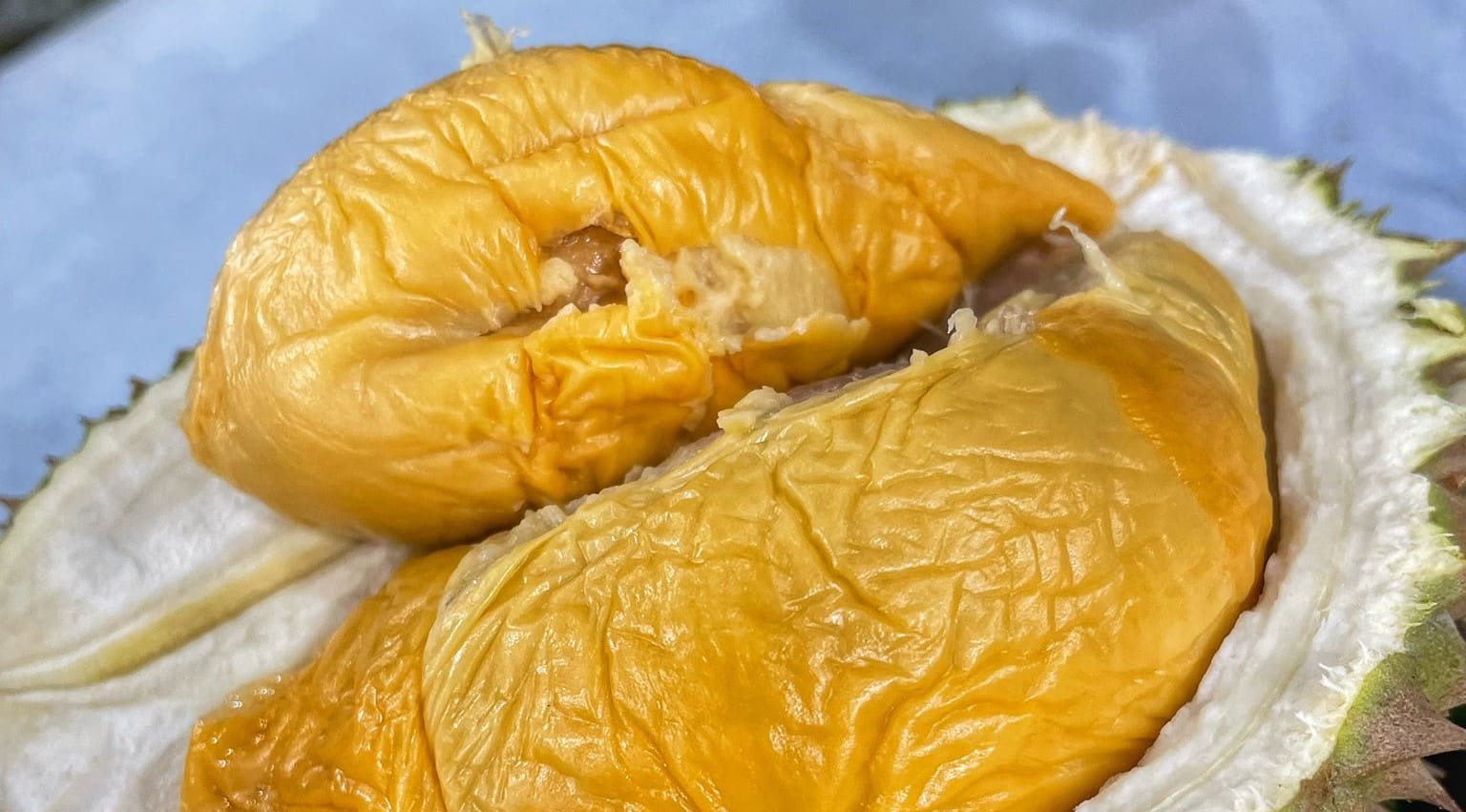
Inside, the flesh is the star. The aril color ranges from bright yellow to deep orange-gold - a brilliant, warm tone that immediately signals quality. The flesh surface is smooth and wrinkle-free, with a clean membrane. The segments are medium-large, and the flesh is medium-thick, providing a satisfying amount of edible pulp per segment.
The seeds are notably flat rather than rounded, and tend to be on the larger side. The flesh peels cleanly away from the seed, which is appreciated by those who prefer a neat eating experience.
Taste & Texture
D168's flavor profile is defined by sweetness first. The initial taste is a warm, honeyed sweetness with vanilla-like undertones - not the sharp, intense sweetness of some varieties, but a smooth, enveloping sweetness that has been described as candy-like or caramel-tinged. Some tasters detect hints of almond in the finish. The overall impression is of a sweet durian with genuine complexity, rather than one-dimensional sugar.
Following the sweetness, a subtle bitterness emerges on the palate. This is not the aggressive, lingering bitterness of Musang King - it is gentler, playing a supporting role that prevents the flavor from becoming cloying. In fruit from older trees, this bitter note becomes more pronounced, adding depth. The balance of sweet and bitter has led many to describe D168 as a milder version of Musang King - a comparison that is flattering but somewhat misleading, as D168 has its own distinct character rather than being a lesser copy.
The texture is firm and creamy - the DOA term "pejal" (firm/solid) captures the structural quality, while the eating experience is decidedly custard-like. The flesh is smooth and dense without being watery, coating the tongue with a richness that rewards slow, deliberate eating. This combination of firmness and creaminess is one of D168's most appealing qualities.
The aroma is moderate. Compared to the room-filling pungency of Musang King or the sharp intensity of XO, D168 has a milder, more approachable scent. This makes it a good choice for durian newcomers or for eating in shared spaces where a powerful durian aroma might not be welcome.
One important note from experienced sellers: D168 tastes noticeably better when eaten fresh, on the day it drops from the tree. After one day, the quality begins to degrade. This is worth keeping in mind when buying - seek out fresh-dropped fruit whenever possible.
How to Identify
Distinguishing D168 from other varieties, particularly at market stalls, relies on a combination of visual and tactile cues.
Shape and size. D168 is round and medium-sized. If the fruit is elongated or distinctly obovate, it is likely a different variety.
The stem. Look for a short, stocky stem approximately 4 cm long with a consistent diameter. This is one of the most distinctive external features. Many other varieties have longer, more tapered stems.
The thorns. D168 has dense, extremely sharp thorns that vary in size and direction. The overall appearance is spiky and somewhat irregular, distinct from the more orderly, pyramidal thorns of Musang King.
The base. The bottom of the fruit shows a bald, indented star pattern where the lobes meet.
Husk color. Greenish-brown at maturity. Not as dark green as some varieties, but not pale either.
Flesh color. Once opened, the orange-yellow to deep gold flesh is a strong indicator. D168's flesh is warmer and more orange-toned than the turmeric-yellow of Musang King.
Taste test. If the flavor is predominantly sweet with gentle bitterness and a vanilla-like quality, and the texture is firm yet creamy, it is very likely D168.
Seeds. The seeds are flat rather than rounded, and relatively large. If the seeds are small and round, the fruit is probably something else.
One practical concern: D168 is one of the durians most commonly sold as fake Musang King. Unscrupulous sellers take advantage of the golden flesh color, which can closely resemble Musang King in certain specimens, and the premium-sounding name Wang Zhong Wang (King of Kings). The key giveaways are the taste (D168 is sweeter and less bitter), the seed shape (flat versus Musang King's more elliptical seeds), and the price. If someone is offering "Musang King" at unusually low prices, there is a reasonable chance it is D168.
Availability & Pricing
D168 is one of the most widely available premium durians in Peninsular Malaysia. During the main season from June to August, it can be found at roadside stalls, durian markets, and specialty shops across Johor, Melaka, Kuala Lumpur, Pahang, Perak, and Penang. Its broad geographic availability is a testament to its commercial viability and consumer demand.
The pricing is where D168 truly shines as a consumer proposition. It typically sells for RM 10 to RM 18 per kilogram - roughly one-third to one-half the price of Musang King. In practical terms, this means a family can enjoy an entire meal of premium golden-fleshed durian for the cost of a single Musang King fruit. For the quality it delivers, D168 is widely regarded as the best value in the Malaysian durian market.
The affordability is not a reflection of inferior quality. Rather, it reflects the variety's higher yield (mature trees can produce 400 to 500 fruits per season), its weather resistance (D168 is notably consistent even in rainy seasons), and the simple economics of supply and demand - D168 is planted more widely and produces more abundantly than the premium varieties that command higher prices.
D168 is also available as frozen durian pulp for export and out-of-season consumption. It appears in frozen form at specialty durian retailers in Singapore, where it is a popular if somewhat underappreciated option compared to better-marketed varieties.
Growing Regions
D168's home is Johor, and the state remains its primary growing region. The districts of Muar (where the original mother tree stood in Hajah Hasmah's garden), Segamat, Batu Pahat, and Tangkak are the core production areas. Johor's lowland terrain and tropical climate suit the variety well, and local growers have decades of experience with its cultivation requirements.
Beyond Johor, D168 has spread to several other states:
- Melaka - Neighboring Johor, with similar growing conditions and strong local demand for the variety.
- Pahang - One of Malaysia's major durian-producing states, where D168 is cultivated alongside Musang King, Black Thorn, and other premium varieties in the highland and foothill regions.
- Penang - In the northern states, D168 goes by an entirely different name: Buaya Emas, meaning Golden Crocodile. The name change reflects the regional nature of Malaysian durian culture, where the same variety can carry different identities depending on local tradition.
- Perak - Another significant growing region where D168 has been adopted by commercial orchards, contributing to supply in the northern half of the peninsula.
One of D168's notable agricultural traits is its consistency. Unlike some premium varieties that produce wildly different quality depending on soil, weather, and tree age, D168 delivers remarkably uniform fruit across different growing regions and harvest conditions. This consistency is valued by both growers (who face less risk of substandard harvests) and consumers (who know largely what to expect).
The variety is also highly resistant to quality degradation from frequent rainfall, which is a significant advantage in Malaysia's tropical climate where sudden downpours during fruiting season are common.
Fun Facts
A home garden champion. D168 stands out among registered durian varieties for its humble origins. While many registered cultivars come from government research stations or established commercial orchards, this one began as a single tree in Hajah Hasmah's backyard in Muar. A chance seedling that happened to produce remarkable fruit, noticed and shared with a neighbor, eventually became one of the most commercially successful durian varieties in the country.
The squirrel connection. The propagation of D168 beyond Hajah Hasmah's garden happened because of a pest problem. Squirrels were raiding her durian tree, and the neighbor she enlisted to help with the squirrels received seeds and cuttings as payment. Without those squirrels, D168 might never have spread beyond a single garden in Muar.
A durian by many names. D168 holds one of the longest lists of alternative names for any Malaysian durian: IOI, D101 (erroneously), Mas Muar, Mas Johor, Hajah Hasmah, Buaya Emas (Golden Crocodile), Wang Zhong Wang (King of Kings), and Jin E Yu (the Mandarin rendition of Golden Crocodile). Each name reflects a different aspect of its history, geography, or market positioning.
The lucky number. The code 168 carries auspicious significance in Chinese culture. The number sequence, pronounced "yi liu ba" in Mandarin, sounds similar to "yi lu fa," meaning "prosperity all the way." This phonetic coincidence adds a layer of cultural appeal in Chinese-speaking markets, where the number 168 is widely associated with wealth and good fortune. It is an unintentional but fitting code for a durian that delivers premium quality at an accessible price.
The consistency champion. While premium varieties like Musang King and Black Thorn can produce fruit that varies dramatically in quality from tree to tree and season to season, D168 has earned a reputation for delivering uniform quality regardless of where it is grown or what the weather has been doing. This reliability makes it a favorite among commercial growers who need a dependable crop.
The fake Musang King problem. D168 is one of the top five durians used by unscrupulous sellers to pass off as Musang King. The golden flesh color can look convincingly similar, and the marketing name Wang Zhong Wang (King of Kings) evokes Musang King in consumers' minds. The price difference between genuine Musang King and D168 is substantial, making the fraud profitable. Consumers can protect themselves by checking the stem shape, seed shape, thorn pattern, and - most reliably - the taste.
The best one-third. At roughly one-third the price of Musang King, D168 is the durian that experienced Malaysian durian eaters recommend to friends who want premium golden-fleshed durian without the premium price tag. It is not a lesser substitute - it is a genuinely excellent variety in its own right, with a distinct flavor profile that many prefer to more expensive alternatives.