

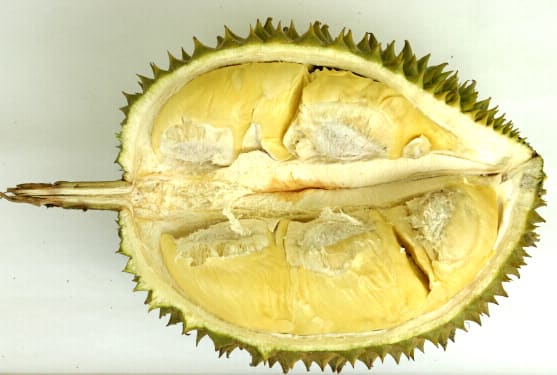
D169 Tok Litok
Overview
Before there was Musang King, there was Tok Litok. Registered in 1989 by a Kelantan-based individual named Wee Chong Beng, D169 Tok Litok is a medium-large durian with thick yellow flesh and a flavor profile described by Malaysia's Department of Agriculture (DOA) as "lemak manis dan sedikit pahit" - creamy sweet and slightly bitter. That description may sound familiar. It is, almost word for word, the same language used to describe D197 Musang King, the variety that Wee Chong Beng would register four years later, in 1993, and that would go on to become the most famous durian in the world.
This shared lineage - same registrant, same state, same flavor vocabulary - is the defining fact of Tok Litok's story. It is a variety that sits in the shadow of a giant, not because it lacks quality, but because the giant it shares a parentage with happens to be the most commercially successful durian cultivar in history.
Tok Litok holds an interim recommendation (Class II) from the DOA for commercial planting in the Tanah Merah district of Kelantan. It has never achieved the national planting recommendation or international fame of Musang King. Among Kelantan's older generation, however, Tok Litok is remembered with real affection - a durian whose thick, satisfying flesh made it a local favorite long before the Musang King phenomenon reshaped the entire Malaysian durian landscape.
Origin & History
The story of D169 begins in the 1980s in Tanah Merah, a district in the southern part of Kelantan, along the banks of the Kelantan River. The variety was registered with Malaysia's Department of Agriculture on 14 May 1989 under the code D169 and the name Tok Litok. The registrant was listed as Wee Chong Beng, classified as an individual (individu) from Kelantan.
The name "Tok Litok" is a local designation. In Malay, "Tok" is a respectful term of address derived from "datuk" - meaning grandfather or elder. It is commonly used in Kelantan and other East Coast states as a title for respected older figures, village leaders, or simply as a familiar, affectionate way to refer to something venerable. The second element, "Litok," does not have a widely documented meaning in standard Malay or in available Kelantan dialect references. It is likely a proper name - the name of a person, possibly the original owner of the tree from which this variety was propagated, or a local figure associated with the area where the tree grew. This naming pattern is common in Malaysian durian culture, where varieties are frequently named after the individuals who cultivated or discovered them.
One source suggests that the original parent tree of the Tok Litok variety stood near Dewan Beta in Kota Bharu, close to the Kelantan River, and was reputed to be over a hundred years old. If accurate, this would place the tree's origins well into the 19th century, making it a genuinely old cultivar that Wee Chong Beng identified and brought through the formal registration process rather than a new variety he bred.
What makes Tok Litok's registration historically significant is what came next. Four years later, in December 1993, the same Wee Chong Beng registered another variety from Kelantan - D197, officially named Raja Kunyit, which the world now knows as Musang King. The DOA records are unambiguous: both D169 and D197 list the same individual as the reporter, and both list Kelantan as the state of origin.
This makes Wee Chong Beng one of the most consequential figures in Malaysian durian history, even though his name is not widely known to the public. In the 1970s, accounts describe Wee trekking through the forests of Kelantan, discovering exceptional durian trees, collecting grafting material, and planting saplings at his property in Tanah Merah. He was, in essence, a durian prospector - a man with the palate to recognize exceptional fruit and the horticultural skill to propagate it. Tok Litok was his first formally registered find. Musang King was his second. The first became a respected local variety; the second became a global phenomenon.
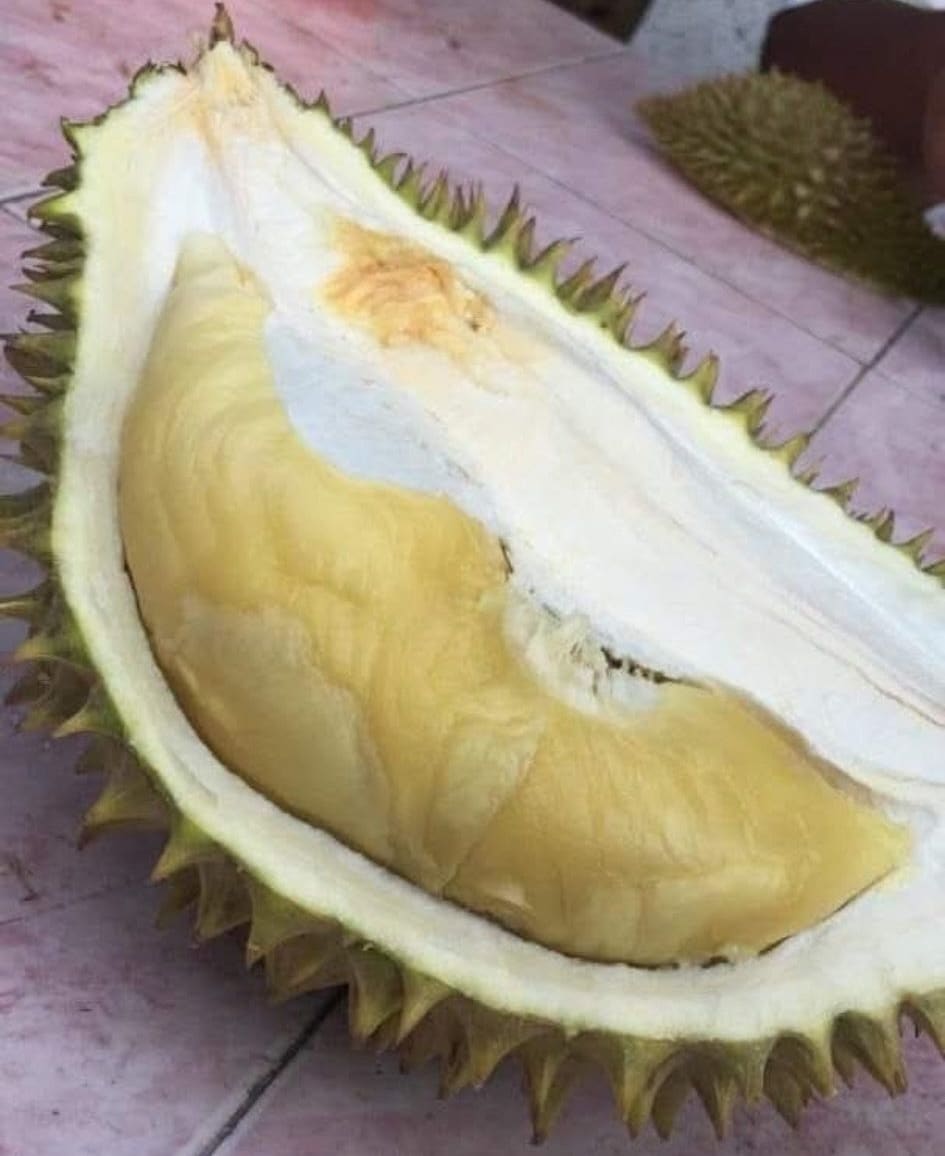
The fact that Wee registered Tok Litok a full four years before Musang King suggests that Tok Litok was the variety he was most confident about first, or perhaps the one he had been cultivating longer. It also raises an intriguing question that the historical record does not conclusively answer: did both varieties come from the same area of forest? Were they neighboring trees? The DOA data gives us the registrant and the state, but not the precise location of the mother trees. What we know is that both were Kelantan varieties, both were identified by the same person, and both share a remarkably similar flavor description.
Appearance
Tok Litok is a medium-large durian, typically weighing between 1.5 and 3.0 kilograms, with an average weight of approximately 2.25 kilograms. This makes it noticeably larger than Musang King, which averages 1.5 to 2.5 kilograms.
The shape is elongated elliptic - longer and narrower than the rounder or obovate profile of many premium varieties. Some specimens also display slight asymmetry, appearing kidney-shaped or lopsided, which gives the fruit a somewhat irregular silhouette. The grooves between the fruit's lobes (pangsa) are typically visible on the husk, indicating where the compartments of flesh lie inside.
The husk is yellowish-green at maturity, covered in thorns that are notably sharp and long - a distinctive feature that sets Tok Litok apart from varieties with shorter, blunter spines. The thorns at the base of the fruit tend to be coarser in texture. The rind is of medium thickness, measured at approximately 1.3 centimeters, which is slightly thinner than Musang King's 1.7-centimeter average.
When opened, the flesh is thick and yellow - ranging from a bright, clear yellow to a deeper bronze-yellow depending on the individual fruit and growing conditions. The flesh envelops seeds that are medium in size. Seed development is relatively consistent: approximately 71 percent of seeds are fully developed and 29 percent are partially filled, with virtually no empty seeds reported. Each section of the fruit typically contains two arils.
Taste & Texture
The DOA registry describes Tok Litok's flavor as "lemak manis dan sedikit pahit" - creamy sweet and slightly bitter. This three-part descriptor places Tok Litok in the same flavor family as Musang King, which is also officially described in bittersweet terms, though Musang King's bitterness tends to be more assertive and its overall flavor intensity more pronounced.
Tok Litok's sweetness is the leading note - rich, fatty, and satisfying in the way that high-quality Kelantan durians often are. The creaminess is integral to the experience: the "lemak" (fatty, creamy) quality gives the flesh a coating, buttery mouthfeel. The bitterness is present but restrained, described as "sedikit" (a little) rather than dominant. For tasters who find Musang King's bitterness too aggressive, Tok Litok offers a gentler version of the same bittersweet profile - the sweetness leads, the bitterness follows as a subtle undertone rather than a competing force.
The texture is smooth and thick, though some sources note that it can occasionally tend toward the slightly fibrous or coarse side, particularly in less-than-ideal growing conditions. At its best, the flesh is dense and paste-like, with a satisfying body that older Kelantanese durian lovers describe as deeply fulfilling - "eating just one is enough," in the words of one local account, a testament to how rich and satiating the flesh can be.
The aroma is notably mild - described as subtle or slight, not the room-filling intensity associated with Musang King. For those who enjoy durian's flavor but prefer a less pungent olfactory experience, this is an appealing trait.
How to Identify
Identifying Tok Litok requires attention to several distinguishing features, particularly since it shares some flavor characteristics with Musang King and could theoretically be confused with other yellow-fleshed, bittersweet varieties.
Shape. The elongated elliptic form is one of the most reliable external markers. Tok Litok is longer and narrower than the obovate (egg-shaped) profile of Musang King. If a durian looks stretched out rather than squat, Tok Litok is a possibility.
Thorns. The thorns are sharp and long - notably more elongated than those on many other varieties. This is a visible feature even from a short distance. The sharp, lengthy spines give the fruit a somewhat aggressive appearance.
Size. At an average of 2.25 kilograms and a range up to 3.0 kilograms, Tok Litok trends larger than Musang King. A durian that weighs close to 3 kilograms and is being sold as Musang King should raise questions.
Husk color. Yellowish-green at maturity, broadly similar to several other varieties and therefore not a strong standalone identifier.
Flesh color. Yellow, ranging to bronze-yellow. It lacks the deep orange-yellow intensity that characterizes the best Musang King specimens, but the yellow is clear and rich.
Taste test. Sweet-dominant with a creamy body and a gentle bitter finish. If the bitterness is mild rather than assertive, and the sweetness takes center stage, you may be eating Tok Litok rather than Musang King.
Aroma. Mild to subtle. If the durian's smell is not filling the room, that is consistent with Tok Litok.
Provenance. Tok Litok is overwhelmingly associated with Kelantan. If you are buying durian in Tanah Merah, Kota Bharu, or other parts of Kelantan and the seller identifies the fruit as Tok Litok, you are in the right geography.
Availability & Pricing
Tok Litok is a seasonal variety available during Malaysia's main durian seasons, which generally fall between May and August (the major season) and between November and December (the minor season) in Peninsular Malaysia.
Availability is limited compared to nationally distributed varieties. Tok Litok's DOA interim recommendation restricts its official commercial planting recommendation to the Tanah Merah district of Kelantan. While this does not prevent the variety from being grown elsewhere, it means that Tok Litok has never received the kind of institutional support - in terms of recommended planting programs, quality standards, or export protocols - that has propelled varieties like Musang King and D24 to national and international prominence.
Pricing for Tok Litok generally falls in the range of RM 40 to RM 60 per kilogram, positioning it as a premium variety but typically below peak Musang King prices. In Kelantan itself, prices may be more accessible, reflecting the variety's local abundance and established reputation. Outside of Kelantan, finding Tok Litok can be genuinely difficult - it is not a variety commonly stocked by urban durian sellers in Kuala Lumpur or Penang, and it has no presence in the export market.
This scarcity is, paradoxically, part of its appeal for durian enthusiasts who seek out lesser-known varieties. Tok Litok is the kind of durian you travel to Kelantan to eat - a regional specialty that rewards the effort of seeking it out.
Growing Regions
Tanah Merah, Kelantan is the heartland of Tok Litok cultivation and the only district for which the DOA has issued an interim commercial planting recommendation. The district lies along the Kelantan River in the southern part of the state, and its alluvial soils and tropical climate provide conditions well suited to durian cultivation. It is also the base from which Wee Chong Beng operated, making it the birthplace of both Tok Litok and the trees that would eventually become Musang King.
Greater Kelantan - including areas around Kota Bharu and the interior regions - is the broader zone where Tok Litok trees can be found, though plantings outside of Tanah Merah are less systematic and more likely to be found in smallholder orchards and kampung (village) settings rather than commercial-scale operations.
Other states have minimal Tok Litok presence. The variety has not been widely propagated outside of Kelantan in the way that Musang King, Red Prawn, or Black Thorn have spread across Peninsular Malaysia. This geographic concentration is both a limitation and a defining characteristic - Tok Litok remains a Kelantan durian through and through.
The contrast with Musang King's geographic trajectory is instructive. Musang King originated in the same state and was registered by the same person, but it was taken to Raub, Pahang, by grower Tan Lai Fook, where it thrived commercially and eventually spread nationwide. Tok Litok never had its own Tan Lai Fook - no one championed it beyond its home region, and so it remained a local treasure rather than a national commodity.
Fun Facts
- D169 Tok Litok and D197 Musang King were both registered by the same individual, Wee Chong Beng, from Kelantan. Tok Litok came first, in 1989; Musang King followed in 1993. This makes Wee Chong Beng one of the most important - and least recognized - figures in Malaysian durian history.
- The DOA descriptions of Tok Litok and Musang King are strikingly similar. Both are described as having creamy, sweet, and slightly bitter flesh. The shared language raises the possibility that the two varieties may have originated from related trees, or at least from the same ecological zone in Kelantan's forests.
- Tok Litok holds an interim (Class II) commercial planting recommendation, limited to the Tanah Merah district. Only three varieties - D24, D99, and D123 - have achieved the higher Class I national recommendation. D169 shares its interim status with D145 (Beserah), D158 (Kan Yau), and D159 (Mon Thong).
- One local account claims the original parent tree of Tok Litok stood near Dewan Beta in Kota Bharu, beside the Kelantan River, and was over a hundred years old. If true, Tok Litok is one of the oldest documented durian cultivars in Malaysia, with roots reaching back to the 19th century.
- The name "Tok" is a Malay honorific derived from "datuk" (grandfather or elder). Durian varieties named with "Tok" are relatively common in the East Coast states, reflecting a tradition of naming trees after the respected elders who tended them. Other examples include Tok Kong, a well-known variety from Penang.
- Tok Litok's aroma is described as mild or subtle - a notable contrast to Musang King, which is famous for its room-filling, powerful smell. For those who love durian's taste but find the odor challenging, Tok Litok offers a more approachable sensory experience.
- Musang King's rise to global fame was catalyzed when grower Tan Lai Fook brought it from Kelantan to Raub, Pahang, where it thrived commercially. No equivalent champion emerged for Tok Litok, which is a key reason it remains a regional specialty rather than a national or international brand.
- Despite its low profile outside Kelantan, Tok Litok is remembered with genuine affection by older Kelantanese durian lovers, who prize its thick, satisfying flesh and gentle bittersweet character. It is a variety that predates the Musang King era and represents an older tradition of Kelantan durian culture.