

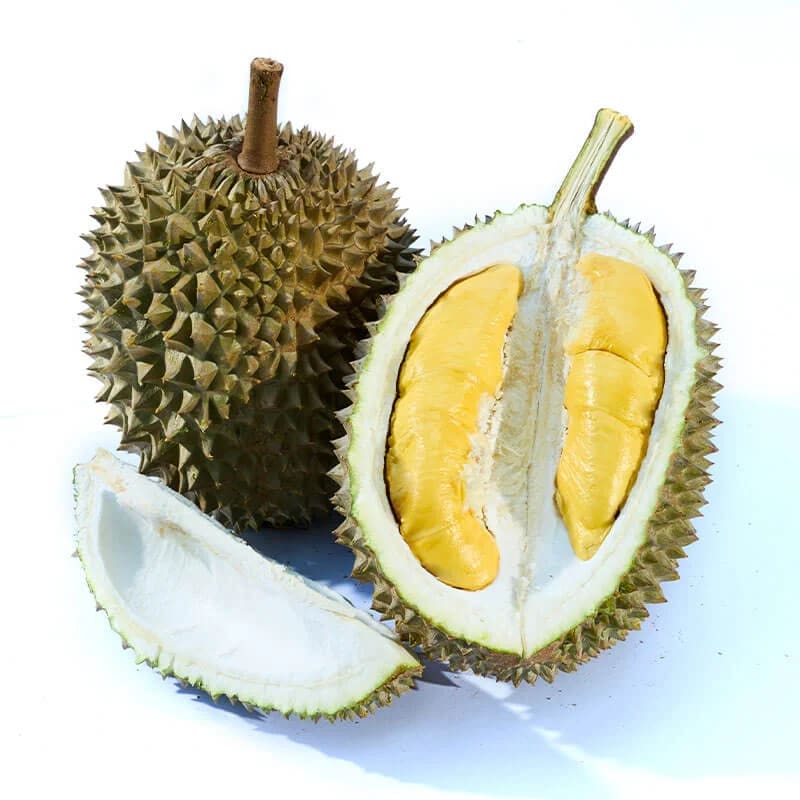
D197 Raja Kunyit (Musang King)
Overview
No durian commands more attention, higher prices, or fiercer devotion than D197 Raja Kunyit - universally known as Musang King. Registered in 1993, this Kelantan-born variety has risen from a regional cultivar to become the undisputed benchmark of premium Malaysian durian. Its deep golden-yellow flesh, intense bittersweet flavor, and thick, creamy texture have made it the standard against which all other premium varieties are measured.
In Chinese-speaking markets, it goes by 猫山王 (Mao Shan Wang, literally "Cat Mountain King"), a transliteration that has become one of the most recognizable durian names in the world. Whether you encounter it at a roadside stall in Raub, a specialty shop in Kuala Lumpur, or a frozen foods section in Shanghai, Musang King is the name that needs no introduction.
Musang King is not merely popular - it is culturally significant. It has driven the expansion of Malaysia's durian industry, shaped international trade agreements, fueled durian tourism, and sparked serious conversations about the environmental cost of monoculture farming. To understand Malaysian durian is to understand Musang King.
Origin & History
The story of D197 begins in Kelantan, a state on the northeastern coast of Peninsular Malaysia. In 1993, an individual named Wee Chong Beng registered the variety with Malaysia's Department of Agriculture (DOA) under the name Raja Kunyit, which translates to "King of Turmeric" - a reference to the deep, turmeric-like yellow color of its flesh. It was assigned the code D197.
The name "Musang King" has a separate origin. It derives from the variety's association with Gua Musang, a town in the interior of Kelantan. Gua Musang itself is named after the musang - the Malay word for the common palm civet, a small nocturnal mammal known to be fond of ripe durian. Over time, the market name "Musang King" eclipsed the registered name Raja Kunyit in everyday use.
The Chinese name 猫山王 (Mao Shan Wang) is a creative transliteration. The word "musang" was approximated using 猫山 - where 猫 means "cat," loosely evoking the civet (sometimes called a civet cat), and 山 means "mountain." The addition of 王 ("king") completes the regal title: Cat Mountain King.
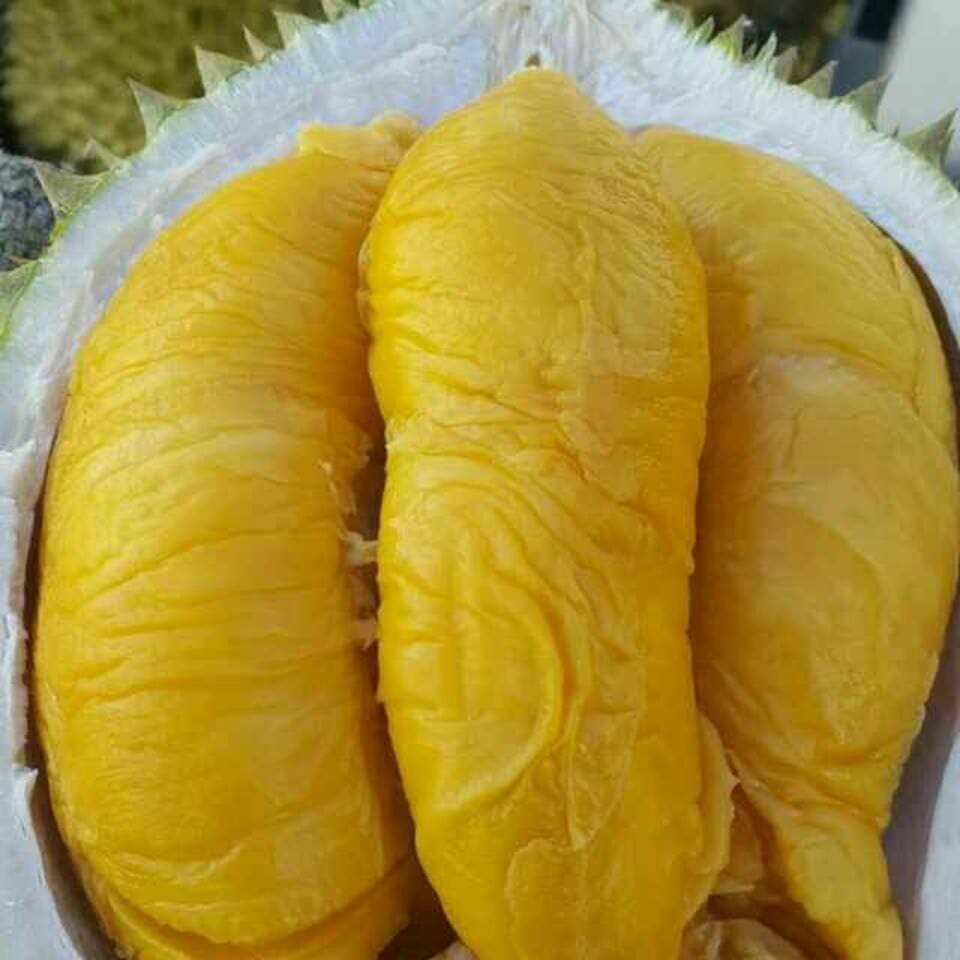
While the variety originated in Kelantan, its commercial rise is closely tied to the town of Raub in Pahang. A grower named Tan Lai Fook is credited with recognizing Musang King's exceptional commercial potential and bringing it to Raub, where the terrain and climate proved ideal for large-scale cultivation. Today, Raub is the heartland of Musang King production, and the variety's ascent has transformed the town's economy.
A pivotal moment in Musang King's international profile came in 2010, when Macau casino tycoon Stanley Ho reportedly paid RM 15,000 for a single premium Musang King durian. The story circulated widely in Asian media and helped cement the variety's reputation as a luxury fruit.
In 2019, another milestone arrived: Malaysia's first official shipment of whole frozen Musang King durians was exported to China, following a bilateral trade protocol signed between the two countries in 2017. This opened the floodgates for a massive export market and further solidified Musang King's position at the pinnacle of the durian world. Malaysia has also pursued Geographical Indication (GI) protection for Musang King, seeking to safeguard the variety's name and provenance. Quality grading is governed by MS 2686:2017, the Malaysian Standard for Musang King.
Appearance
Musang King is a medium-sized durian, typically weighing between 1.5 and 2.5 kilograms. Its shape is elongated obovate - somewhat egg-shaped, broader at the top and tapering toward the stem. In cross-section, the fruit is round with slight ridging.
The husk is green to yellowish-green at maturity, covered in pyramidal thorns that are notably wider at the base than many other varieties. The thorns are acute (sharply pointed), with a broad, fine-textured area near the tips, and they point upward at the apex of the fruit.
One of the most reliable identification features is the shell seam: the suture lines between the fruit's lobes (pangsa) are clearly visible and well-defined. The ridging along these seams is prominent. The husk has a medium thickness of approximately 1.7 cm, and the stem (tangkai) averages about 5.4 cm in length.
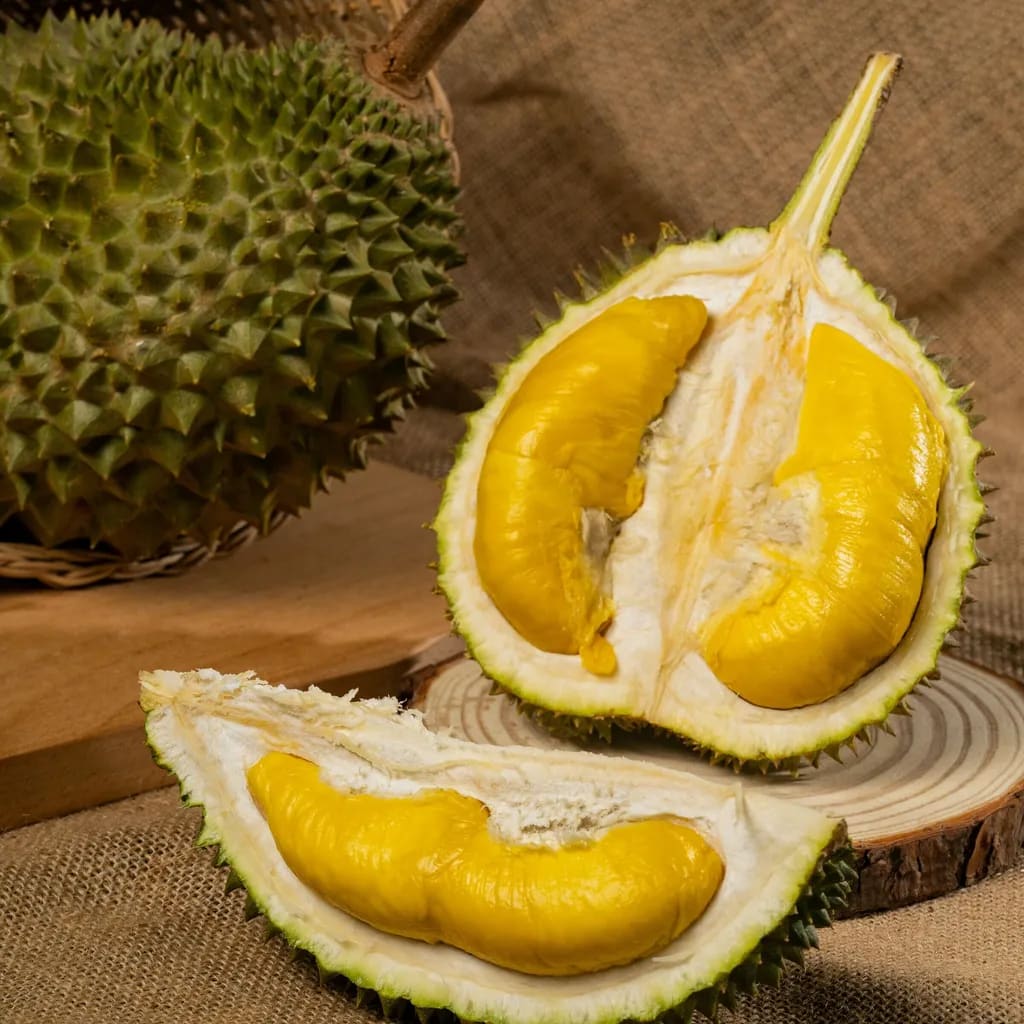
When opened, the flesh is immediately striking. The aril is thick, enveloping seeds that are elliptical in shape and medium in size. The color of the flesh is deep golden yellow - almost tending toward orange-yellow in prime specimens - a richness that earned it the "turmeric" reference in its registered name. Vestigial seeds (biji kesep) are frequently present, which means more flesh and less waste for the consumer.
Taste & Texture
This is where Musang King earns its crown.
The flavor profile is intensely bittersweet - a complex interplay that sets it apart from varieties that offer only sweetness. The initial taste is a rich, deep sweetness, but this is quickly followed by a distinct bitter undertone that lingers on the palate. This bitterness is not a flaw; it is the defining characteristic that durian connoisseurs seek. It adds depth and complexity, preventing the flavor from becoming cloying, and it is the quality that most clearly separates Musang King from sweet-only varieties.
The texture is thick, creamy, and custard-like. A high fat content gives the flesh an almost buttery mouthfeel, coating the tongue in a way that few other fruits can match. The DOA registry describes the texture as "moderate" (sederhana), but most tasters would describe the experience as luxuriously rich.
The aroma is strong and pungent - it fills a room. While the DOA's original registration notes the aroma as "weak" (lemah), this assessment is at odds with the experience reported by virtually all growers and consumers. Ripe Musang King has an unmistakably powerful smell, even by durian standards.
The aftertaste is long and persistent. Minutes after eating, the bittersweet complexity continues to develop on the palate, which is part of the appeal for those who appreciate the variety. This lingering finish is often cited as evidence of Musang King's superiority in taste comparisons.
How to Identify
Identifying a genuine Musang King among the many durian varieties on offer is an important skill, particularly given the price premium it commands. Here are the key markers:
The star pattern. Look at the base of the fruit (the bottom, opposite the stem). A genuine Musang King displays a distinctive star-shaped pattern - a five-pointed star formed by the converging suture lines of the fruit's lobes. This is one of the most reliable external identifiers.
Thorn shape. The thorns are pyramidal, broad at the base, and sharply pointed (acute). They are spaced more widely than some varieties and have a somewhat organized appearance.
Visible seam lines. The suture lines between the lobes are clearly defined and pronounced. You can trace the ridge along each lobe with your finger.
Husk color. At peak ripeness, the husk is green to yellowish-green. It does not turn brown as readily as some other varieties.
Flesh color. Once opened, the deep golden-yellow to orange-yellow flesh is distinctive. If the flesh is pale yellow or whitish, it is not Musang King.
Taste test. The bittersweet flavor is the ultimate confirmation. A durian that is only sweet, no matter how golden the flesh, is not a true Musang King.
Size and weight. Medium-sized, typically 1.5 to 2.5 kg. The average length is about 20 cm and the average width about 15.5 cm.
Availability & Pricing
Musang King is available during Malaysia's main durian seasons, which generally fall between June and August (the major season) and between November and February (the minor season), though exact timing varies by region and weather patterns.
Pricing for Musang King sits at the top of the Malaysian durian market. Under normal conditions, farm-gate prices range from RM 45 to RM 65 per kilogram, while retail prices in cities like Kuala Lumpur and Penang typically run from RM 65 to RM 100 per kilogram. Export-grade frozen Musang King commands RM 80 to RM 150 per kilogram, reflecting the added costs of processing, freezing, and logistics.
However, durian pricing is notoriously volatile. In January 2026, a surge in supply caused Musang King prices to crash to RM 15 to RM 35 per kilogram at the farm level - a dramatic drop that delighted consumers but squeezed growers. Such price swings are a recurring feature of the durian market, driven by the unpredictable timing and volume of each season's harvest.
The 2019 opening of the China export market was a transformative event for Musang King economics. China's enormous demand has raised the commercial stakes significantly, encouraging new plantings across Malaysia and making Musang King the centerpiece of the country's durian export strategy.
Quality grading follows the SIRIM standard MS 2686:2017, which establishes criteria for classifying Musang King durians by grade. This standard is particularly important for the export market, where consistency and traceability are required by trading partners.
Growing Regions
Raub, Pahang is the dominant growing region for Musang King, accounting for an estimated 60 to 70 percent of commercial supply. The hilly terrain, elevation, and soil conditions in and around Raub are considered ideal for producing Musang King with the deepest flavor and richest flesh color. Raub has become synonymous with premium Musang King, and the town has developed a thriving durian tourism industry built around orchard visits and seasonal feasts.
Kelantan, the variety's state of origin, remains an important growing area, particularly in and around Gua Musang. The interior highlands of Kelantan provided the original growing conditions in which Raja Kunyit was first identified and registered.
Perak has a growing Musang King presence, with orchards in the Cameron Highlands periphery and other parts of the state contributing to supply.
Johor, in the south of Peninsular Malaysia, has seen significant new plantings of Musang King, driven by its proximity to the Singapore market and strong domestic demand.
Sabah, on the island of Borneo, represents the newest frontier for Musang King cultivation. New plantations have been established in the state, taking advantage of available land and a growing appetite for the variety beyond Peninsular Malaysia.
The expansion of Musang King cultivation has not been without controversy. The high profitability of the crop has incentivized the clearing of old-growth forest and conversion of other agricultural land to durian orchards, raising environmental concerns about deforestation, biodiversity loss, and the sustainability of the rapid expansion.
Fun Facts
- The name "Musang King" has nothing to do with the musang (civet cat) eating this particular variety. It is a geographical reference to Gua Musang, the town in Kelantan where the variety gained its early reputation.
- Stanley Ho's RM 15,000 Musang King purchase in 2010 is one of the most frequently cited stories in durian marketing, though the exact details are difficult to verify independently.
- The Chinese name 猫山王 is so well-known that many Chinese-speaking consumers do not realize it is a phonetic adaptation rather than a literal description. The "Cat Mountain King" branding has taken on a life of its own.
- Musang King consistently wins taste competitions in Malaysia and is the benchmark against which all premium durian varieties are judged. When a new variety is praised, it is almost always compared to Musang King.
- The 2017 bilateral protocol between Malaysia and China, which led to the first official frozen Musang King exports in 2019, was a milestone not just for durian but for Malaysian agricultural trade policy as a whole.
- Musang King's high frequency of vestigial seeds (biji kesep) is a consumer-friendly trait - it means less seed and more edible flesh per fruit.
- The SIRIM standard MS 2686:2017 is, to date, one of the few formal quality standards applied to a specific durian variety anywhere in the world. It reflects the commercial importance Musang King has achieved.
- Despite its fame, Musang King is a relatively recent commercial phenomenon. Its rise from a regional Kelantan cultivar to an internationally traded commodity has taken place largely within the last two decades.