

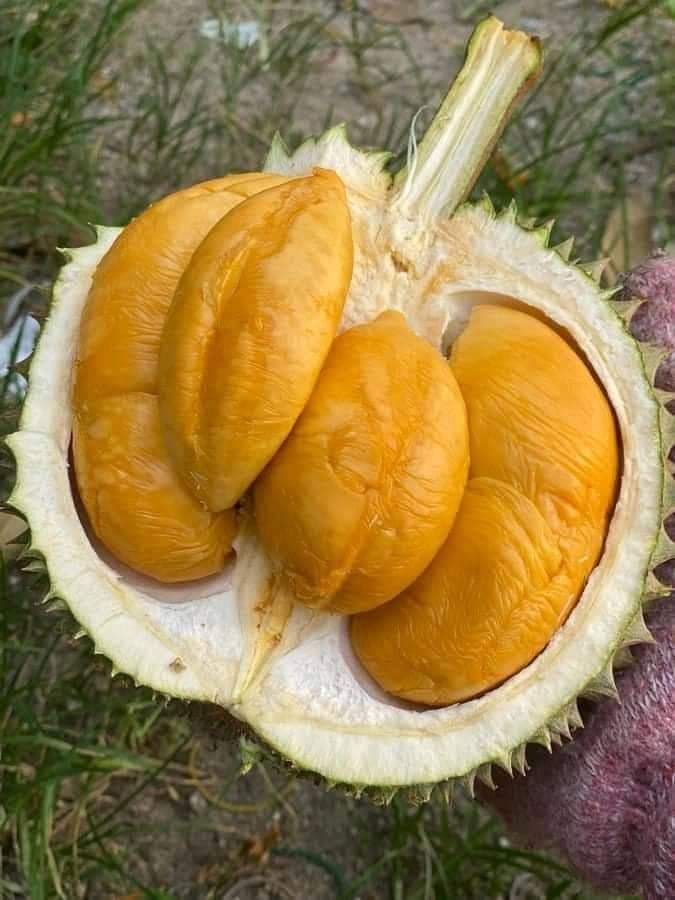
D200 Ochii (Black Thorn)
Overview
D200 Ochii, universally known as Black Thorn, is one of the most sought-after durian varieties in Malaysia. Registered with the Department of Agriculture (DOA) in 2016, it has rapidly ascended to become a serious rival to Musang King in the premium durian market. Black Thorn is defined by its exceptionally creamy flesh, a flavor profile that balances intense sweetness with a refined bitterness, and a telltale dried black stamen at the base of the fruit that gives the variety its common name.
Representing an estimated 1% of Malaysia's total durian production, Black Thorn's scarcity is a significant part of its allure. Its limited supply, concentrated growing regions, and the striking quality difference between old-tree and young-tree fruit have made it a prized find among durian connoisseurs. The variety's crowning moment came at the 2022 World Durian Championship, where it defeated Musang King to claim the title -- cementing its status as a legitimate contender for the throne of durian varieties.
Origin & History
Black Thorn traces its roots to a single mother tree in Kampung Lima Kongsi, Sungai Bakap, located on the mainland side of Penang state (Seberang Perai). The original tree, locally known as "Bagi Kau," is estimated to be around 30 to 40 years old. This mother tree produced fruit of such exceptional quality that it caught the attention of growers and agricultural authorities in the region.
The variety was formally registered as D200 Ochii by Datuk Leow Cheok Kiang, who submitted the application through an official government agency (Jabatan/Agensi). Heng Mee Oo of Serene Orchard is also closely associated with the early commercialization of Black Thorn, playing an instrumental role in bringing the variety from a local curiosity to a nationally recognized premium durian.
The name "Ochii" is the registered variety name, but it is the common name "Black Thorn" that has become iconic. The name refers to the distinctive dried flower stamen -- a small, dark remnant -- visible at the base of the fruit, opposite the stem end. This black marking serves as the primary visual identifier for the variety. In Penang Hokkien, the durian is called "Hei Ci" (Black Thorn), rendered in Chinese as 黑刺, a name that is widely used throughout Chinese-speaking durian communities in Malaysia and abroad.
Since its registration, Black Thorn has been increasingly planted beyond its original Penang heartland. Growers in Pahang, Johor, and other states have begun cultivating the variety, attracted by its premium pricing. However, the original clones from the Penang-Kedah region, particularly those from older trees, remain the most highly regarded.
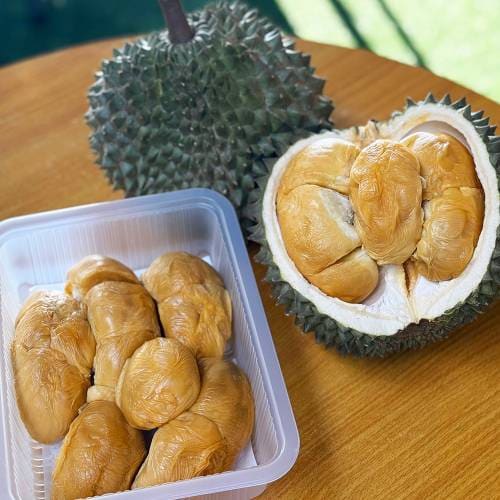
Appearance
Black Thorn has an obovate fruit shape -- somewhat elongated and wider toward the apex, tapering toward the stem. The cross-section is round with slight ridging. In terms of size, it is a medium fruit, typically weighing between 1.5 and 2.5 kg, with an average length of around 20 cm and a width of about 15.5 cm according to DOA measurements.
The husk is relatively thick, averaging 1.7 cm, with sharp, acute thorns. The thorns at the tip of the fruit are notably fine-textured, with a broad smooth area at the tip, and positioned upright. The lobe lines (garisan pangsa) on the fruit's surface are clearly defined and prominent, and the lobe ridges are visibly present, which helps in identifying the segments within.
The stem (tangkai) is of medium length, averaging 5.4 cm.
The most distinctive external feature, and the one that gives the variety its name, is the small dried black flower stamen (stigma remnant) found at the base of the fruit. This dark speck is the single most reliable way to identify a Black Thorn durian from the outside, and experienced buyers look for it as a mark of authenticity.
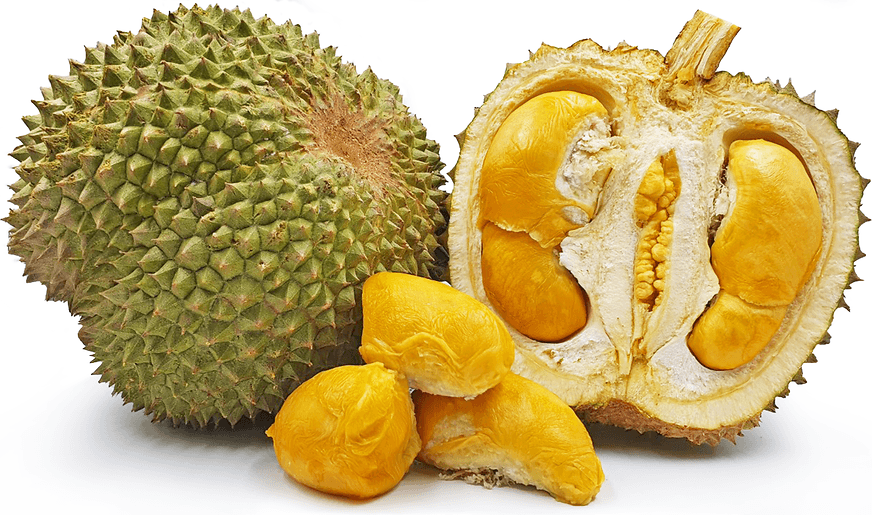
The flesh itself is thick and displays a pale golden yellow color, often with a slightly orange tinge that distinguishes it from the brighter yellow of Musang King. The seeds are elliptic in shape and medium in size, with a notably high occurrence of aborted seeds (biji kesep), which means more flesh relative to seed in each lobe.
Taste & Texture
Black Thorn's taste profile is what sets it apart in the crowded field of premium durians. The texture is extraordinarily creamy -- often described as custard-like or similar to rich, dense ice cream. The flesh practically melts on the tongue, leaving a velvety coating in the mouth.
The flavor is a sophisticated interplay of sweetness and bitterness. The sweetness is intense and forward, hitting the palate immediately, while a distinctive mild bitterness follows as a counterpoint. This bitter note is not harsh or unpleasant; rather, it adds complexity and depth, preventing the sweetness from becoming one-dimensional. Many connoisseurs describe the overall effect as having a wine-like or slightly alcoholic quality -- a fermented richness that no other durian variety quite replicates.
The aroma of Black Thorn is notably subtler and less pungent than Musang King. While it still unmistakably smells like durian, the scent is more restrained and refined, making it more approachable for those who find other varieties overwhelming.
The aftertaste is one of Black Thorn's greatest strengths. It is long-lasting and evolves on the palate, leaving behind notes of caramel and honey that linger well after the last bite. This extended finish is something that durian enthusiasts specifically seek out and is a hallmark of high-quality specimens.
According to the DOA registration data, the variety is officially classified as having strong sweetness, slight bitterness, weak aroma, and medium texture -- though many who have tasted premium old-tree specimens would argue that "medium texture" undersells the remarkable creaminess of the best Black Thorn fruit.
How to Identify
Identifying a genuine Black Thorn durian involves checking several key features:
The black stamen (most important): Look at the base of the fruit, opposite the stem. A small dried black flower remnant (the stigma) should be visible. This is the signature feature and the origin of the "Black Thorn" name. If this marking is absent, the fruit is unlikely to be a genuine Black Thorn.
Fruit shape: The overall shape is obovate -- elongated and wider at the top, narrowing toward the stem. It should not be perfectly round or overly elongated.
Lobe lines: The lines separating the lobes should be clearly defined and strong. The lobe ridges should also be visible on the surface of the husk.
Thorns: The thorns are acute (sharp-pointed) and relatively fine, especially near the tip of the fruit. The tip area has a broad smooth zone with upright-positioned thorns.
Flesh color: When opened, the flesh should be a pale golden yellow, sometimes with a slight orange tinge. It should not be bright or deep yellow.
Seed characteristics: Seeds are elliptic and medium-sized. A high proportion of aborted seeds (small, flat, undeveloped seeds) is typical and considered desirable, as it means more edible flesh per lobe.
Size and weight: Expect a medium-sized fruit weighing between 1.5 and 2.5 kg. Unusually small or very large specimens should be examined more carefully.
Availability & Pricing
Black Thorn is one of the most expensive durian varieties on the Malaysian market. Prices typically range from RM 55 to RM 95 per kilogram, placing it above Musang King in many markets. Premium specimens, especially those from old trees (15 years and older), can exceed RM 100 per kilogram during peak season.
The high price is driven primarily by scarcity. Black Thorn is estimated to account for only about 1% of Malaysia's total durian production. While new plantings are expanding the supply, the trees take years to mature, and the older trees that produce the most highly regarded fruit remain limited in number.
There is a significant quality and price distinction between old-tree and young-tree Black Thorn. Old-tree fruit, harvested from trees aged 15 years and above, tends to have more complex flavors with deeper bitterness, a creamier texture, and a more pronounced aftertaste. Young-tree Black Thorn, while still excellent, tends to be sweeter but less nuanced. Serious connoisseurs actively seek out old-tree specimens and are willing to pay a substantial premium for them.
The high demand and limited supply have even led to reported incidents of Black Thorn being smuggled to Singapore, where prices can climb even higher. This underground trade underscores just how coveted the variety has become in the regional market.
Black Thorn is primarily available during Malaysia's main durian season (typically June to August) and the minor season (December to February), though availability can vary by region and year. The best sources remain orchards in the Penang-Kedah region, particularly those with older trees.
Growing Regions
Black Thorn's heartland is Penang, specifically the Seberang Perai (mainland Penang) area where the original mother tree stands in Kampung Lima Kongsi, Sungai Bakap. Balik Pulau, on the island side of Penang, is also an important growing area for the variety.
Parts of neighboring Kedah state also have established Black Thorn orchards, benefiting from the proximity to the original growing region and similar soil and climate conditions.
In recent years, as the variety's reputation and pricing have soared, growers in other states have begun planting Black Thorn. Pahang and Johor, both major durian-producing states, have seen increasing Black Thorn cultivation. However, fruit from these newer growing regions is generally from younger trees and may not yet match the complexity and depth of flavor found in the original Penang-Kedah specimens.
The concentration of the best Black Thorn production in the Penang-Kedah corridor adds to the variety's mystique and reinforces the importance of terroir -- the idea that the specific combination of soil, climate, and tree age in a region contributes to the character of the fruit.
Fun Facts
- Championship pedigree: Black Thorn won the 2022 World Durian Championship, defeating the long-dominant Musang King and announcing itself as a serious contender for the title of Malaysia's finest durian variety.
- The name behind the name: The mother tree in Kampung Lima Kongsi was locally known as "Bagi Kau," which translates roughly to "Give You" in Malay -- an unexpectedly generous name for a tree that would produce one of the most expensive durians in Malaysia.
- Spot the dot: The small dried black stamen at the base of the fruit is not just a curiosity -- it is the single most reliable way to authenticate a Black Thorn durian. Buyers who know what to look for check the base of the fruit before anything else.
- More flesh, less seed: Black Thorn has a notably high occurrence of aborted seeds (biji kesep), meaning many of the seeds are small and undeveloped. This translates to more edible flesh per lobe -- a feature that helps justify the premium price.
- Smuggler's prize: The demand for Black Thorn is so intense that there have been reported cases of the fruit being smuggled across the border to Singapore, where it commands even higher prices.
- Old tree, deep flavor: Not all Black Thorn is created equal. Fruit from trees aged 15 years and above is considered significantly superior, with a more complex flavor profile that includes deeper bitterness, richer creaminess, and a longer-lasting aftertaste. Young-tree fruit, while still good, is sweeter and less layered.
- The 1% club: With an estimated share of just 1% of Malaysia's total durian production, Black Thorn is one of the rarest commercially available premium varieties -- making every season a race between supply and demand.