

Durian has a reputation problem when it comes to nutrition. Depending on who you ask, it's either a superfood packed with vitamins or a calorie bomb you should avoid. The truth is somewhere in between, and the numbers paint a more interesting picture than either camp admits.
I got curious about this when we started tracking harvest data on our own farm. We weigh every fruit, log every tree. So naturally, the question came up: what exactly is in the thing we're growing? I went looking for real data, not wellness blog fluff, and here's what I found.
The Per-Seed Breakdown
This is what most people actually want to know: how many calories am I eating per piece?
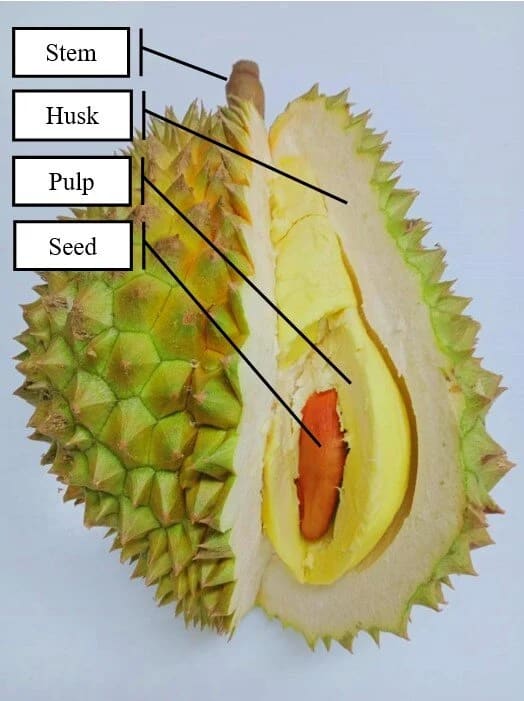
A quick note on terminology: in Malaysia and Singapore, people say "seed" to mean one whole segment of durian, the creamy pulp and the hard seed inside it together. The edible part is the pulp (or flesh) that wraps around the seed. When we say "one seed" below, we mean one whole piece, and the weights refer to the pulp only.
The answer depends on size, because durian pieces vary quite a bit. A small one gives you roughly 40g of edible pulp, while a large piece can be closer to 80g. Here's how that breaks down:
| Small Seed (~40g) | Medium Seed (~60g) | Large Seed (~80g) | |
|---|---|---|---|
| Calories | ~59 kcal | ~88 kcal | ~118 kcal |
| Protein | 0.6g | 0.9g | 1.2g |
| Fat | 2.1g | 3.2g | 4.3g |
| Carbs | 10.8g | 16.3g | 21.7g |
| Fiber | 1.5g | 2.3g | 3.0g |
Calculated from USDA FoodData Central values for durian, raw or frozen (FDC ID 168192), scaled by pulp weight. Source: USDA FoodData Central
For context, a medium piece is roughly the same calories as a medium banana. Three medium pieces puts you at about 265 kcal, which is already a decent snack. This is why nutritionists in Singapore and Malaysia typically recommend capping your intake at two to three pieces per sitting.
Full Nutrition Per 100g
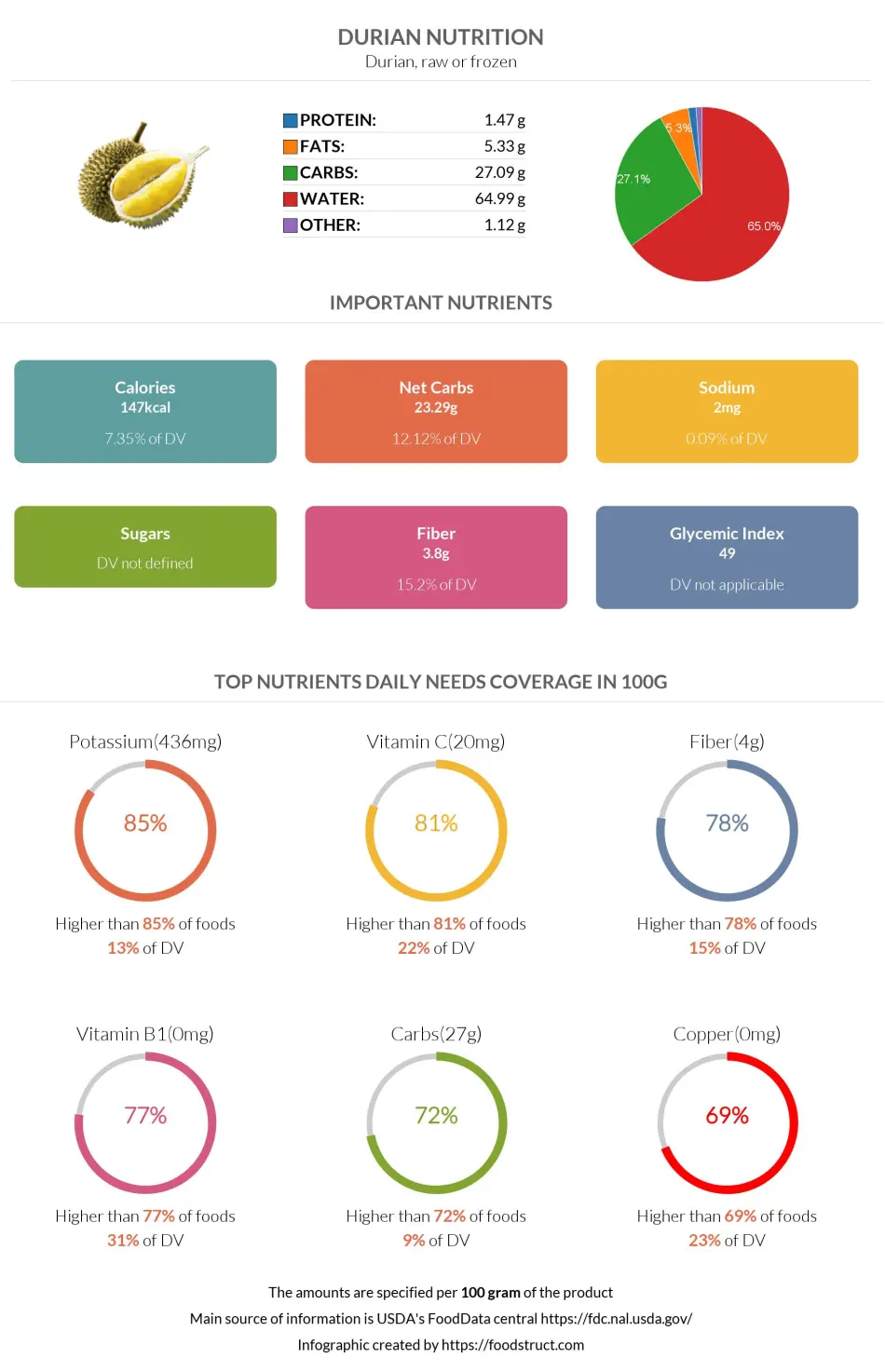
Here's the complete picture, based on USDA data for raw durian flesh:
| Nutrient | Per 100g | % Daily Value |
|---|---|---|
| Calories | 147 kcal | 7% |
| Protein | 1.5g | 3% |
| Total Fat | 5.3g | 7% |
| Saturated Fat | 1.5g | 8% |
| Carbohydrates | 27.1g | 10% |
| Dietary Fiber | 3.8g | 14% |
| Sugars | 12.9g | -- |
| Vitamin C | 19.7mg | 22% |
| Thiamin (B1) | 0.374mg | 31% |
| Riboflavin (B2) | 0.2mg | 15% |
| Niacin (B3) | 1.074mg | 7% |
| Vitamin B6 | 0.316mg | 19% |
| Folate | 36mcg | 9% |
| Potassium | 436mg | 9% |
| Phosphorus | 39mg | 3% |
| Magnesium | 30mg | 7% |
| Manganese | 0.325mg | 14% |
| Copper | 0.207mg | 23% |
| Iron | 0.43mg | 2% |
Source: USDA FoodData Central, FDC ID 168192. % Daily Values based on a 2,000 calorie diet.
A few things jump out from this table. The thiamin content is surprisingly high at 31% of your daily value per 100g. Thiamin (vitamin B1) helps your body convert food into energy and supports nerve function. Most people associate B vitamins with meat or whole grains, not fruit.
Copper is another standout at 23% DV. Copper plays a role in iron absorption and immune function, and most people don't think about it much because deficiency is rare. But if you're eating durian, you're getting a meaningful amount.
The Fat Question
Durian is one of the fattier fruits, sitting at around 5.3g of fat per 100g. For comparison, most fruits barely register above 0.5g. This is why durian feels rich and creamy on the tongue.
But the type of fat matters. A significant portion of durian fat is monounsaturated, the same category as olive oil and avocado. A 2019 review published in the journal Molecules noted that durian's lipid profile includes oleic acid, a monounsaturated fatty acid associated with cardiovascular health benefits in broader dietary research. (Aziz & Jalil, 2019, PMC6463093)
Durian also contains zero cholesterol. This is true of all plant foods, but worth stating because "durian raises cholesterol" is a persistent myth in Southeast Asia. The fruit itself has no cholesterol. Whether eating large amounts of durian affects your blood lipid levels is a separate, more nuanced question, but the fruit doesn't contain the stuff.
Vitamins and Minerals Worth Noting
Beyond the macros, durian carries a solid spread of micronutrients. Here are the highlights:
Vitamin C (22% DV per 100g): Not as high as an orange, but respectable for a fruit that nobody eats for the vitamin C. One study in the Journal of Food Science and Technology identified durian as a meaningful contributor to dietary vitamin C intake in Southeast Asian populations.
B Vitamins: Durian is unusually rich in B vitamins across the board. Thiamin, riboflavin, niacin, B6, and folate are all present in meaningful amounts. A 2018 study in Plant Foods for Human Nutrition specifically highlighted certain durian cultivars as "superior folate sources," with some varieties containing higher folate levels than commonly recognized folate-rich fruits. (Ho & Bhat, 2015, PMC6279852)
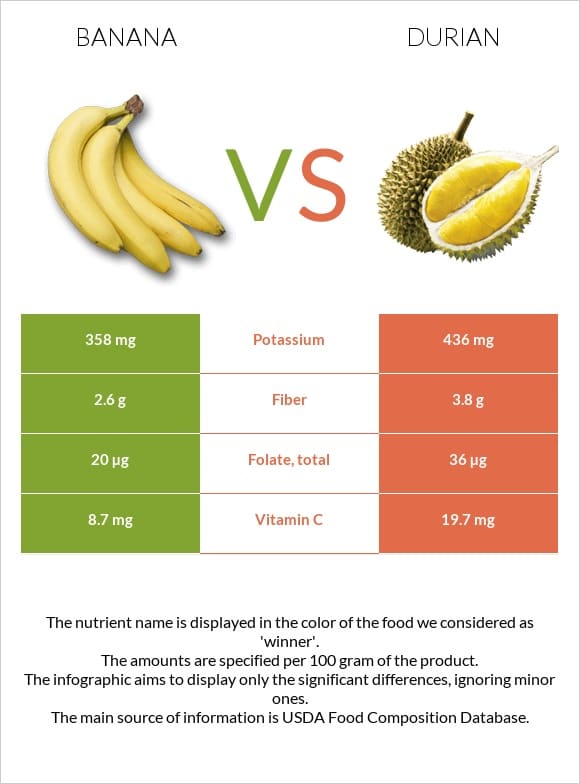
Potassium (436mg per 100g): This puts durian in the same league as bananas (358mg per 100g). Potassium helps regulate fluid balance, muscle contractions, and nerve signals. If you're physically active, this matters.
Dietary Fiber (3.8g per 100g): Durian is a decent fiber source, especially considering that most people eat it as a treat rather than a staple. Three medium pieces gives you about 7g of fiber, which is roughly a quarter of the recommended daily intake.
So Is Durian Healthy?
It depends on how much you eat.
Two to three pieces? You're looking at roughly 175 to 265 calories, a solid hit of B vitamins and potassium, some fiber, and a dose of monounsaturated fat. That's a reasonable snack by any measure.
Half a durian to yourself after dinner? Now you're in the 500 to 700 calorie range on top of your meal, which is where the "durian makes you fat" reputation comes from. The fruit itself isn't unhealthy. The portion sizes people tend to eat can be.
The other factor is sugar. At 12.9g per 100g, durian is a moderately sugary fruit. It's lower than grapes (16g) but higher than strawberries (4.9g). For most people this is fine, but if you're watching blood sugar, it's worth knowing.

The Bottom Line
Durian isn't a health food and it isn't junk food. It's a calorie-dense, nutrient-rich fruit that's fine in moderation and easy to overeat because it tastes incredible. The per-piece calorie count is lower than most people assume, but the per-sitting total is higher than most people realize, because nobody stops at one piece.
If you're a farmer tracking your trees with DurianPro, understanding what's actually inside the fruit you're growing adds another dimension to your work. Nutrition data can factor into how you market your harvest, which varieties you prioritize, and what story you tell buyers.
Frequently Asked Questions
How many calories are in one durian seed? A small piece (about 40g of pulp) has roughly 59 calories. A large piece (about 80g of pulp) has around 118 calories. Most fall somewhere in between.
Is durian high in sugar? Durian contains about 12.9g of sugar per 100g of pulp. That's moderate for a fruit. It's less than grapes but more than most berries.
How many durian seeds can I eat per day? Nutritionists in Singapore and Malaysia generally recommend two to three pieces per sitting. That keeps you in the 120 to 265 calorie range, which is reasonable as a snack or dessert.
Is durian fattening? Durian has more fat than most fruits (5.3g per 100g), but much of it is monounsaturated fat. The fruit becomes "fattening" mainly when people eat large quantities in one sitting, which is easy to do.
Does durian have cholesterol? No. Durian contains zero cholesterol. All cholesterol in food comes from animal sources. The myth that durian raises cholesterol likely comes from its creamy, rich texture and high calorie density.
What vitamins are in durian? Durian is particularly rich in thiamin (B1) at 31% of your daily value per 100g, vitamin C at 22%, copper at 23%, and vitamin B6 at 19%. It also contains meaningful amounts of riboflavin, niacin, folate, potassium, and manganese.
Sources: Nutritional data from USDA FoodData Central (FDC ID 168192). Health benefits referenced from Aziz & Jalil (2019), "Bioactive Compounds, Nutritional Value, and Potential Health Benefits of Indigenous Durian", Molecules, and Ho & Bhat (2015), "Durian Fruits Discovered as Superior Folate Sources", Plant Foods for Human Nutrition. Per-seed calorie estimates calculated by scaling USDA per-100g data to typical seed flesh weights of 40g, 60g, and 80g.