

Overview
D162 Tawa is a medium-large durian variety registered in 1987 from Selangor, notable for its distinctive sweet-bitter flavor profile. Among the three varieties that Lim Hai Chua registered on the same day -- D160 Buluh Bawah (Tekka), D161 Merah, and D162 Tawa -- it is D162 that has developed the most interesting afterlife among enthusiasts, not for mainstream fame, but for a quietly passionate following among lovers of bitter durian.
The name "Tawa" has been subject to debate. In Malay, "tawa" can refer to a type of tropical hardwood tree from the genus Hopea. Some sources have suggested the name derives from Tawau, a city in Sabah, though this connection remains unverified and the variety is firmly registered as originating from Selangor. The DOA describes D162 as medium-large, elongated-elliptic, with green-yellow skin and dark yellow flesh that is sweet with a slight bitterness -- a flavor combination that has proven magnetic for a certain subset of durian eaters.
In durian circles, Tawa occupies a particular niche. It is frequently mentioned alongside XO and other bitter-profile varieties, and those who have tasted it often describe it in enthusiastic terms. Yet its supply is severely limited and unpredictable, with good harvests reportedly occurring only once every two to three years. This scarcity has made Tawa something of a grail variety -- widely discussed but rarely encountered.
Origin & History
D162 was registered on June 30, 1987, submitted by Lim Hai Chua from Banting, Selangor. Lim is best known for D160 Buluh Bawah, the variety discovered growing wild among bamboo that later became Tekka and was marketed as Musang Queen. D161 Merah was the third variety Lim registered on the same date. All three originated from the Banting area in the Kuala Langat district of coastal Selangor.
The DOA's official Malay-language description reads: "Buah bersaiz sederhana besar; berbentuk eliptik panjang; warna kulit hijau kuning. Isi berwarna kuning gelap ulas bersaiz sederhana; mempunyai rasa manis dan sedikit pahit." In English: the fruit is medium-large, elongated-elliptic in shape, with green-yellow skin. The flesh is dark yellow with medium-sized arils, tasting sweet with a slight bitterness.
The origin of the name "Tawa" is uncertain. One explanation links it to Tawau, Sabah, suggesting the original tree may have had East Malaysian parentage, but this is unconfirmed and speculative. Another possibility is that the tree grew near tawa trees (Hopea species), which are native hardwoods found in Malaysian lowland forests. Without documentation from Lim Hai Chua himself, the naming origin remains an open question.
Unlike D161 Merah, which faded into near-total obscurity after registration, D162 Tawa gradually found an audience. Durian enthusiasts writing in blogs and forums -- particularly in Singapore, where Malaysian durian culture has an avid following -- have championed Tawa as an underappreciated variety with a complex flavor that rewards experienced palates.
Characteristics
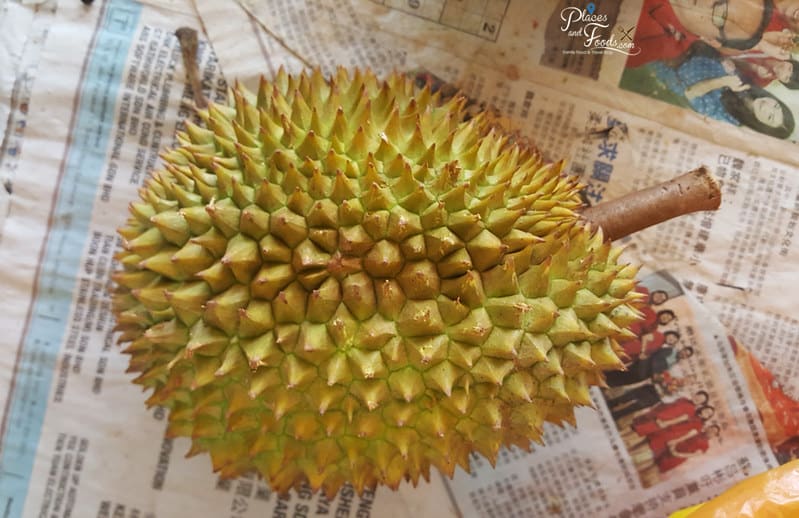
Size and shape. D162 is classified as medium-large ("sederhana besar") with an elongated-elliptic form. The shape is oblong, similar in profile to D160 and D161. Some enthusiast descriptions characterize it as having clearly visible seams along the husk and a distinctive depressed mark at the bottom. No specific weight has been officially recorded, though durian sellers have listed it at weights consistent with a medium-large classification.
Husk and skin. The skin is green-yellow ("hijau kuning"), lighter in tone than the green-brown husks of D160, D161, and D167. Enthusiast sources describe the exterior color as faded green or yellow-green, often non-homogeneous. The thorns are described as short and blocky at the sides, thinner and more clustered at the top and bottom of the fruit. The husk is considered thin by durian standards, which would make it easier to open but more susceptible to damage.
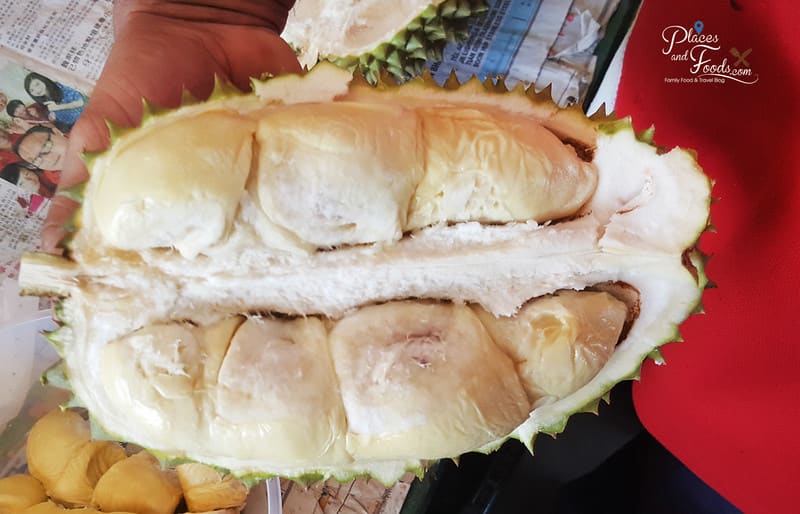
Flesh. The flesh is dark yellow ("kuning gelap"), warmer and deeper in tone than pale-yellow varieties but distinct from the orange-yellow of D160. The arils are medium-sized ("ulas bersaiz sederhana"), smaller than the large arils noted for D160 and D167. Enthusiast accounts describe the flesh-to-fruit ratio as above average despite the medium aril size.
Taste. The DOA describes the flavor as "manis dan sedikit pahit" -- sweet with a slight bitterness. This is D162's signature characteristic and the primary reason for its cult following. Independent tasters have elaborated on this, describing Tawa as belonging to the bitter durian category, with some asserting it is "more bitter than XO." The bitterness reportedly varies with ripeness: less ripe fruits tend toward sweetness, while fully ripe specimens emphasize the bitter note. This variability means that individual experiences of Tawa can differ significantly depending on the fruit's maturity.
Texture. The DOA record does not mention texture, but enthusiast descriptions are notably effusive. The flesh of a ripe Tawa has been compared to the softest pudding, with a consistency that melts in the mouth. This silky, creamy texture stands in contrast to the fibrous quality of its sibling D161 Merah.
Aroma. No official information on aroma is available. Enthusiast sources do not highlight aroma as a distinctive feature, suggesting it may be moderate rather than overpowering.
The sweet-bitter duality is what sets D162 apart from most registered varieties. While many DOA descriptions use "lemak manis" (creamy-sweet) as the standard flavor descriptor, D162's inclusion of bitterness places it in a smaller and more polarizing category -- one that tends to attract experienced durian eaters who have moved beyond simple sweetness.
Availability
D162 Tawa is rare, but unlike many obscure registered varieties, it does surface in the market -- sporadically and unpredictably. Durian sellers in Malaysia and Singapore occasionally stock Tawa, typically during years when the harvest is favorable. However, good harvests are reported to occur only once every two to three years, often around March, making Tawa one of the less reliable varieties in terms of supply.
When available, Tawa has been priced at the affordable end of the market. Reports from Singapore indicate prices around SGD 9 per kilogram, occasionally rising to SGD 12 -- well below premium varieties like Musang King or Black Thorn. This modest pricing, combined with its complex flavor, has earned Tawa a reputation as excellent value among those who enjoy bitter durians.
Saplings of D162 Tawa are available from Malaysian nurseries and online plant sellers, indicating that some propagation continues. In Selangor, Tawa has traditionally been planted alongside other local varieties including D160 Buluh Bawah, reflecting the region's historically diverse durian cultivation.
No DOA planting recommendation has been issued for D162, and it is not cultivated at commercial scale. For enthusiasts seeking Tawa, the most realistic approach is to monitor durian sellers who specialize in lesser-known varieties and to be prepared for the possibility that it may not be available in any given season. Tawa rewards patience -- both in waiting for supply and in developing the palate to appreciate its bittersweet complexity.