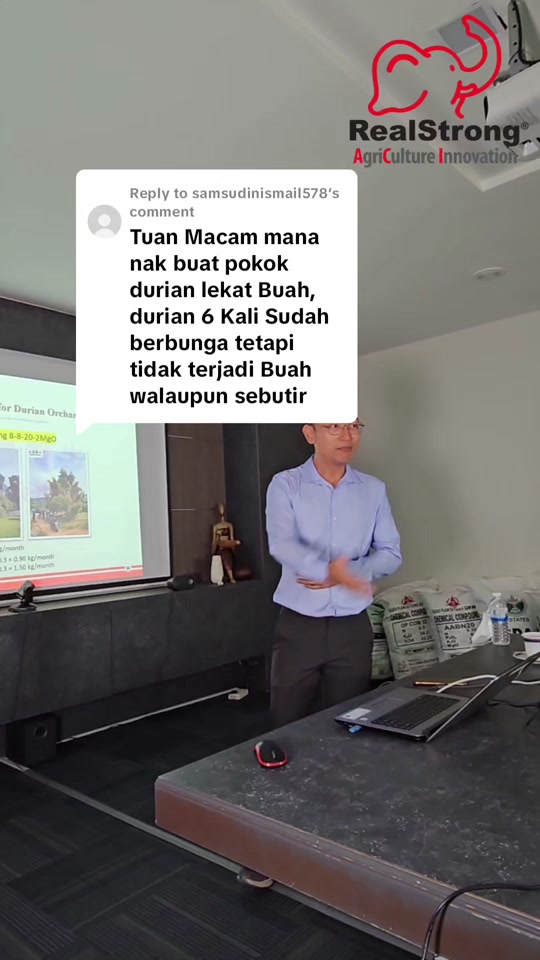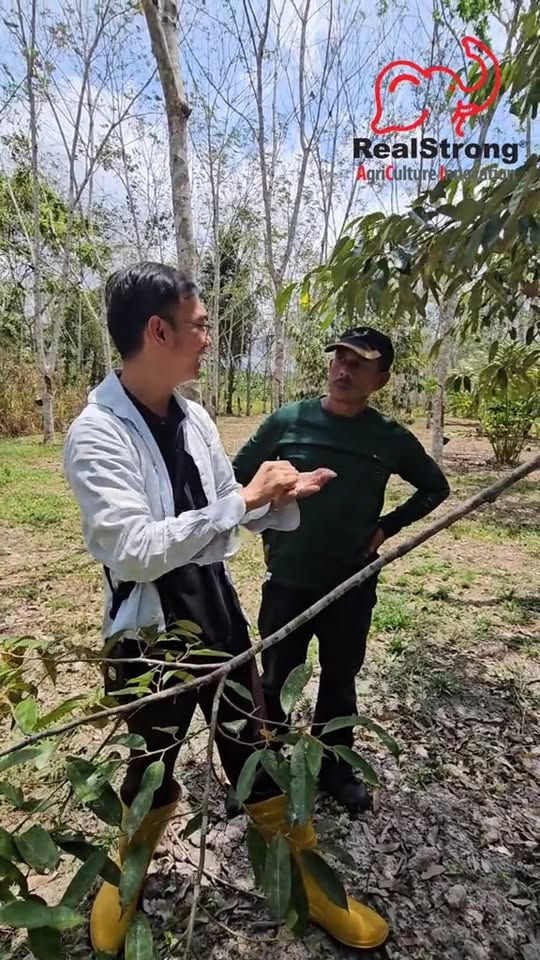

A durian tree flowers when it stops growing leaves, so inducing flowers is really about tipping a tree out of "grow" mode and into "reproduce" mode. Across these durianpro Academy videos, growers describe four things that do it: getting the tree's vegetative balance right (read from leaf size), preparing the soil with calcium and then phosphorus before the dry season, letting a stretch of dry heat pull the trigger, and giving the forming flowers just enough water that they do not drop. This guide digests what the experts say, in their own words.
Why a healthy tree still won't fruit
Mr. Ng of realstrong frames it simply: a durian tree runs on one road with two directions, vegetative (leaves, getting bigger) and productive (flowers and fruit). Plenty of Malaysian growers, he says, have gorgeous trees that never fruit, because everything the tree receives, fertilizer and water, keeps pushing it down the leaf road. Soil Telling on Reels adds the physiology behind it: a tree can really only do one job at a time, grow leaves or grow flowers or grow roots, so a tree that flushes leaves endlessly barely builds roots, which is why the lushest trees are the ones that blow over in a strong wind. The lever, in these videos, is not a magic product. It is getting the tree to stop.
Step 1: Read the leaves, fix the balance
Mr. Ng's most portable idea is that every clone has a standard leaf size, and the leaves tell you which way the tree is running. Big, wide, lush leaves mean it has gone too far vegetative: a beautiful tree with little or poor fruit. Small leaves mean it has overshot the other way and flowers too readily, which over a few years can yellow it to death. His approach is to steer back toward that standard rather than to either extreme: an over-leafy tree gets a high-potassium, low-nitrogen feed (he names AS20) to calm it down; a too-small-leafed tree gets AS5 to grow it gently back. He also insists on dosing by the tree's physical size, not its planting date, on the order of 0.3 kg per "year" of size for chemical feed and around 0.5 kg for the more organic AS5.
Step 2: Prepare before the dry season
Baba农业新天地 stresses that flowering needs the soil to carry enough calcium and phosphorus, but the two interfere, so they are applied in sequence: a calcium-rich material (lime or gypsum) about two months ahead, then phosphorus about one month before the dry season. Release them together, the video explains, and soil calcium locks up the phosphorus so the tree cannot use it. For the phosphorus step the video points to a high-phosphorus fertilizer, or an organic option (Nitra Foscal) whose microbes also break down leftover salts in the soil.
Pruning is the other half of the preparation, and All Cosmos Industries draws a sharp line between young and old trees. A young, still-thin tree (judge by the trunk, not the calendar) is pruned only lightly, around 30 percent, leaving enough canopy to fatten the trunk. A vigorous mature tree can take a further 30 percent or so specifically to stimulate flowering. The detail growers repeat: apply the fruit fertilizer before you prune, so the tree is already standing by. Once it switches to fruit feed, the new shoots slow and the leaf spacing tightens, and that tightening is the signal that the tree is ready to prune.
Step 3: Let the weather pull the trigger
Fertilizer and pruning only set the stage. The trigger is weather. Baba农业新天地 notes the threshold growers cite: the soil needs to sit above 30 degrees Celsius for roughly five straight days before flowering starts. That is also why a wet, blighted block is so hard to flower, it never dries out enough to heat up.
realstrong turns this into a timing lesson. The weather has become erratic, Mr. Ng says, swinging wet-dry-wet-dry instead of holding long clean seasons, so he reads the month-by-month rainfall and gets ready before the heat arrives rather than after. From flower to a visible fruitlet takes roughly one to two months, faster when it is hotter, so a grower who only starts work once it is already dry has usually missed the window for that season.
Step 4: Don't starve the flowers
Withholding all water in the dry season, says Hans of Baba农业新天地, is a common and costly mistake, because forming flowers need some water to keep their cells plump or they simply drop. His approach during the dry induction window is to give roughly 10 percent of the tree's normal water (for example 1.5 litres where it would usually get 15), to mist the flowers so they cool, and to add anti-drought and anti-drop inputs. He is just as insistent about the roots: durian feeder roots sit in the top 20 cm or so of soil, and every one scorched by dry heat shows up as a dropped leaf, so mulch, compost and humic or fulvic materials keep that root zone alive through the dry spell.
Reading the signs it worked
Soil Telling on Reels shows what success looks like on the tree. On a treated block the new leaves stop flushing and mature faster, going thicker and harder, and then, tucked into the branch forks, tiny flower "eyes" start to appear. An untreated tree keeps pushing soft new leaves and never pauses. The whole point of induction, the video says, is to get the leaves to stop and harden; only then does the tree turn its energy to flowering.
A note on disease
Several of these videos tie flowering back to leaf health. Heavy rain from November to February brings leaf blight (hawa daun), made worse by too much nitrogen, which thins the leaves and leaves them easy to damage. The Raub district agriculture office reminds growers to head into February with clean, blight-free foliage, and notes that if flowering does not set then, the next real chance comes around July. Baba's video pairs induction directly with blight control: clear the disease and drop the humidity first, or the block never dries out enough to flower at all.
Keeping track
Because induction is so much about reading the individual tree, and so specific to each block (leaf size, when you pruned, when the heat came), a record of what each tree received and when is what lets you repeat a good result instead of guessing the next season. That per-tree history is what durianpro is built to log.
Sources and credits
This guide digests durianpro Academy videos by durian growers and agronomists, most speaking in Bahasa Malaysia or Chinese. Credit to:
- realstrong (Mr. Ng)
- Baba农业新天地 (Hans)
- All Cosmos Industries Sdn. Bhd.
- Soil Telling on Reels
- Pejabat Pertanian Daerah Raub
The three videos above are a starting point; the full set lives in the durianpro Academy. Always confirm rates and timings against your own soil and local conditions before acting.