

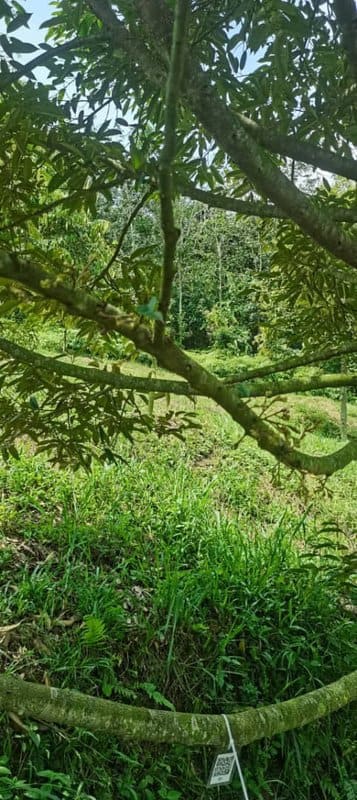
Software is a controlled environment. At its core, everything is binary - true or false, 1 or 0. Even the most complicated systems are just layers of simple logic stacked on top of each other. If you nail the logic, complex software can feel manageable, controlled, reliable.
Then you try to run a durian farm.
Nothing Is Controlled
On a farm, the variables never stop. Weather. Pests. Disease. Irrigation. Pruning. Whether the soil is waterlogged. Altitude. The health of a single tree can be affected by a dozen factors at once, and to an untrained eye, you have no clue what's causing what.
And then there are the workers.
Workers are the biggest variable of all. Not because they're unreliable - but because they're human, working in conditions that software engineers never think about. We learned this the hard way when designing DurianPro.
Dark mode? Workers can't see the screen under tree canopy. Complex navigation? Nobody wants to tap through five screens while standing in the hot sun with gloves on. If the UX feels like a hassle, workers skip steps or enter rough estimates. Accuracy drops, and your data becomes noise.
So we built two modes: a lite flow for workers who just need to log the basics (5 taps, done), and a power mode for managers who want every detail - fruit weight, pest observations, photos, the lot. The 5-tap harvest flow covers 90% of daily work. Everything else is optional depth.
Creating a Digital Twin Is the Easy Part
Here's what surprised me: the data modeling was actually straightforward. Farm → Trees → Fruits. It maps cleanly to data structures any programmer would recognize. Location data, time series, parent-child relationships - it's a well-understood problem in software.
The hard part isn't the technology. It's the humans.
"Why Do I Need an App?"
Malaysian durian farmers want to keep costs at an absolute minimum. Proposing the idea of paying for software that helps manage their farm is often a non-starter.
"My farm is fine without an app. Why do I need one now? That's just extra expense."
We hear this constantly. And honestly? They're not wrong to be skeptical. A lot of farms have operated for decades without software. The trees still grow. The fruit still sells.
But there's a gap between "functioning" and "optimized." Between "I think this tree is good" and "I know this tree produced 88.75kg last season, which is 3x the block average, and here's why." Between guessing which trees to treat for pests and disease and having data that tells you exactly where the problems cluster.
We're still figuring out how to communicate that value. It's a marketing challenge and a strategic one. Do farmers really need DurianPro? We think so, but we have to prove it - not just claim it.
The Signals That Keep Us Going
While we wrestle with positioning, the market keeps sending signals.
A large estate reached out saying they need exactly this - a system to manage operations at scale. A farm owner asked about our Academy feature, saying he wants something that teaches durian farming from A to Z. Another farmer specifically asked for harvest analytics to identify his best-performing trees so he could breed from them. Someone else requested fruit-level origin tracking - tracing every fruit back to the tree it came from.
These aren't features we pitched. These are problems farmers brought to us.
The Advisor Unlock
Here's where I think DurianPro could change the game.
Right now, when a farmer has a problem - yellowing leaves, dropping fruit, pest damage - they post a photo in a WhatsApp group and hope someone knowledgeable responds. The advisor sees a single photo with zero context. No history of what's been applied to that tree, no data on surrounding trees, no pattern to work with.
Imagine if the farmer could share a question that comes pre-loaded with context: this tree's treatment history, its harvest record, what the neighboring trees look like, soil conditions in that block. The advisor could look up as much or as little context as they want.
That's what structured farm data unlocks. Not just record-keeping - but a shared language between farmers and the experts who advise them. A bridge between "I don't know what's wrong" and "based on the pattern, here's what to check."
No one in the Malaysian durian market has this yet.
Work in Progress
I won't pretend we've figured it all out. We're a programmer and a farm, building something we needed ourselves. The product works - we use it daily on our own 350-tree estate. But finding the right market position, the right pricing, the right way to convince skeptical farmers that data matters... that's the real challenge.
Software problems have solutions. Farming problems have probabilities. And building a business around agriculture? That's somewhere in between.
If you're a durian farmer who's curious about what data can do for your operation, try DurianPro. It's free to start. And if you're an advisor who works with durian farmers, we'd especially love to hear from you - because we think this tool is as much for you as it is for them.
Frequently Asked Questions
Is DurianPro only for big estates? No. We built it for our own 350-tree farm. It works for small family operations and scales up to large estates.
Do my workers need to be tech-savvy? If they can use WhatsApp, they can use DurianPro. The basic harvest flow is 5 taps.
What does it cost? DurianPro is free to start. No credit card required.
Can advisors access my farm data? Only if you share it with them. You control who sees what.
How is this different from just using Excel? Excel traps your data in flat files. DurianPro structures it so you can track sales, map pest patterns, compare tree performance, and share context with advisors - all from the same data you entered once.
CJ is a software engineer who co-manages a 350-tree durian estate in Malaysia. He built DurianPro because he couldn't find a tool that solved the actual problems his farm had.