

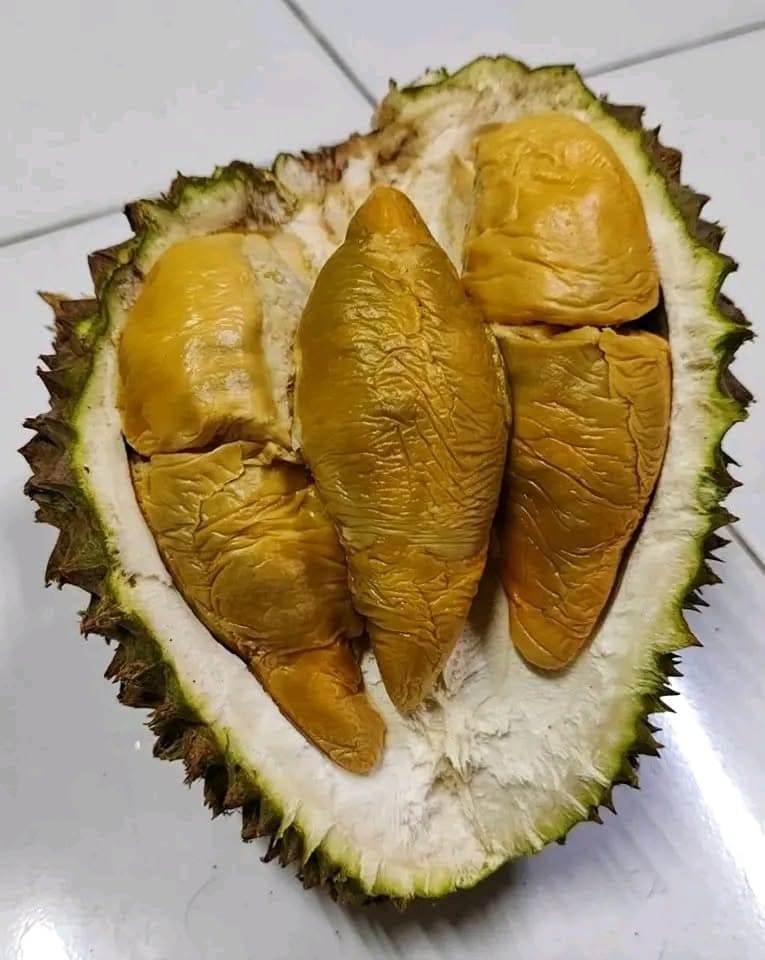
D214 Tupai 226 (Tupai King)
Overview
D214 Tupai 226, known throughout the market as Tupai King, is the newest serious contender in Malaysia's premium durian tier and currently the most expensive durian in the country. Registered with the Department of Agriculture (DOA) in February 2021, it is one of the most recent varieties to enter a registry that has been running since 1934, and it has climbed to the top of the price ladder faster than any variety before it.
During the 2025 and 2026 seasons, Tupai King has traded at RM 120 to RM 150 per kilogram. In the same period, Musang King sold at roughly RM 80 per kilogram and Black Thorn at roughly RM 90. A variety registered less than five years ago now commands a premium over both of the durians it is measured against.
The reason is arithmetic rather than hype. There are very few mature Tupai King trees in existence. In 2025, the chairman of Penang's agriculture committee put the total number of mature trees in the entire state at 43. Demand has simply arrived long before supply.
Tupai King is recognisable by three things: a bittersweet flavour with a pronounced fermented finish, flesh that often carries a distinctive grey cast, and a husk so thick that the fruit is opened from the top rather than the base.
Origin & History
Tupai King comes from Sungai Ara, in the Bayan Lepas area on Penang island. The original tree grew on land managed by Chew Chee Wan, who noticed the quality of its fruit in the early 2000s. Accounts place the discovery around 2003, and separately describe it as roughly twenty years before registration, which points to the same period. By local accounts the tree had been close to being cut down for firewood before the fruit was properly tasted.
The variety stayed a local curiosity for years. Chew submitted it to the Department of Agriculture on 15 May 2020. Registration was granted on 26 February 2021, assigning the code D214 and the official name Tupai 226.
The registration is notable for who filed it. Tupai 226 was registered by the grower himself as an individual, not through a government agency. This sets it apart from D200 Black Thorn, which was submitted through an official channel, and places Tupai King in the older tradition of Malaysian durian registration, where a farmer who found something exceptional on his own land brought it forward and had it recorded.
The name has a more prosaic origin than most people assume. "Tupai" is the Malay word for squirrel, and the obvious guess is that squirrels favoured the fruit. In fact the name comes from Chew's own durian business, Cap Tupai, meaning Squirrel Brand. The Chinese name 松鼠王 (Song Shu Wang, Squirrel King) is a direct translation of the market name rather than an independent dialect name, which is unusual among Malaysian durians. Most Chinese durian names, such as 猫山王 for Musang King or 黑刺 for Black Thorn, evolved separately in Hokkien-speaking communities.
Tupai King was not the only new Penang variety of its period. D219 Mata Merah was registered in the same wave, and the Penang state government has since taken an active role in promoting both, including publishing hillslope durian planting guidelines to open up more cultivation area.
Appearance
Tupai 226 is an oval fruit, described in the registration record as egg-shaped, with a rounded base and a pointed tip. It is a medium-sized durian. The registered average weight is 2.1 kg, with most fruit falling between 1.8 and 2.5 kg. Larger specimens have been reported but are not typical.
The husk is greenish brown. The thorns are large and set closely together, giving the surface a denser, blockier look than the finer thorning of Musang King.
The husk itself is the variety's most unusual physical trait. It is very thick, and noticeably harder to open than most premium durians. Because of this, Tupai King is conventionally opened from the top of the fruit, where the skin is thinner, rather than from the base along the seam lines. This is the reverse of standard practice for most varieties and is a practical detail worth knowing before buying a whole fruit.
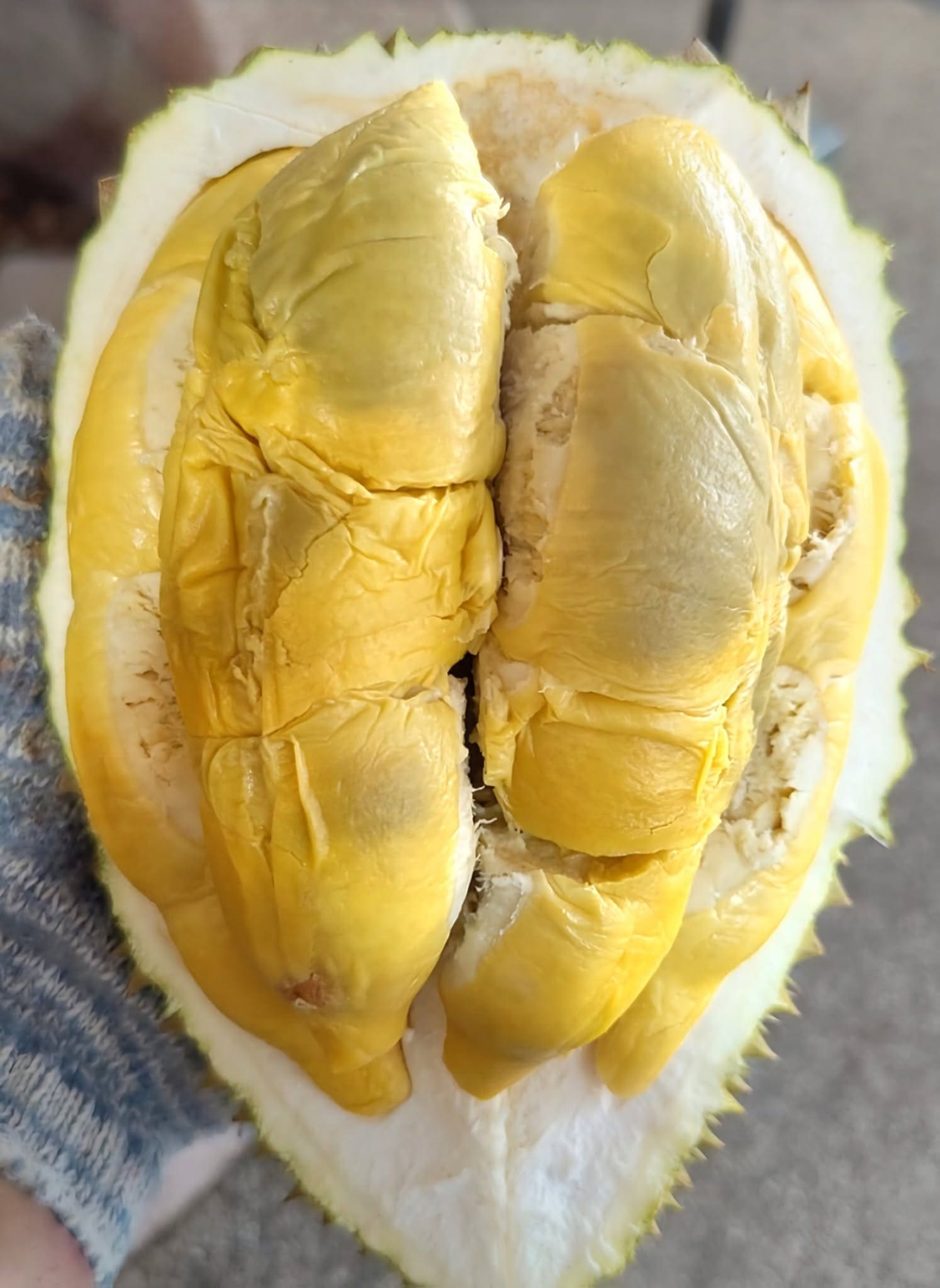
Inside, the fruit carries about nine lobes, and the flesh is orange-yellow. The variety is closely associated with a dark grey to black marbling through the lobes, which Chew himself has described as the fruit's most eye-catching characteristic. It is not a defect or a sign of over-ripeness. In practice it varies a great deal: it shows most strongly on fruit from the older Sungai Ara trees, and can be faint or absent on fruit that is otherwise unmistakably Tupai King.
The registration record puts average flesh weight at 0.7 kg against an average fruit weight of 2.1 kg. That is a flesh yield of roughly 33 percent, a figure that is rarely published for any durian variety and useful for judging what you are actually paying for.
Taste & Texture
Tupai King is a bittersweet durian with a concentrated flavour. The registration record gives a sweetness reading of 39 brix, which is high, yet the fruit does not read as simply sweet. Bitterness runs alongside the sugar rather than behind it, and the finish carries a distinct fermented or alcoholic quality that tasters consistently single out.
The texture is fine, slightly dry, and not watery. This is a meaningful distinction in a premium field where creaminess usually means moisture. Tupai King is dense and sticky instead, and has been compared to natural peanut butter for the way it clings rather than melts. The dryness is also why the fruit holds its condition longer than most.
The aroma is moderate rather than overwhelming. Tasters have noted a note in it reminiscent of Musang King, though softer overall, which may partly explain how quickly the variety found an audience among Musang King drinkers.
One caveat on the official data. The DOA record classifies aroma, bitterness, texture and creaminess as moderate across the board. Anyone who has eaten a good Tupai King from a mature tree would find "moderate" an understatement, particularly on the bitterness and the alcoholic finish. Registration descriptors are recorded from a limited sample at a fixed point in time, and they tend to flatten the character of a fruit that varies with tree age and season.
How to Identify
Husk thickness (most reliable): The husk is very thick and resists opening, and the pith rim visible once the fruit is halved is noticeably wide. If the fruit splits easily or the husk is thin, it is unlikely to be Tupai 226.
Opened from the top: A genuine Tupai King is normally opened from the pointed top end, not the base, because the husk is thinner there. A seller who opens it conventionally may not be handling the variety often.
Grey cast in the flesh: Many lobes carry a grey tint or darker streaking through the orange-yellow flesh, and this is the trait the variety is best known for. Treat it as supporting evidence rather than proof. It is strongest on mature-tree fruit and can be subtle or absent on younger fruit, so plain golden flesh does not by itself rule the variety out.
Shape: Oval and egg-like, with a rounded base and a pointed tip. Not obovate like Musang King or Black Thorn.
Thorns: Large and closely spaced, coarser in appearance than the fine thorning of Musang King.
Lobe count and flesh yield: Around nine lobes, with roughly 0.7 kg of flesh in a 2.1 kg fruit. A markedly poorer yield suggests either a young tree or a different variety.
Weight: Expect 1.8 to 2.5 kg. Very small or very large fruit should be checked more carefully, particularly given the counterfeiting that has been reported around this variety.
Availability & Pricing
Tupai King is the most expensive durian in the Malaysian market. Through the 2025 and 2026 seasons it has sold at RM 120 to RM 150 per kilogram, with RM 130 the most commonly quoted figure. Premium whole fruit has been reported at RM 600 to RM 1,000 apiece, and export pricing in Hong Kong has been quoted at around RM 250 per kilogram.
For context, a May 2025 market report priced Musang King at RM 80 per kilogram and Black Thorn at RM 90 in the same season. Tupai King sits above both.
Scarcity, not marketing, sets that price. In 2025 the total number of mature Tupai King trees in Penang was reported as 43. At one 53-hectare orchard, only 20 of more than 2,000 planted trees were mature enough to bear fruit. The plantings exist; the trees simply have not aged into production yet.
The season runs from roughly mid-June to the end of August, within Penang's broader May to August durian window. Supply is thin enough that pre-ordering is normal, and buyers should be aware that counterfeit Tupai King has been reported precisely because genuine fruit is so hard to obtain.
One commercial trait deserves attention. Because the husk is thick and resists splitting, Tupai King holds its condition for around three days after harvest without cracking. Most premium durians do not. That shelf life is why the variety is being seriously discussed as a fresh export fruit rather than a purely domestic one, and it may end up mattering more to the variety's future than its flavour does.
Growing Regions
Sungai Ara in Bayan Lepas, on Penang island, remains both the origin and the centre of production. Chew's own orchard covers more than eight acres and holds over 50 Tupai 226 trees, including 16 of the original mature specimens that produce the most highly regarded fruit.
Bukit Lada has been named as a further planting area within Penang, and the state government has actively promoted the variety, including through guidelines intended to open hillslope land to durian cultivation.
Planting has begun to spread beyond Penang as growers respond to the price, though almost all of it is immature. This is the defining fact about Tupai King's supply: the trees are in the ground, but the fruit is years away. Buyers seeking the best examples still look to the original Penang trees, and the gap between old-tree and young-tree fruit is likely to remain significant for some time, as it has for Black Thorn.
Fun Facts
- Named after a shop, not a squirrel: Tupai means squirrel in Malay, but the variety takes its name from Chew Chee Wan's durian business, Cap Tupai, or Squirrel Brand. The Chinese name 松鼠王 is a straight translation of the market name rather than a separate dialect name, which is unusual for a Malaysian durian.
- Nearly firewood: By local accounts the original tree at Sungai Ara was close to being cut down before anyone paid proper attention to its fruit.
- Fast to fruit: Bud-grafted onto mature rootstock, Tupai 226 has been observed flowering and setting fruit after about three years. It is described by growers as both early-bearing and high-yielding, which is unusual for a premium variety and helps explain the speed of planting.
- Expensive before it is even a tree: Saplings have sold at RM 100 for a one-foot plant and RM 250 at five feet, several times the going rate for Musang King stock.
- A rare published number: The registration record gives an average flesh weight of 0.7 kg against a 2.1 kg fruit, a flesh yield of about 33 percent. Very few durian varieties have a measured yield figure on record at all.
- Built to travel: The thick husk resists splitting for around three days after harvest. For a fruit that normally has to be eaten where it falls, that is a commercially significant trait.
- 43 trees: In 2025, the entire state of Penang was reported to hold 43 mature Tupai King trees. Whatever the variety becomes, its current reputation rests on a very small number of them.