

D196 Simpang Permata
Overview
D196 Simpang Permata occupies an unusual position in Malaysia's durian registry. It is one of the most searched D-codes in the country, and one of the hardest durians to actually buy. Registered in Melaka in 1993, it has never been commercialised, never advertised at scale, and never appeared in the standard listings that dominate the durian trade. Its reputation has been built almost entirely by people who tracked it down and told other people about it.
What they found is a bitter-leaning durian with pale cream flesh, a thick and sticky texture, and a finish that lingers well past the last bite. Among growers and enthusiasts who favour the bitter end of the spectrum, D196 has a following out of all proportion to its commercial footprint.
The variety carries a second distinction that is easy to miss. It was registered in 1993, the same year as D197 Raja Kunyit. Two durians entered the registry side by side, one code apart. One became the foundation of a national export industry. The other stayed in the orchards around Alor Gajah, known mainly to people who went looking for it.
Origin & History
D196 comes from Alor Gajah, a district in the northern part of Melaka, one of peninsular Malaysia's older durian-growing states. It was registered in 1993 by Md. Nor Ibrahim, an individual grower rather than a government agency or research station.
The name is a place name. "Simpang" means junction or crossroads in Malay, and "permata" means gem or jewel, so Simpang Permata reads roughly as Gem Junction. Names of this form are common across peninsular Malaysia, and the variety was almost certainly named after the village or junction nearest the original tree rather than for any quality of the fruit itself.
The 1993 registration places D196 in an active period for the Department of Agriculture, which spent the late 1980s and early 1990s expanding its registry of named clones. Many entries from that cohort were documented once and never revisited. D196 is one of them.
The comparison with D197 is worth sitting with, because it says something about how durian varieties actually succeed. Registration confers a code and a record. It does not confer distribution, grafting stock, marketing, or the attention of the people who decide what gets planted. D197 found all of those. D196 found none of them, despite entering the registry on the same day-to-day timeline from a state with a longer durian history than Kelantan.
In recent years the variety has turned up outside Melaka. Trees are now fruiting in Segamat, Johor, and sellers there have brought small quantities to market. Whether those are propagated from the original Alor Gajah stock or from a parallel local selection carrying the same name is not documented.
Appearance
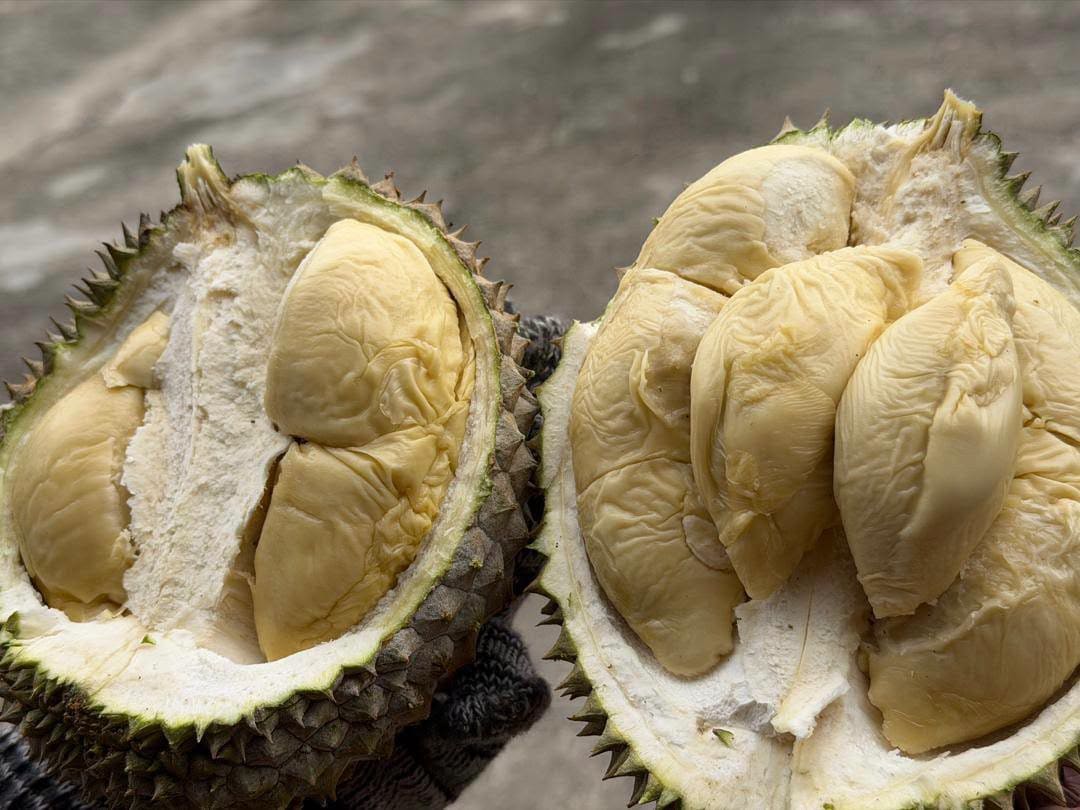
D196 is a wide-elliptic fruit with a green to green-brown husk and thorns that darken toward the tips. The registration record is brief, as is typical for early-1990s entries made before more detailed characterisation protocols came in, and it does not include weight, husk thickness, stem length or seed descriptors.
The flesh is the part worth knowing about, and it is where the written record and the fruit in hand diverge.
The registration describes the flesh as yellow. Fruit that actually reaches people is consistently paler than that: a soft cream, sometimes barely yellow at all. Growers describe a shift with tree age, with young trees giving a cream-yellow flesh and older trees producing something closer to cream-white. Do not expect the saturated golden colour of Musang King or the deep orange of a Red Prawn. A pale, almost buttery lobe is normal for this variety and is not a sign of an unripe or poor fruit.
D196 also carries a characteristic that its enthusiasts refer to as a black face. Dark undertones sit beneath the surface of the aril, visible through the translucent membrane and more obvious in direct light, and lobes often show what looks like bruising. On older-tree fruit this can deepen to a grey cast. It is a recognised trait of the variety rather than damage in transit.
One further physical trait matters if you ever get the chance to buy one. The flesh-to-husk ratio is poor. The pith is thick and the fruit gives up less than its size suggests, with a one-kilogram fruit sometimes yielding only two rooms of flesh, occasionally just one. This is a genuine drawback and part of why the variety never attracted commercial planting.
Taste & Texture
D196 sits at the bitter end of the Malaysian spectrum. The bitterness is not a background note behind sweetness, as it is in Musang King; it leads. Enthusiasts place it in the same bracket as D162 Tawa, which is a useful reference point for anyone calibrating how far they want to go.
Sweetness is present but subordinate, and the two arrive together rather than in sequence. What people single out most often is the finish. The flavour builds after swallowing and stays, a returning sweetness that Chinese-speaking durian circles describe as 回甘. It is the quality that turns casual eaters into people who go looking for it the following season.
The texture is thick and sticky rather than silky. The flesh is soft but does not melt cleanly, and it clings to the palate and the throat in a way that suits the flavour but will not appeal to everyone. The aroma is strong.
There is an oddity here worth noting: despite that soft flesh, D196 holds its condition unusually well, staying good for a day or two unopened. Soft-fleshed durians normally deteriorate fast, and this one does not.
How to Identify
Pale cream flesh: The single most useful cue. D196 flesh runs pale cream, not golden or orange. If the lobes are vividly yellow, question whether you have the right fruit.
Dark undertones in the aril: Look for the black face. Dark shading beneath the membrane, sometimes reading as bruising, sometimes deepening to grey on older-tree fruit. Present rather than absent is the norm here.
Thick pith and few rooms: Expect the fruit to feel heavier than it eats. A one-kilogram fruit may hold only two rooms of flesh.
Wide-elliptic shape: Broad through the middle rather than elongated or markedly obovate.
Bitterness that leads: If the first impression is sweetness, it is probably not D196.
Sold by code: Nobody markets this variety under a brand name. It is sold as D196, or as Simpang Permata, or not at all. A seller offering it under an invented premium name is worth a second look.
Availability & Pricing
D196 is genuinely difficult to buy, and that is not scarcity marketing. It does not appear in the commercial listings that carry Musang King, Black Thorn, D24 and Red Prawn. Most stalls have never handled it. What supply exists tends to be spoken for before the season starts, reserved by people who know the grower.
The most reliable approach is to go to the source. Alor Gajah in Melaka during the main season is where the original clone trees are, and the newer Segamat plantings in Johor are the other place it surfaces.
No dependable per-kilogram price is published for D196, and this guide will not invent one. It is not traded in enough volume for a market rate to exist, and prices are set fruit by fruit between grower and buyer. Seedlings, by contrast, are available and inexpensive, with young plants offered from around RM 40, which tells you something about where the variety's economics actually sit: it is cheap to plant and hard to sell.
If you do get hold of one, the fruit will keep a day or two unopened, which is more forgiving than most soft-fleshed varieties.
Growing Regions
Alor Gajah, Melaka is the registered origin and remains the centre of what little production exists. The original clone trees are there, and the surrounding orchards are the best bet during season.
Segamat in Johor is the second location where D196 now appears. Trees there have reached bearing age and small volumes have reached the market, giving the variety a foothold outside its home state for the first time.
Beyond those two, there is nothing organised. The Department of Agriculture has issued no planting recommendation for D196 in any district, and there is no evidence of commercial-scale cultivation anywhere in the country. The poor flesh-to-husk ratio is the likely reason. A variety that eats well but yields little is a hard case to make to a grower choosing what to plant on limited land, however good the fruit is.
Fun Facts
- One code from fame. D196 and D197 Raja Kunyit were both registered in 1993, one number apart. Musang King went on to reshape Malaysia's durian industry and its export economy. D196 stayed in Alor Gajah. There is no known relationship between the two varieties beyond the sequential numbering.
- The black face. Enthusiasts use this term for the dark shading beneath the aril's surface. What would be read as bruising or spoilage on another variety is, on D196, simply what the fruit looks like.
- Heavier than it eats. A one-kilogram D196 can yield as little as two rooms of flesh. The thick pith is the reason it never became a commercial crop, and the reason the people who like it treat finding one as an event.
- A name that means nothing about the fruit. Simpang Permata translates as Gem Junction. It is a road, not a description. The variety is named for where the tree stood.
- A borrowed nickname. Durian specialists report D196 being labelled 忘不了 (wang bu liao, "unforgettable"), and occasionally Empurau, after the prized Sarawak river fish that carries the same Chinese name. The usage is reported rather than established, and it is not a name you will hear at most stalls.
- Searched far more than it is sold. D196 is among the most looked-up codes in the Malaysian registry, which sits oddly with a variety almost nobody can buy. Being one digit from the most famous durian in the world may have something to do with it.